
Overview
Advance Queensland (AQ) was a significant government initiative designed to foster innovation by building a diversified economy and creating jobs. It grew substantially and changed focus from its beginning in 2015 – with 8 programs and an initial budget of $180.2 million – to 2026 with a budget of $843.8 million and 114 programs managed over its life by multiple government departments.
Tabled 27 November 2026.

Report summary
This report outlines our assessment of the key processes for overseeing the delivery of the Advance Queensland initiative from its beginning in 2015 to its replacement in 2026.

| Why did we perform this assessment? |
Advance Queensland (AQ) was a significant government initiative designed to foster innovation by building a diversified economy and creating jobs that was launched in 2015. In August 2026 the Queensland Government released a new Ideas into Impact: From discovery to delivery, Science and Innovation Strategy, which will replace the AQ initiative.
During this time, its approved budget grew from $180.2 million to $843.8 million. The AQ initiative was delivered through 114 individual programs managed by several government departments.
In 2022, the Queensland Government launched Advance Queensland – Innovation for a Future Economy 2022–2032 Roadmap (2022–2032 roadmap), which refocused the AQ initiative’s objectives and amended the way it was monitored and evaluated.
In June 2025, the Minister for the Environment and Tourism and Minister for Science and Innovation wrote to the Auditor-General requesting QAO consider auditing the AQ initiative and raising concerns about the initiative’s effectiveness, governance, and value for money. Given the length of the initiative, the number of programs, and the initiative’s changes since 2015, our assessment focused on how the overall impact of the AQ initiative was monitored and evaluated rather than focusing on the outcomes of the individual programs or activities under it. We refer to this as the whole-of-initiative level.
In this report we use the following terms to describe the AQ initiative and the activities under it.
AQ initiative: all funded programs and activities agencies delivered as part of the government’s targeted investment in innovation.
Programs: a funded program or activity delivered to advance the objectives of the AQ initiative. These included grants, partnerships, competitions, procurement of goods and services, events, and sponsorships.

| What did we find? |
The AQ initiative had broad objectives, that were not supported by key targets and defined success metrics
While the AQ initiative identified objectives linked to approved strategies, the objectives did not include specific targets or success measures. Well-defined objectives and measurable expected outcomes allow for better data capture when measuring performance. Information provided to us about the individual AQ programs did not clearly demonstrate how program objectives aligned with the overall AQ initiative objectives.
Monitoring and evaluation of the AQ initiative changed focus under the 2022–2032 roadmap
In approving the AQ initiative, the Queensland Government set clear governance expectations, including rigorous evaluation, trial-based approaches, and a monitoring and evaluation framework. The initial governance structures aligned with this expectation, with monitoring and evaluation occurring at a whole-of-initiative level.
The Queensland Government commissioned 2 macro-level evaluations of the AQ initiative in 2019 and 2021. The second macro-level evaluation, completed in 2022, reported that many effects from the AQ initiative (both positive and negative) would likely emerge over the next 5 years. No macro-level evaluations of the AQ initiative were performed after 2022.
With the launch of the 2022–2032 roadmap, governance was decentralised, with individual departments responsible for monitoring and evaluating the AQ programs they delivered. This meant that after June 2022, monitoring of the AQ initiative only focused on legacy AQ programs, with unexpected funds and programs funded under the 2022–2032 roadmap.
By June 2022, budgeted funds for programs commenced prior to the launch of the 2022–2032 roadmap were largely committed and most programs were no longer accepting applications or had formally closed. However, the outcomes of these programs were only likely to emerge over the next 5 years. Monitoring of initiatives and programs with longer-term objectives should consider how the outcomes of the initiative and supporting programs will be assessed after the allocated funds are spent.
We could not identify the total amount spent on the AQ initiative
Reporting on the total spend for the AQ initiative against the approved budget was initially provided to the AQ steering committee. This information was also provided as part of quarterly briefs to the Minister for Innovation.
However, following the launch of the 2022–2032 roadmap, the reporting of budget and expenditure only focused on programs funded under the 2022–2032 roadmap. There was no longer reporting on the total budget and expenditure of the AQ initiative from its inception.
In preparing this report, we relied on information from the Department of the Environment, Tourism, Science and Innovation (DETSI) and annual state budgets. As the information provided was compiled from several different sources, it was difficult to reconcile the total amount funded and spent under the AQ initiative.
Based on the information provided, the Queensland Government does not currently have oversight of the total funds spent across the AQ initiative and does not know how it compares to the approved budget. The lack of central monitoring of spending meant DETSI could not confirm if AQ funding was used efficiently, effectively, and economically in alignment with the AQ initiative’s objectives.

| What do entities need to do? |
We make 5 recommendations to all departments based on our assessment and learnings that can be applied to future initiatives. Our recommendations focus on the following themes:
- establishing governance at a whole-of-initiative level
- designing objectives for initiatives and programs
- enhancing performance monitoring and evaluation
- improving transparency and accountability.
We asked DETSI to respond on whether it agrees with our recommendations. The department has agreed to all of our recommendations.
1. Recommendations
The Advance Queensland (AQ) initiative provides a useful broad case study about designing, governing, and evaluating large government initiatives. For this reason, our recommendations are forward-looking and intended to strengthen the overall governance and financial accountability of future initiatives.
In August 2026, the Queensland Government released its new 15-year Ideas into Impact: From discovery to delivery, Science and Innovation Strategy. This will effectively replace the AQ initiative. The Department of the Environment, Tourism, Science and Innovation (DETSI) should consider how the learnings from our report can apply to the monitoring and governance structures implemented for the new strategy to ensure it effectively meets its objectives and delivers its intended outcomes.
While our assessment focused on DETSI, we have addressed our recommendations to all departments, which should consider these learnings when developing and leading similar initiatives.
| Ensure the initiative and supporting programs have well-defined targets and measures | Entity responses |
| Agree |
| Establish whole-of-initiative governance for the life of the initiative | Entity responses |
| Agree |
| Support performance assessment through consistent, accurate, and timely data capture and reporting for the life of the initiative | Entity responses |
| Agree |
| Enhance transparency and accountability in assessing whether the initiative and programs achieve their desired outcomes | Entity responses |
| Agree |
| Enhance transparency and accountability of spending | Entity responses |
| Agree |
Reference to comments
In accordance with s. 64 of the Auditor-General Act 2009, we provided a copy of this report to relevant departments. In reaching our conclusions, we considered their views and represented them to the extent we deemed relevant and warranted. Any formal responses from the departments are at Appendix A.
2. Context and background
This chapter provides background information on the Advance Queensland (AQ) initiative from its commencement in 2015 through to the Queensland Government releasing its new Ideas into Impact: From discovery to delivery, Science and Innovation Strategy, in August 2026. It also provides context to the basis of our assessment and the objective of this report.
What is Advance Queensland and why was it established?
AQ was an initiative launched by the Queensland Government in 2015 to foster innovation by supporting a more diversified economy and creating jobs.
The Queensland Government established AQ following a 2015 election commitment and to respond to weaknesses and opportunities identified in Queensland’s Innovation Ecosystem and Recommendations for Future Action, known as the Lerner report. The previous Queensland Government commissioned the Lerner report in 2014 to assess the state’s technology and entrepreneurial sectors.
AQ began with 8 programs supported by $180.2 million over 4 years, approved in the Queensland Budget 2015–16.
What were Advance Queensland’s original strategies?
The AQ initiative was developed around 5 key strategies:
- supporting culture: engaging the community on innovation, inspiring current and future generations to be creative, developing ideas, working together, and identifying innovation potential
- building capability: maintaining a strong research base to support entrepreneurship, business commercialisation, and creativity, and create and update new technologies
- fostering collaboration: building networks and partnerships across organisations, sectors, and disciplines to spark creativity, share existing knowledge, and translate ideas into outcomes
- increasing investment: facilitating access to funds for translating ideas to outcomes and assisting innovators to be investment ready
- scaling for jobs and growth: empowering businesses and key industries to benefit from technologies and access global chains to unlock potential for innovation and development for small businesses, high-growth firms, and regions.
How was Advance Queensland to be governed?
The Queensland Government set clear expectations for governance of the AQ initiative, including:
- requiring rigorous evaluation and trial-based approaches
- establishing a central program management team
- establishing an expert panel
- implementing a monitoring and evaluation framework and progress reporting.
How has the initiative changed?
The AQ initiative grew substantially and changed focus from its beginning in 2015 until it was replaced in 2026.
In 2022, the Queensland Government released the new $142.2 million Advance Queensland – Innovation for a Future Economy 2022–2032 Roadmap (2022–2032 roadmap), which reset the government’s innovation priorities.
In August 2026, the Queensland Government released the new 15-year Ideas into Impact: From discovery to delivery, Science and Innovation Strategy, which will replace the AQ initiative. While the Queensland Government is now focused on delivering the new strategy, some contractual commitments from previous AQ programs will continue through to expiry of funds.
Responsibility for delivering the AQ initiative and providing oversight of it was initially assigned to the Department of Science, Information Technology and Innovation as the department responsible for the government’s innovation function. Over the course of the initiative, the innovation function was transferred in and out of multiple departments through machinery of government changes. Some departments were also renamed.
In November 2024, the innovation function was transferred to the Department of the Environment, Tourism, Science and Innovation.
In this report, we use the term ‘innovation department’ to refer to the department responsible for delivering the AQ initiative between 2015 and 2024.
What did we assess?
On 9 June 2025, the Minister for the Environment and Tourism and Minister for Science and Innovation wrote to the Auditor-General requesting QAO consider conducting an audit of the AQ initiative. The minister raised concerns about the initiative’s effectiveness, governance, and value for money.
We performed our assessment in accordance with the Auditor-General Auditing Standards and the Auditor-General Act 2009. These allow the Auditor-General to assess information provided by anyone with concerns about financial management in Queensland public sector entities and, if appropriate, investigate the issue with the aim of strengthening and improving public sector performance and accountability.
This report outlines the findings from our assessment of the key processes implemented to oversee the delivery of the AQ initiative since it began in 2015. Given the length of the initiative, the significant number of programs, and the initiative’s changes since 2015, our assessment focused on whether there was whole-of-initiative oversight that:
- assessed whether the AQ initiative was meeting its approved objectives
- aligned with initial governance arrangements approved for the AQ initiative
- allowed for monitoring and reporting on total funding allocated to and spent on the AQ initiative.
We did not assess the merits of the AQ initiative’s objectives or whether they were achieved.
We conducted our assessment based on information and documentation that was either publicly available or which the relevant coordination and delivery departments provided.
Our assessment was not conducted as an audit or assurance engagement under Australian auditing and assurance standards. Accordingly, this report does not include a formal opinion or conclusion on the implementation of the AQ initiative. Further information on how we conducted our assessment is included in Appendix B.
3. The Advance Queensland initiative
Advance Queensland (AQ) started in 2015 as a $180.2 million initiative with 8 programs. By 2021, it grew to 114 programs with a total approved budget of $755 million.
In 2022, the Queensland Government released Advance Queensland – Innovation for a Future Economy 2022–2032 Roadmap (2022–2032 roadmap), refocusing the objectives and desired outcomes of the AQ initiative.
The Queensland Government identified the strategies and priorities to be addressed through the original AQ initiative and through the 2022–2032 roadmap. It also identified the objectives to be achieved through these strategies and priorities. It did not, however, include specific targets for measuring success against these objectives.
In August 2026, the Queensland Government launched a new science and innovation strategy, which replaced the AQ initiative. While the Queensland Government is now focused on delivering the new strategy, some contractual commitments from previous Advance Queensland programs will continue through to expiry of funds.
What were the 8 initial programs?
In 2015, the Queensland Government approved 8 initial programs for the AQ initiative. These programs were intended to foster innovation, build a more diversified economy, and create jobs. They supported 4 of the AQ initiative’s 5 strategies: building capability, increasing investment, scaling for jobs and growth, and supporting culture.
The 8 programs were supported by $175.8 million of the $180.2 million in funding approved in the Queensland Budget 2015–16. Queensland Treasury held the remaining $4.4 million as a contingency. This first tranche of programs targeted universities and innovation start-ups.
The Department of Science, Information Technology and Innovation (innovation department) was initially responsible for all programs except the Business Development Fund, which Queensland Treasury was responsible for. Figure 3A identifies the 8 initial programs, describes their objectives, and shows their approved funding.
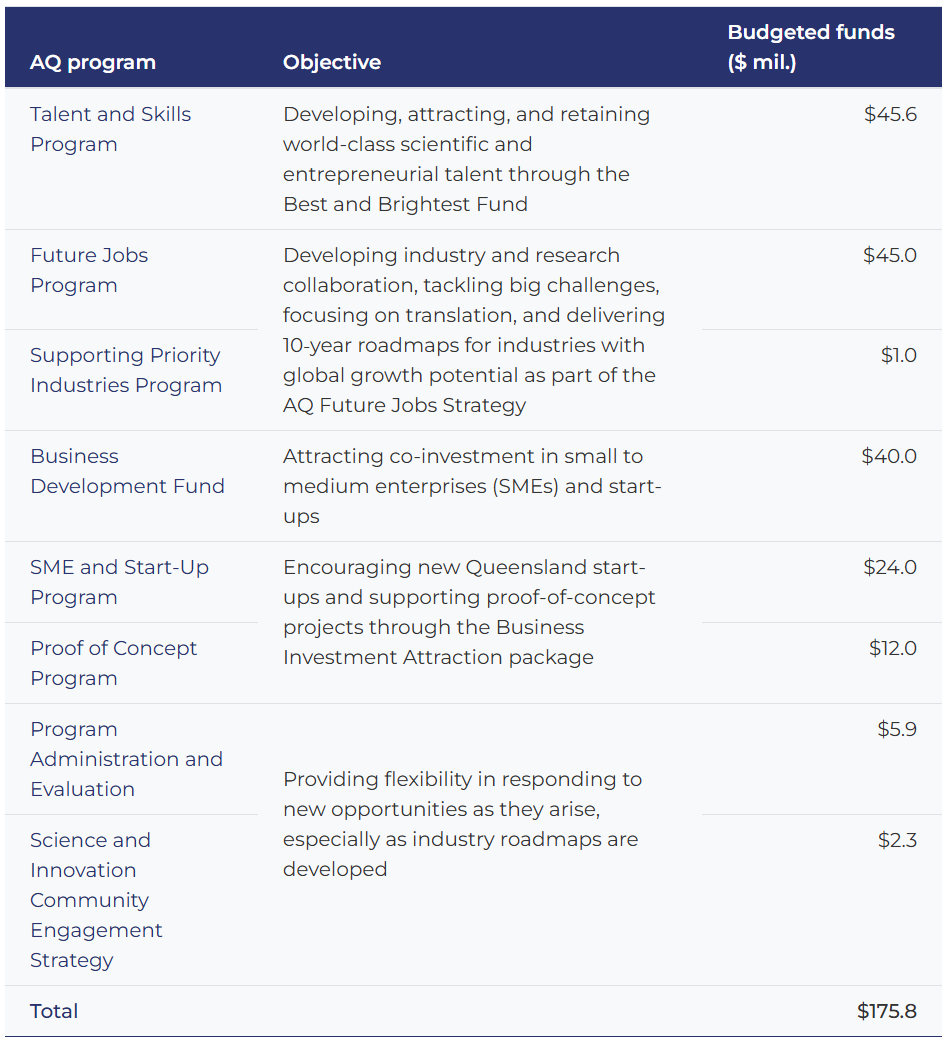
Compiled by Queensland Audit Office from information provided by the Department of the Environment, Tourism, Science and Innovation and other government entities.
Start-ups: a new or small company with the potential to grow quickly, founded by entrepreneurs to introduce a new product, technology, or service.
How did the AQ initiative change from 2015 to 2026?
Over its life, the AQ initiative grew from the initial 8 programs to a peak of 114 programs being delivered by 9 departments. Total funding of $843.8 million was allocated to the AQ initiative between 2015 and June 2026. This includes adjustments for amounts reallocated and returned to the consolidated fund or reprioritised to other programs.
The AQ initiative involved a range of programs and activities including grants, partnerships, competitions, procurement, events, sponsorships, and an administration function.
Figure 3B provides a timeline of key Queensland Government announcements and funding decisions to demonstrate how the AQ initiative changed between 2015 and 2026.
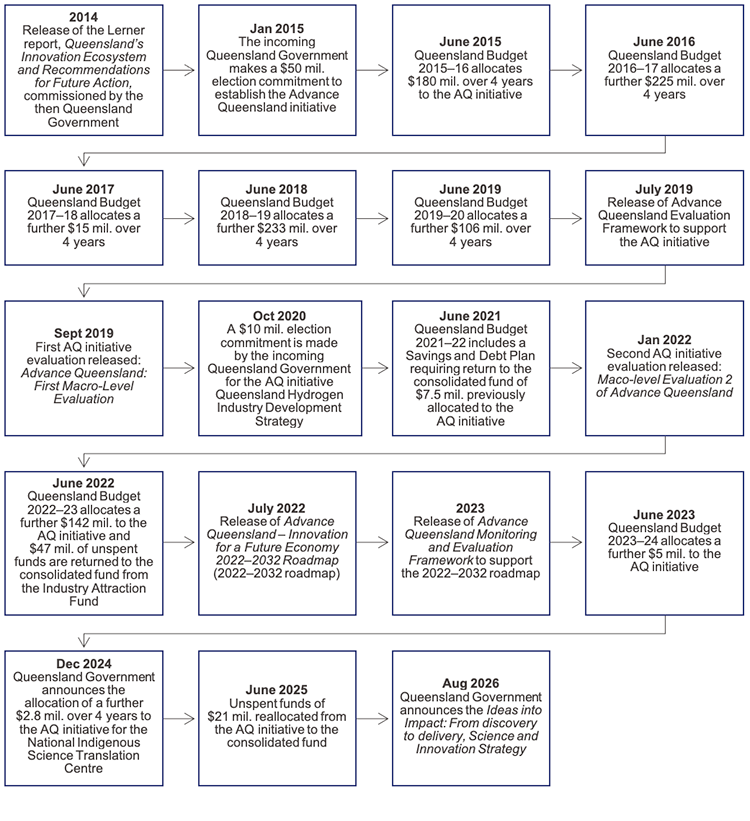
Compiled by Queensland Audit Office.
Release of the 2022–2032 roadmap
From mid-2021, the Queensland Government redirected the AQ initiative toward a new strategy focused on innovation and science. In July 2022, the Queensland Government released the 2022–2032 roadmap.
The 2022–2032 roadmap was supported by additional funding of $142.2 million. This increased the overall budget for the AQ initiative from $755 million at 30 June 2022 to $843.8 million by 30 June 2026. The total overall budget included additional funding for new programs approved in 2023–24 and 2024–25 and unspent funds returned to the consolidated fund.
Figure 3C outlines the 6 priority outcomes and the funding announced under the 2022–2032 roadmap.
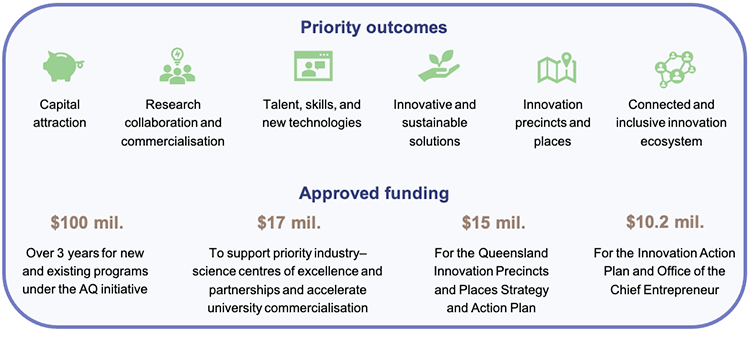
Compiled by Queensland Audit Office from Advance Queensland – Innovation for a Future Economy Roadmap 2022–2032.
Release of the 2026 science and innovation strategy
On 18 August 2026, the Minister for the Environment and Tourism and Minister for Science and Innovation released the Queensland Government’s Ideas into Impact: From discovery to delivery, Science and Innovation Strategy.
This new strategy aims to provide a 15-year plan for accelerating ideas, unlocking investment, and strengthening the partnerships needed to take innovation from concept to commercialisation.
The Queensland Government committed $22 million over 4 years as initial support, and $5.5 million per year ongoing, for implementing the strategy. In launching the new strategy, the Queensland Government also announced it was establishing a new chief innovator role within the Department of the Environment, Tourism, Science and Innovation (DETSI).
Coinciding with the release of the new strategy, DETSI replaced the previous AQ website with an innovation website based around the new strategy. It removed previously available documents and reports about the AQ initiative.
Who was responsible for delivering AQ programs?
While AQ was a whole-of-government initiative, the Queensland Government established expectations that individual departments were responsible for implementing individual programs. Each department was responsible for the budget provided to deliver its programs, and for monitoring and reporting on the programs it delivered.
Figure 3D outlines the total number and approved funding for AQ programs by portfolio area between 2015 and 2026.
| Portfolio area | No. of programs | Total budget ($ mil.) |
|---|---|---|
| Innovation | 82 | $392.9 |
| Treasury | 3 | $193.0 |
| State development | 2 | $68.0 |
| Health | 2 | $60.0 |
| Science | 12 | $55.5 |
| Tourism | 2 | $33.5 |
| Small business | 6 | $26.7 |
| Education | 3 | $10.3 |
| Primary industries | 2 | $3.9 |
| Total | 114 | $843.8 |
Note: This table was prepared using portfolio areas as several departments were subject to machinery of government changes between 2015 and 2026, resulting in the transfer of program responsibilities.
Compiled by Queensland Audit Office from information provided by the Department of the Environment, Tourism, Science and Innovation.
Did the AQ initiative and supporting programs have clear objectives and expected outcomes?
The overall objectives of the AQ initiative were revised with the release of the 2022–2032 roadmap. The new 2026 science and innovation strategy has identified its own focus areas, actions, and success measures. While these have changed over time, they all reflect similar themes including:
- increasing investment in innovation
- supporting and enhancing collaboration between key stakeholders
- improving capability and skills in innovation, including STEM (science, technology, engineering, and mathematics) skills
- supporting job creation.
Objectives of the AQ initiative
Initial objectives
In approving the AQ initiative, the Queensland Government set clear expectations around monitoring and evaluation of the initiative’s objectives. An evaluation framework was developed to support this expectation.
We reviewed the July 2019 version of the AQ evaluation framework, which formally documented the objectives of the AQ initiative and matched them to the 5 key strategies approved by the Queensland Government.
The framework outlined the approach and high-level strategy for evaluating the AQ initiative and its programs and activities, and provided guidance on appropriate evaluation methodologies, measures, and data. It also identified high-level measures for each objective. However, it did not include specific targets for measuring success.
Further information on the objectives and how they link to the key strategies is available in Appendix C.
2022–2032 roadmap objectives
In the 2022–2032 roadmap, the Queensland Government replaced the original 5 key strategies with 6 priority outcomes as outlined in Figure 3C. It also identified objectives considered critical to achieving these outcomes.
Similar to the original AQ initiative, while the objectives identified high-level measures for assessing the outcomes of the 2022–2032 roadmap, they did not include specific targets for measuring success.
Further information on the 2022–2032 roadmap priorities and objectives is available in Appendix C.
Science and innovation strategy objectives
The Queensland Government launched Ideas into Impact: From discovery to delivery, Science and Innovation Strategy (science and innovation strategy) in August 2026. The science and innovation strategy identifies 3 key focus areas to replace the 6 priority outcomes in the 2022–2032 roadmap:
- Accelerating ideas – bringing people together to grow ideas and turn research into real-world solutions
- Unlocking investments – opening doors to new investments and markets for everyone
- Advocating partnerships and places – strengthening connections through science and innovation hubs and partnerships.
The science and innovation strategy also establishes broad actions and success measures for each focus area and identifies the following targets:
- doubling the value of Queensland’s innovation ecosystem
- increasing our share of Australian Government research and development funding
- increasing the impact of Queensland’s intellectual property.
Further information on the science and innovation strategy’s focus areas, actions, and success measures is available in Appendix C.
Publicly reported targets
Since 2016–17 the innovation department has included the following performance measure in its service delivery statements (SDS) prepared as part of the annual state budget process:
Ratio of investment leveraged as a result of Queensland Government funding invested
This measure is directly linked to activities conducted for advancing Queensland through innovation. The initial target of $1.25 of investment leveraged for each dollar the Queensland Government funds has not changed from 2016–17 to 2026–27. This is despite the expansion of the AQ initiative during this period.
The actual performance reported against this target in the department’s annual SDSs ranged from a low of $1.10 leveraged in 2016–17 to a high of $1.44 leveraged in 2022–23. The actual result reported in DETSI’s annual report for 2025–26 was $1.35.
AQ program objectives
In approving the AQ initiative, the Queensland Government set clear expectations that all programs would follow strict monitoring and assessment criteria to ensure they met the objectives of the program. It expected implementing departments to establish the objectives for each program they were responsible for delivering. An evaluation framework was developed to support the monitoring and evaluation of the AQ initiative.
The 2019 version of the AQ evaluation framework also identified that each program within the AQ initiative had several expected outputs and outcomes, contributing to one or more of the AQ initiative’s strategies and objectives. As the AQ initiative developed, objectives for some AQ programs were also established within program guidelines.
While our assessment largely focused on whole-of-initiative oversight, we also assessed a sample of AQ programs to identify whether they had clear objectives aligned with the strategic objectives of the AQ initiative.
In performing our assessment, we reviewed documents and information the innovation department provided as the department with central oversight responsibility under the original AQ initiative governance framework. We identified that some of the information included detail on the programs’ purpose and, for some programs, case studies of successful recipients. However, the documents provided only minimal information about the programs’ objectives and how they aligned with the approved objectives and strategies of the overall AQ initiative.
Based on our review of the information provided, it was not possible to identify whether departments established appropriate detailed objectives for all programs under the AQ initiative.
Clearly documented program objectives are important for ensuring:
- appropriate measures can be developed for assessing programs’ success
- relevant data can be identified and captured for measuring programs’ success.
A lack of appropriately documented program objectives limits the oversight that can be exercised over the AQ initiative. This reduces the ability of the Queensland Government to demonstrate that funds spent on the AQ initiative were successful in meeting its overall objectives.
We also identified some funded programs that did not have an obvious direct link to the AQ initiative’s objectives and its focus on innovation. Some of the programs we assessed appeared to have funded business-as-usual activities, with either no established objectives or with a limited link to innovation. Figure 3E includes a case study for the Connecting with Asia Strategy.
| Connecting with Asia Strategy |
|---|
The Connecting with Asia Strategy was launched in 2016–17 with a funding commitment of $33.5 million in the Queensland budget. The department responsible for the Queensland Government’s tourism function delivered this program. The overall objective of the Connecting with Asia Strategy was to grow tourism and make Queensland the number one destination for millions of Asian visitors by:
Information provided by the Department of the Environment, Tourism, Science and Innovation identified that the program had committed $32.96 million across 11 recipients. Tourism and Events Queensland (TEQ), a government statutory body, received several payments for this program. As TEQ’s operations are largely funded through government grants from the tourism department, it appears that the AQ program grants supplemented other grants funding TEQ’s operations rather than being used to meet any strategic objectives under the AQ initiative. Further, in reviewing the program objectives and the grant project details, we found only limited connection between the program and the AQ initiative’s key strategies and objectives. For example, the 2 highest-funded projects were Australia's Tropical Holiday Resort Destination Project and Welcoming China to Southern Queensland and Beyond, both of which are more closely related to tourism objectives than innovation. |
Compiled by Queensland Audit Office from information provided by the Department of the Environment, Tourism, Science and Innovation.
Recommendation 1: Ensure the initiative and supporting programs have well-defined targets and measures We recommend that, when establishing future initiatives, all departments:
|
4. How AQ was monitored and evaluated against its objectives
In 2015, the Queensland Government set clear governance expectations for the Advance Queensland (AQ) initiative, including rigorous evaluation, trial-based approaches, and establishing a monitoring and evaluation framework. This demonstrated an expectation that all programs would follow strict monitoring and assessment criteria to ensure they met the objectives of the program and the AQ initiative.
The then Department of Science, Information Technology and Innovation (innovation department) established governance structures that supported this expectation. Central oversight of the AQ initiative was provided through key governance bodies including an AQ steering committee and an AQ evaluation subcommittee. The director-general and other senior executives of the innovation department led these committees.
In 2016, an initial evaluation framework was developed outlining the overarching approach and high-level strategy to evaluating the AQ initiative. In July 2018, the AQ steering committee considered and approved a final draft evaluation framework. In July 2019, the Queensland Government published an updated version of the Advance Queensland Evaluation Framework to ensure appropriate monitoring and evaluation.
Under the evaluation framework, 2 macro-level evaluations were completed – in 2019 and 2022. These evaluations identified that the AQ initiative was generally meeting its objectives, but highlighted limitations in measuring performance against the objectives.
The second macro-level evaluation, completed in 2022, reported that many effects from the AQ initiative (both positive and negative) would likely emerge over the next 5 years. No macro-level evaluations of the AQ initiatives were performed after 2022, and monitoring of the AQ initiative was refocused following the release of the Advance Queensland – Innovation for a Future Economy Roadmap 2022–2032 (2022–2032 roadmap).
With the launch of the 2022–2032 roadmap, governance became decentralised, with individual departments responsible for monitoring and evaluating the AQ programs they delivered. This meant that after June 2022, monitoring of the AQ initiative focused only on legacy AQ-funded programs with unexpended funds and programs funded under the 2022–2032 roadmap.
Changes to the governance and monitoring arrangements were based on budgeted funds for programs under the AQ initiative being largely committed and most AQ programs no longer accepting applications or had formally closed. However, as the second macro-level evaluation identified, the outcomes of these programs were likely to emerge over the next 5 years.
Monitoring of initiatives and programs with longer-term objectives should consider how the outcomes of the initiative and supporting programs will be assessed after the allocated funds are spent.
How was delivery of the AQ initiative monitored?
Initial governance structure
In approving the AQ initiative, the Queensland Government noted that delivery would be overseen by a senior officer group from the innovation department, the Department of the Premier and Cabinet, Queensland Treasury, and any other relevant agencies.
This senior officer group was to establish a monitoring and evaluation framework and a reporting regime. The innovation department was required to allocate a senior executive to develop a coordinated program-management approach to program delivery.
In addition to the senior officer group, an AQ interdepartmental committee was established to provide leadership and oversight. The Director-General of the innovation department chaired this committee, and it included representatives from other implementing departments.
The initial governance arrangements were reviewed in December 2017 following machinery of government changes to ensure they remained fit for purpose. In January 2018, the Minister for Innovation and Tourism Industry Development and Minister for the Commonwealth Games approved an updated governance structure. This revised structure involved several committees and groups, as outlined in Figure 4A.
| Group/committee | Role and responsibilities |
|---|---|
| AQ Strategic Leadership Group | Strategic direction for the AQ initiative |
| Expert panel | High-level independent strategic advice and direction to the government on the overall AQ initiative |
| AQ steering committee | Leadership and oversight in delivering the AQ initiative, programs, and activities |
| AQ evaluation subcommittee | Oversight of evaluation activities |
| AQ Implementation Unit | Whole-of-initiative coordination through:
|
| Implementing agencies and program managers | Planning, implementing, monitoring, evaluating, and reporting on AQ programs and activities |
Compiled by Queensland Audit Office from Advance Queensland Evaluation Framework – July 2019 and Advance Queensland: First Macro-Level Evaluation (Term 1) – Evaluation Report.
Further information on these committees and groups, including membership, is included in Appendix D.
The innovation department developed a whole-of-government innovation policy framework to communicate policies supporting investment strategies and to provide an evidence base and rationale for the AQ programs. In conjunction with the innovation policy framework, a whole-of-initiative AQ evaluation framework was also developed.
AQ steering committee and evaluation subcommittee
The innovation department established the AQ steering committee and an AQ evaluation subcommittee to provide governance over program monitoring and evaluation. The steering committee reported to the Minister for Innovation. The evaluation subcommittee reported to the steering committee. Both committees were supported by formal terms of reference.
Under the approved terms of reference, both committees were required to meet quarterly. These meetings were evidenced through formal agendas, minutes, and meeting papers.
Our review of minutes and meeting papers identified that:
- the steering committee met quarterly between May 2018 and March 2020; from March 2020 to March 2021, considerations were only evidenced through out-of-session papers
- the evaluation subcommittee met at least quarterly between May 2018 and May 2020; it also met an additional 3 times in 2019.
In 2021, the innovation department decided that the committees were no longer required. The Department of the Environment, Tourism, Science and Innovation (DETSI) advised QAO this was because:
- during COVID-19, resources were moved from the innovation portfolio to support tourism as part of the COVID-19 response and recovery
- formulation of the 2022–2032 roadmap had begun, affecting innovation priorities
- by March 2021, 94.5 per cent of budgeted funds for the AQ initiative were committed and most AQ programs were no longer accepting applications and/or had formally closed.
Governance arrangements under the 2022–2032 roadmap
Under the 2022–2032 roadmap, new funding only supported science and innovation programs. Delivery and evaluation of these programs was managed by the innovation and science departments including through:
- a strategic projects and governance team that managed program-level governance
- internal program governance meetings and reporting tools
- evaluations monitored and governed by the Innovation Executive Leadership Team within the innovation department.
In 2024–25, an internal audit was conducted over the Innovation Grants Review Program at DETSI, including the AQ initiative. The internal audit found that the grants program was generally well structured with several areas of good practice in place. However, the audit identified that DETSI’s innovation division had been impacted by multiple machinery of government changes and, as a result, current practices did not fully reflect the department’s grants management framework. It also noted that the AQ initiative’s grants management framework had not been revised and did not reflect current processes.
The internal audit identified 3 areas for improvement:
- clearer portfolio- and program-level governance structures to strengthen oversight, decision-making, and portfolio risk management
- reduce variability in key assessment procedures to improve defensibility of grant decision-making and award processes
- opportunities to strengthen the use of existing Power BI dashboards for improved decision-making and portfolio monitoring.
How did the Queensland Government evaluate the implementation and success of the AQ initiative?
In December 2016, the AQ interdepartmental committee endorsed a whole-of-initiative approach for reporting on the status, achievements, data, and funding commitments of all AQ programs. This approach was developed to:
- enable regular, consistent, and transparent information collection from relevant agencies
- provide a consolidated view of AQ for the Premier, ministers, and directors-general
- provide agencies with a forward schedule of reporting to enable planning
- provide the necessary evidence base for ongoing program evaluation and design.
The AQ initiative was supported by the Advance Queensland Evaluation Framework. The evaluation framework outlined the approach and high-level strategy for evaluating the AQ initiative, programs, and activities, and provided guidance on appropriate evaluation methodologies, measures, and data.
The evaluation framework was designed to ensure a coordinated approach to reviewing implementation, measuring AQ initiative outcomes, and informing future investment and policy direction. It outlined the approach for evaluating the AQ initiative and associated programs including:
- key principles underpinning the evaluation methodology and activities
- a system-wide approach to identify overall impact
- the levels and types of evaluations to be conducted
- logic frameworks for key elements
- planning and prioritisation of evaluation activities.
As identified in Chapter 3, the evaluation framework formally documented the objectives to be achieved across all programs, aligned to the 5 key strategies of the AQ initiative.
Our assessment identified several reports used to monitor and assess the performance and governance of the AQ initiative since its inception. These are outlined in the following sections.
AQ steering committee
Under the AQ interdepartmental committee’s endorsed reporting approach, implementing departments were required to report quarterly on the implementation and performance of their AQ-funded programs. The AQ Implementation Unit within the innovation department was to use this information to develop an AQ quarterly highlight report and provide a consolidated view of the AQ initiative for responsible ministers, implementing departments, and governance groups.
Each quarterly highlight report was intended to be tabled at AQ steering committee meetings for consideration and endorsement. Our review of available minutes and documents for the steering committee identified that quarterly highlight reports were tabled between January 2018 (consultation draft) and December 2019.
These reports provided high-level information on program status, budget and expenditure, applications received and approved, investment sourced from outside the Queensland Government, and jobs supported.
AQ evaluation subcommittee
The evaluation framework outlined the evaluation subcommittee’s responsibilities:
- considering risks and issues relevant to monitoring and evaluating AQ programs and activities
- addressing evaluation risks and issues as escalated by implementing departments
- providing advice to the steering committee on significant strategic and directional issues relating to monitoring and evaluation
- endorsing the AQ evaluation plan and overseeing its implementation
- reviewing and endorsing evaluation plans and reports.
Our review of minutes for the evaluation subcommittee identified evidence that the subcommittee fulfilled its responsibilities in these areas. However, our review also identified that the meeting notes of the final subcommittee meetings in February and May 2020 documented concerns about factors that limited the completion of evaluation activities, including:
- inadequate financial resourcing to complete the necessary evaluation activities
- inadequate or insufficient data to enable appropriate evaluations.
As the subcommittee was abolished in May 2021, we were unable to assess whether these issues were resolved. From May 2021, departments responsible for implementing the individual AQ programs conducted evaluation activities.
Macro-level evaluations
The Queensland Government commissioned 2 macro-level evaluations to evaluate the implementation, achievements, and benefits of the AQ initiative. These assessed the overall impact, systemic outcomes, and long-term value of the AQ initiative rather than focusing on the outcomes of the individual programs or activities under it.
These were released in 2019 and 2022. While the external firms responsible for completing the evaluations concluded that the AQ initiative was generally meeting its objectives, they highlighted limitations in interpreting the results.
First macro-level evaluation
In September 2019, the innovation department commissioned an external firm (the first evaluator) to conduct a whole-of-initiative evaluation of the implementation, achievements, and benefits of the AQ initiative. It considered all programs and activities between 2015–16 and 2017–18. The evaluation assessed the extent to which the AQ initiative was:
- implemented as intended to successfully reach its target audience, with governance arrangements that supported implementation
- responsible for achieving outcomes
- delivered at the lowest possible cost, to the areas of greatest need, and improved over time by finding better or lower-cost ways to deliver outcomes.
The first evaluator concluded that the AQ initiative was largely delivered as intended, the allocation of funding was on track, and associated programs were designed and implemented in line with recommendations from the Lerner report’s recommendations and policy framework. However, they also reported that:
- improvements could be made around some aspects of governance relating to structures and roles and responsibilities
- a lack of visibility about how data and information are used could be a barrier to successful implementation.
In their report, the first evaluator outlined several challenges and limitations for noting when interpreting the evaluation findings. This included noting that their analysis was limited by available data.
Further information on the findings from this evaluation is included in Appendix E.
Second macro-level evaluation
In 2021, the innovation department commissioned a second macro-level evaluation to assess the AQ initiative from its inception to March 2021. This evaluation was conducted by a second firm (the second evaluator) and focused on the extent the AQ initiative:
- was adopted by key stakeholders
- delivered on its stated objectives
- provided value for money.
The evaluation report prepared by the second evaluator identified that while the AQ initiative was generally meeting its objectives, there were improvement opportunities. It also identified constraints in assessing some objectives due to limitations with available data.
The second evaluator identified opportunities to enhance program design and reporting by:
- embedding outcomes measurement and reporting to demonstrate the value of each program
- defining key terms, measures, and indicators, and calculating baselines of key metrics prior to expenditure.
In its evaluation report, the second evaluator identified that, at the time of their analysis, approximately one-third ($167 million) of AQ funding was committed but unspent, and that many effects (both positive and negative) would likely emerge over the next 5 years.
Further information on the findings from this evaluation is included in Appendix E.
No further macro-evaluations of the AQ initiative were commissioned by the innovation department after 2021.
Evaluations under the 2022–2032 roadmap
To support the 2022–2032 roadmap, an AQ monitoring and evaluation framework was developed and released in 2023. Within the framework, the innovation department committed to publishing the following performance reports:
- quarterly performance reporting for AQ-funded programs
- 6-monthly achievements and initiative tracking
- annual progress reporting.
Prior to launching the 2022–2032 roadmap, quarterly briefs were given to the Minister for Innovation providing updates at a whole-of-initiate level. These briefs provided high-level information on budget and expenditure, the number of funding recipients, investment sourced from outside the Queensland Government, and jobs supported.
While the ministerial briefs continued following the launch of the 2022–2032 roadmap, the focus of the information changed. Instead of reporting at the whole-of-initiative level from inception, the reports focused only on legacy AQ funded programs, with unexpended funds and programs funded under the 2022–2032 roadmap.
The quarterly performance reports to the minister also supported quarterly performance reports published on the dedicated AQ website containing the same high-level information provided in the briefs. The last ministerial brief prepared was for the June 2024 quarter.
From June 2023 to June 2026, quarterly reports were also prepared for the Deputy Director-General, Innovation within the innovation department. These reports contained similar high-level information to that provided to the minister. After June 2024, the quarterly performance reports published on the dedicated AQ website were approved by the deputy director-general.
Key achievements of the 2022–2032 roadmap were published on the AQ website and were updated every 6 months. The key achievements reported included announcements on activities, events, and funding for each priority outcome area under the 2022–2032 roadmap. They did not identify specific outcomes these activities delivered. The final update published reflected achievements up to December 2023.
An annual progress review was also published on the AQ website for 2022–23. This review identified high-level achievements and case studies for each of the 6 priority outcomes.
Other reviews
While our assessment did not include a detailed review of individual programs, we reviewed a report commissioned by the former Department of State Development, Manufacturing, Infrastructure and Planning in 2018–19 to assess the implementation of 2 AQ programs:
- Advance Queensland Industry Assistance Fund
- Jobs and Regional Growth Fund.
While the report found the programs were achieving their objectives, it identified opportunities to improve efficiency, standardise systems and data, and improve monitoring of program performance. These improvement opportunities included:
- enhancing data integrity and use by improving the way that data is entered, generated, and used to understand fund performance
- establishing clear measures and targets for performance
- measuring performance against broader benefits of the initiative
- demonstrating the need for current administrative spend and projected trajectory of future spending.
Recommendation 2: Establish whole-of-initiative governance for the life of the initiative We recommend that, when establishing future initiatives, all departments establish and maintain a whole-of-initiative approach to governance, budgeting, expenditure, performance monitoring, and reporting for the life of the initiative. This should include monitoring and reporting on the long-term outcomes of the initiative and supporting programs after the allocated funds are spent. |
Recommendation 3: Support performance assessment through consistent, accurate, and timely data capture and reporting for the life of the initiative We recommend that, when establishing future initiatives, all departments:
|
Recommendation 4: Enhance transparency and accountability in assessing whether the initiative and programs achieve their desired outcomes We recommend that, when establishing future initiatives, all departments:
|
5. Funding provided for the Advance Queensland initiative
Reporting on the total spend for the AQ initiative against the approved budget was initially provided to the AQ steering committee. This information was also provided as part of quarterly briefs to the minister through to June 2022. However, following the launch of the Advance Queensland – Innovation for a Future Economy Roadmap 2022–2032 (2022–2032 roadmap) the reporting of budget and expenditure focused on programs funded under the 2022–2032 roadmap and legacy programs under the AQ initiative with unexpended funds.
In preparing this report, we relied on information provided by the Department of the Environment, Tourism, Science and Innovation (DETSI/innovation department) and amounts reported through annual state budgets. As the information provided was compiled from several different sources it was difficult to reconcile the total amount funded and spent under the AQ initiative. We acknowledge that the information DETSI provided is likely to have been impacted by the age of the AQ initiative, the impact of machinery of government changes, and the shift to a decentralised governance framework for oversight of the AQ initiative.
The lack of central monitoring over how funds under the AQ initiative were applied over the full life of the initiative meant DETSI could not confirm if AQ funding was being used efficiently, effectively, and economically in a way that aligned with the AQ initiative’s objectives.
How did the AQ initiative budget grow over time?
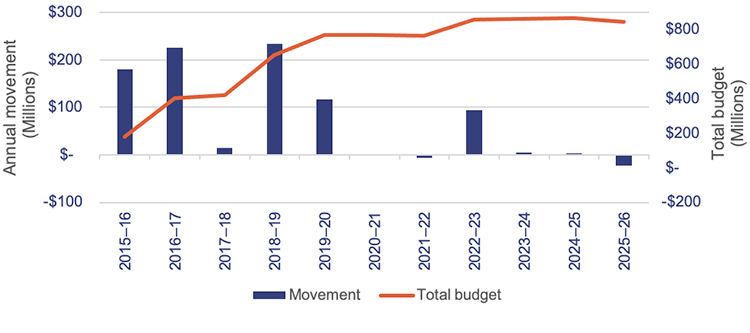
As identified in section 3, the Queensland Government's initial approved budget of $180.2 million grew to $843.8 million by 30 June 2026.
With the release of the Advance Queensland – Innovation for a Future Economy Roadmap 2022–2032 (2022–2032 roadmap) and the move to a decentralised governance framework for oversight of the AQ initiative, it became more difficult to verify movements in the approved AQ initiative budget. In performing our assessment, we relied on information DETSI provided to identify the budget allocated to the AQ initiative between 2021–22 and 2025–26.
Figure 5A shows the budget movement for the AQ initiative between 2015–16 and 2025–26.
Compiled by Queensland Audit Office from information provided by the Department of the Environment, Tourism, Science and Innovation.
The information provided by DETSI included a list of all 114 programs operated under the AQ initiative and the total budget allocated to each program. The top 5 funded programs accounted for approximately 38 per cent of the AQ initiative’s total budget. These programs and their allocated budgets were the:
- Business Development Fund: $80.0 million
- Industry Attraction Fund: $77.5 million
- Ignite Ideas and Ignite+: $62.7 million
- Industry Research Fellowship: $55.5 million
- Research Infrastructure Co-investment Fund: $40.8 million.
Further information on the amount spent on these programs is included in Appendix F.
Who monitored how AQ initiative funds were spent?
While individual agencies were responsible for implementing AQ programs, the AQ interdepartmental committee was initially responsible for overseeing the whole-of-initiative implementation. This role was subsequently performed by the AQ steering committee.
Our review of minutes and meeting papers identified that the steering committee was provided with information on the overall budget and expenditure of the AQ initiative. A report to the steering committee providing summary data as at 31 March 2021 identified that, of the $757.5 million whole-of-initiative budget:
- over $500 million was spent
- a further $216 million was contractually committed.
Together, this represents 95 per cent of the total budget.
Our assessment of information DETSI provided identified approximately $113 million of grant funding allocated to programs after the committee was abolished.
The quarterly ministerial briefs on AQ performance reported on the total expenditure against the AQ whole-of-initiative budget up to 30 June 2022. Subsequent briefs only reported on funded activities under the 2022–2032 roadmap.
After the 2022–2032 roadmap launched, unspent funds allocated to programs under the AQ initiative and not delivered by the innovation department were no longer monitored at a whole-of-initiative level. Instead, the Innovation Executive Leadership Team within the innovation department monitored the program evaluation, supported by a strategic projects and governance team. This reflected the revised focus of the 2022–2032 roadmap where the innovation department managed all new programs.
DETSI advised us that a central whole-of-government recipients' register, developed at the beginning of the AQ initiative, is used to record amounts allocated on each AQ program. The central recipients’ register identifies the amount provided to grants recipients for each AQ program and is updated quarterly.
This indicates that from June 2022 until the end of the AQ initiative in 2026, there was no central oversight or reporting of the total budget and spend at a whole-of-initiative level. This is despite agencies outside the innovation department continuing to deliver programs funded under the AQ initiative before the 2022–2032 roadmap was launched.
How much of the funding has been spent?
We asked DETSI to provide information supporting the total amount spent on the AQ initiative. As this amount is no longer reported and monitored at a whole-of-initiative level, DETSI provided us with information compiled from several sources, including DETSI’s grant management platform, and the central recipients’ register.
The information provided by DETSI identified that program allocation for all 114 AQ programs was $785.8 million as at December 2025. This represents approximately $57 million less than the allocated budget for the AQ initiative identified in other information DETSI provided to us.
Based on the information provided, we could not separately quantify the extent to which this difference related to:
- funds allocated to AQ programs that remained unspent
- AQ program costs that were not identified through the information provided
- AQ programs that were not identified and included in the information provided, where funding was approved but not recorded on the central recipients’ register
- support and administration costs applied to overall AQ initiative management that are not allocated to specific AQ programs.
Based on the information provided, the Queensland Government does not currently have oversight of the total funds spent across the entire life of the AQ initiative and does not know how it compares to the approved budget. There is also a risk that the central recipients' register of all programs and the funds allocated to and spent on them is not complete.
How much was spent on the larger programs?
In assessing the information provided by DETSI and other departments, we identified that $484.3 million was allocated to the 10 AQ programs with the highest amount of committed funds. This represents approximately 57 per cent of the overall budget for the AQ initiative.
Further information available to QAO identified that approximately $463.8 million was spent on these programs. A breakdown of these programs is included in Appendix F. This represents approximately 96 per cent of the committed funds for these programs.
How much has been spent under the 2022–2032 roadmap?
The Queensland Government approved $142.2 million to support the 2022–2032 roadmap in the 2022–23 State Budget. Of the $142.2 million, $110.9 million was made available to the innovation department and $0.8 million to other departments. The remaining $30.5 million reflects amounts the Queensland Government reprioritised to fund other programs and services and other adjustments.
Information provided by DETSI identified that the amount the department spent on science and innovation programs under the 2022–2032 roadmap to 30 June 2026 was $89.4 million. A breakdown of the amounts it spent on these programs is included in Appendix F.
Did the Queensland Government report publicly on amounts spent on the AQ initiative?
While the Queensland Government made formal announcements of approved funding for the AQ initiative and AQ programs, we did not identify any regular and consistent public reporting on the status of amounts spent at either the initiative or program level over the life of the initiative.
While there was high-level reporting on the amount spent at the whole-of-initiative level up to June 2022, the changed focus of reporting under the 2022–2032 roadmap meant there was no public reporting on the amount spent over the entire life of the AQ initiative.
The lack of consistent public reporting on the total amount spent on the AQ initiative over its life means that key stakeholders and interested parties cannot assess whether the approved funding was spent on the AQ initiative; whether the funds were applied economically, efficiently, and effectively; and whether they provided value for money.
Recommendation 5: Enhance transparency and accountability of spending We recommend that, when establishing future initiatives, all departments:
|