
Overview
The Queensland Audit Office (QAO) provides independent assurance, recommendations, and insights to state and local government entities to strengthen their performance and enhance the services they deliver. This is important work that supports better outcomes for Queenslanders.
This is our sixth report to parliament on the status of Auditor-General’s recommendations. We asked 124 entities to self-assess their progress in implementing 606 recommendations, from 37 performance audit reports to parliament tabled between 2015–16 and 2024–25. Based on these self-assessments, we share insights on entities’ progress and highlight common challenges entities face and opportunities for improvement.
Starting this year, we also performed limited assurance procedures over entities’ self-assessments for 2 selected reports: Regulating firearms (Report 8: 2020–21) and Minimising gambling harm (Report: 9: 2023–24). We assessed whether evidence supported the entities’ reported progress and whether their actions addressed the intent of our recommendations. We selected these reports based on ongoing public interest and because entities had sufficient time to progress implementation of the recommendations.
Tabled 5 November 2026.

Report summary
The Queensland Audit Office makes recommendations to state and local government entities to help them deliver better public services and improve the lives of Queenslanders.

| What is important to know about this report? |
When we make recommendations as part of performance audits, we ask entities to tell us whether they agree with our recommendations and to provide an indicative time frame for implementing them. Entities are responsible for implementing the recommendations.
Each year, we track and report entities’ self-assessed progress. This year, for the first time, we also provided limited assurance over entity assessments for recommendations in 2 selected reports. We asked entities to report their progress to us in May and June 2026.

| What did we do? |
We asked entities to self-assess their progress in implementing recommendations from 37 reports. This included 6 reports tabled in 2024–25 and 31 earlier reports with recommendations previously reported as partially implemented or not implemented.

Note: The 37 reports contain 148 unique recommendations. Some recommendations apply to multiple entities, resulting in 606 individual recommendations.
Queensland Audit Office.
We selected 2 reports for further assessment:
- Regulating firearms (Report 8: 2020–21)
- Minimising gambling harm (Report 9: 2023–24).
We performed limited assurance procedures over the self-assessments for recommendations in these 2 reports. We assessed whether evidence supported entities’ reported progress and whether their actions addressed each recommendation’s intent. We did not assess whether the actions achieved their intended outcomes.

| What did entities report to us? |
Entities reported they had made the following progress in implementing the 606 recommendations:

Queensland Audit Office, using data self-reported by entities.
Key insights from our analysis
Results of our further assessmentFor the 2 reports selected for further assessment, we assessed whether evidence supported entities’ reported statuses and whether their actions addressed each recommendation’s intent.
Closing a recommendation before the underlying issue is resolved can leave risks unmanagedWe have identified issues in previous audits, including follow-up audits, where entities’ reported statuses did not always reflect the work remaining. We will continue to assess selected self-assessments and report the results to parliament in future years. It is important that entity reporting mechanisms and controls are effective in ensuring their reported statuses reflect completed and remaining work. Their assessments should also consider whether actions address the recommendation’s intent. |
Appendix B presents entities’ self-assessed progress in implementing the recommendations. Our interactive dashboard provides a convenient way to explore their reported progress on each recommendation and is available at www.qao.qld.gov.au/status-auditor-generals-recommendations-dashboard.
1. Insights – recommendation themes
This chapter examines recommendation themes from reports between 2015–16 and 2024–25, and the 606 recommendations included in this year’s entity self-assessment.
These recommendations are from 37 reports and comprise:
- 203 recommendations that entities reported as partially implemented or not implemented in last year’s entity self-assessment
- 403 recommendations from reports tabled in 2024–25, which entities reported on for the first time this year.
To identify themes, we grouped 2,197 recommendations in reports tabled from 2015–16 and after into categories. We examined what entities reported about their progress in implementing the recommendations and identified which were the most common categories of outstanding recommendations.
Entities self-assessed each recommendation as fully implemented, partially implemented, not implemented, or no longer applicable. They reported their progress to us between May and June 2026. Appendix D explains the assessment criteria.
What are the recommendation categories?
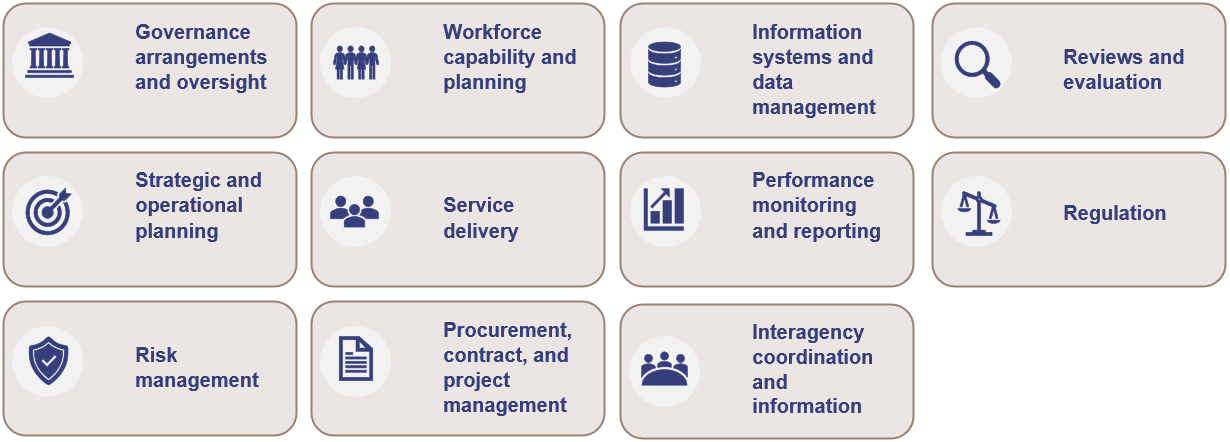
We design our recommendations to help entities improve their practices, address identified issues, and better manage risks. To analyse common themes, we grouped the recommendations into 11 categories. Figure 1A shows these categories.
Note: Some categories, such as risk management, can form part of broader governance arrangements. We present them separately to support more detailed analysis.
Queensland Audit Office.
Our interactive dashboard allows users to explore recommendation categories and implementation status for recommendations included in our annual entity self-assessment process. It is available at www.qao.qld.gov.au/status-auditor-generals-recommendations-dashboard. Appendix C explains the recommendation categories.
What are the most common recommendation categories?
Where a recommendation applies to multiple entities, we count it separately for each entity. Figures 1B and 1C show the 3 most common categories for all recommendations made in reports tabled from 2015–16 to 2024–25 for state government entities and local governments. The recommendations making up the categories include those implemented, partially implemented, and not yet implemented.
| Number of recommendations by category | Examples of underlying issues | |
|---|---|---|

| 367 governance arrangements and oversight recommendations |
|

| 263 performance monitoring and reporting recommendations |
|

| 195 information systems and data management recommendations |
|
Note: Starting this year, we expanded the analysis to include all recommendations included in our entity self-assessment process. In last year’s status report, we only analysed outstanding recommendations included in that year’s self-assessment.
Queensland Audit Office, from our analysis of recommendations in reports to parliament.
| Number of recommendations by category | Examples of underlying issues | |
|---|---|---|
|
| 175 governance arrangements and oversight recommendations |
|

| 78 workforce capability and planning recommendations |
|

| 72 reviews and evaluation recommendations |
|
Note: Starting this year, we expanded the analysis to include all recommendations included in our entity self-assessment process. In last year’s status report, we only analysed outstanding recommendations included in that year’s self-assessment.
Queensland Audit Office, from our analysis of recommendations in reports to parliament.
Which categories have the most recommendations still outstanding?
We asked 124 public sector entities, including local governments, to self-assess their progress on implementing recommendations. Entities reported 302 as partially implemented or not implemented, which we classify as outstanding.
We analysed these 302 recommendations across the 11 categories to identify which categories had the most outstanding recommendations.
We consider the outstanding recommendations from the report Managing Queensland’s regional water quality (Report 7: 2024–25) separately as it represents 52 per cent (157) of the 302 outstanding recommendations.
The outstanding recommendations from Managing Queensland’s regional water quality related to governance arrangements and oversight, risk management, and workforce capability and planning. They sought to strengthen councils’ processes for managing drinking water by improving record keeping, addressing capability gaps, and enhancing risk management and oversight.
Councils reported updating drinking water quality management plans, procedures, record keeping, and monitoring arrangements. They also reported ongoing recruitment efforts, but cited difficulty attracting and retaining suitably qualified staff, particularly in regional and remote areas.
Among the remaining 145 recommendations from other reports, the most common types of outstanding recommendations related to:
- strategic and operational planning
- reviews and evaluation
- governance arrangements and oversight
- information systems and data management.
Figure 1D shows the categories with the most outstanding recommendations, and excludes recommendations from Managing Queensland’s regional water quality.
| Recommendation category | Outstanding recommendations | Percentage of remaining outstanding recommendations | |
|---|---|---|---|

| Strategic and operational planning | 26 | 18% |
|
| Reviews and evaluation | 23 | 16% |
|
| Governance arrangements and oversight | 22 | 15% |
|
| Information systems and data management | 22 | 15% |
| Total | 93 | 64% |
Queensland Audit Office, using data self-reported by entities.
Strategic and operational planning
Between 2015–16 and 2024–25, we made 169 recommendations about strategic and operational planning. These recommendations focused on improving entities’ planning processes, clarifying roles and responsibilities, setting strategic priorities, and developing measures to assess strategic outcomes.
Last year, this category also had the highest number of outstanding recommendations, with 41 recommendations – 40 partially implemented and one not implemented. This year, 26 recommendations remain outstanding, all partially implemented. Entities reported fully implementing 18 of the 41 recommendations outstanding last year, leaving 23 still outstanding. The other 3 outstanding recommendations are from 2 reports tabled in 2024–25.
Most of the 23 recommendations carried forward from last year are from 3 reports:
- 6 are from Forecasting long-term sustainability of local government (Report 2: 2016–17)
- 5 are from Improving asset management in local government (Report 2: 2023–24)
- 3 are from Planning for sustainable health services (Report 16: 2020–21).
Overall, entities reported drafting new asset management plans and developing or updating strategies and frameworks. Further work includes developing key performance measures, and reviewing, endorsing, and operationalising updated strategies.
Reviews and evaluation
Between 2015–16 and 2024–25, we made 188 recommendations relating to reviews and evaluation. These focused on strengthening entities’ functions and frameworks through legislative reviews, audit committee assessments, and program evaluations.
Of the 188 recommendations, 12 per cent (23) remain outstanding. Entities reported partially implementing 19 recommendations and not implementing the remaining 4.
Seventy per cent (16) of the outstanding recommendations are from Insights on audit committees in local government (Report 10: 2024–25). Some councils reported reviewing or revising their audit committee terms of reference and developing charters and induction packs for new members. Other councils reported they had not yet assessed the performance of their audit committee. These recommendations are recent, and councils still have time to implement them.
Governance arrangements and oversight
Between 2015–16 and 2024–25, we made 406 recommendations about governance. These focused on developing frameworks and guidance, and strengthening systems, processes, and oversight responsibilities to improve monitoring.
Of the 406 recommendations, 22 remain outstanding. Entities reported partially implementing 16 and not implementing 6. Most of the outstanding recommendations are from 2 reports:
- 10 are from Insights on audit committees in local government (Report 10: 2024–25), with 5 partially implemented and 5 not implemented
- 5 are from Improving asset management in local government (Report 2: 2023–24), with 4 partially implemented and one not implemented.
The recommendations from Insights on audit committees in local government asked councils without an audit committee to assess how effectively they discharge their financial and governance responsibilities. Some councils reported reviewing their risk framework, internal responsibilities, and the costs and benefits of having an audit committee. Others reported taking no action because they were focused on improving historical financial accounts or planned to review the issue later.
For the recommendations relating to improving asset management, councils reported endorsing strategic asset management plans and improving processes to evaluate projects. Further work includes establishing a working group to guide councils’ approach to asset management and continuing to refine processes for projects.
Information systems and data management
Between 2015–16 and 2024–25, we made 201 recommendations about information systems and data management. These focused on improving how entities collect, store, and share information, and on improving data quality.
Of the 201 recommendations, 22 remain outstanding. Entities reported partially implementing 21 recommendations and not implementing one.
Similar to last year, more than half (55 per cent) of the outstanding recommendations are from Implementing machinery of government changes (Report 17: 2022–23). Entities reported continuing to implement digital information management systems to improve the retention, transfer, and disposal of information. They also reported further work to approve and publish a digitisation policy, implement the systems, and strengthen records management.
2. Overall status of implementation
This chapter reports entities’ self-assessed progress on 606 recommendations. These are from 37 performance audit reports, over the period 2015–16 to 2024–25, that were outstanding at the start of this year’s entity self-assessment. They comprise:
- 403 recommendations from 6 reports tabled in 2024–25
- 203 recommendations from 31 earlier reports that were outstanding when we reported on them last year.
We examine overall implementation status, status by report, changes since last year, timeliness of implementation, and progress by entity type.
Implementation status
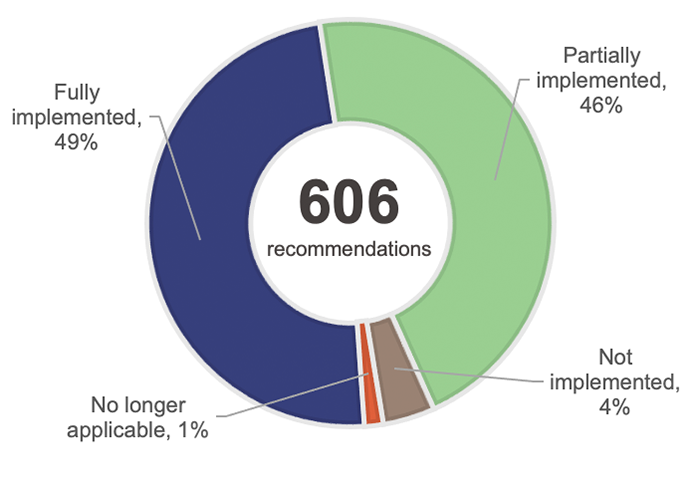
Most recommendations were reported as either fully or partially implemented. Figure 2A shows the breakdown of entities’ self-assessed implementation status. Entities report their status as fully implemented, partially implemented, not implemented, or no longer applicable. We classify as outstanding any recommendations reported as partially implemented or not implemented.
Appendix B lists the reports included in this year’s assessment and presents entities’ self-assessed progress.
Queensland Audit Office, using data self-reported by entities.
Status of recommendations by report
Entities reported that all recommendations for the following 8 reports were fully implemented:
- The National Disability Insurance Scheme (Report 14: 2017–18)
- Conserving threatened species (Report 7: 2018–19)
- Investing in vocational education and training (Report 1: 2019–20)
- Responding to complaints from people with impaired capacity—Part 1: The Public Trustee of Queensland (Report 5: 2020–21)
- Enabling digital learning (Report 1: 2021–22)
- Enhancing government procurement (Report 18: 2021–22)
- Measuring emergency department patient wait time (Report 2: 2021–22)
- Managing invasive species (Report 1: 2023–24).
The remaining 29 reports had at least one outstanding recommendation.
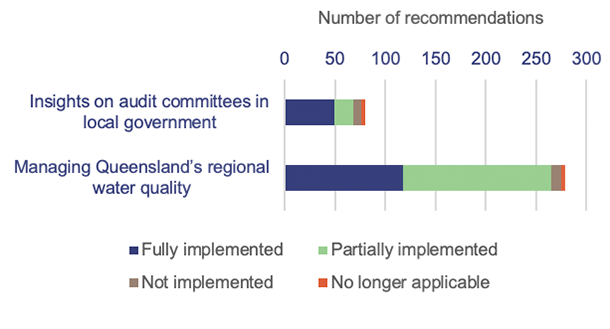
Two reports tabled in 2024–25 account for a large number of individual recommendations because some recommendations applied to multiple councils. We show them separately in Figure 2B.
Queensland Audit Office, using data self-reported by entities.
Figure 2C shows the status of recommendations for the other 27 reports. For earlier reports, it only includes recommendations that were outstanding at the start of this year’s follow-up.
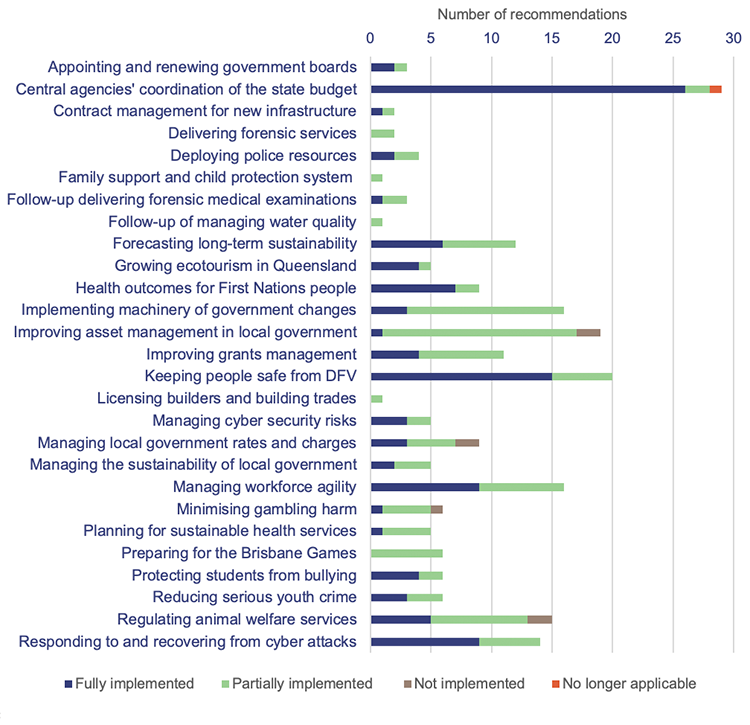
Note: We have shortened some report titles in this figure. DFV means domestic and family violence.
Queensland Audit Office, using data self-reported by entities.
Status of outstanding recommendations from prior years
In 2025 status of Auditor-General’s recommendations (Report 3: 2025–26), we reported 203 recommendations as outstanding. Of these, entities reported this year that they had:
- fully implemented 48 per cent (97)
- partially implemented 49 per cent (99)
- not implemented 3 per cent (7).
This means 106 of the 203 recommendations remain outstanding. Figure 2D compares the number of outstanding recommendations reported last year with the number that remain outstanding this year.
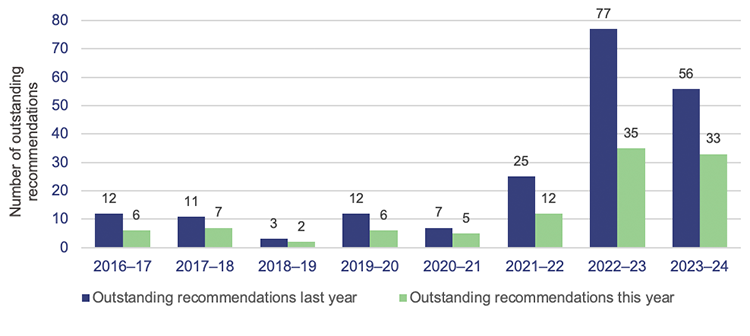
Queensland Audit Office, using data self-reported by entities.
Of the 106 recommendations that remain outstanding, 21 relate to reports tabled between 2016–17 and 2019–20. Six of these are partially implemented recommendations from Forecasting long-term sustainability of local government (Report 2: 2016–17). This is the oldest report with outstanding recommendations. The remaining 15 recommendations are from reports tabled between 2017–18 and 2019–20.
Of the 21 recommendations, 42 per cent (9) relate to strategic and operational planning. A further 19 per cent (4) relate to performance monitoring and reporting.
Entity responses provide some insight into why these older recommendations remain outstanding, although they do not consistently explain the reasons for delay. We did not identify a consistent explanation across the long-standing recommendations, and responses included technical and data challenges, dependencies on other agencies, historical data limitations, community engagement challenges, and resource constraints.
Timeliness of implementation
When developing our recommendations, we ask entities whether they agree with them and when they plan to implement them. Some entities agree with our recommendations but do not provide an implementation time frame.
There are instances where we make a recommendation to multiple entities, because the recommendation applies to other entities beyond those in scope for the audit. In these cases, we ask only the in-scope entities to provide an implementation time frame. We may later ask other entities to self-assess their progress against the recommendation.
Setting an expected implementation time frame supports accountability, coordinated planning, and monitoring of progress.
For reports tabled between 2021–22 and 2024–25, entities provided expected implementation time frames for 205 recommendations. Of these, 47 remain outstanding and are overdue, 4 are not yet due, and entities assessed 3 as no longer applicable. We classified a recommendation as timely if the entity reported it fully implemented at the first follow-up after its expected implementation time frame.
We analysed the time it took entities to implement the remaining 151 recommendations reported as fully implemented:
- 76 per cent (115) were timely
- 24 per cent (36) were not timely.
The 36 recommendations classified as not timely relate to 12 reports and are based on entities’ reported implementation time frame.
Figure 2E shows how long after the expected implementation time frame entities reported implementing the 36 recommendations classified as not timely.
| Number of recommendations | Time overdue |
|---|---|
| 5 | 6 months to less than 1 year |
| 18 | 1 year to less than 2 years |
| 12 | 2 years to less than 3 years |
| 1 | More than 4 years |
Queensland Audit Office, using data self-reported by entities.
Half (18) of the 36 recommendations were implemented one–2 years after the expected time frame. A further 13 were implemented more than 2 years late.
Entities reported the actions they had taken to address the recommendations, but did not explain why they were implemented late.
This year for the first time, we asked entities to report when they fully implemented recommendations. This information will support more precise analysis of implementation timeliness in future status reports.
Progress with implementation by type of entity
We report implementation progress separately for departments, hospital and health services, local governments, and statutory bodies and other state entities. The mix and age of recommendations differ across these groups, so their implementation rates are not directly comparable.
Departments
We asked 23 departments to self-assess their progress on 158 recommendations across 32 reports. These comprised:
- 51 recommendations from 6 reports tabled in 2024–25
- 107 recommendations that were outstanding from previous years from 26 reports.
Departments reported fully implementing 59 per cent (94) of the 158 recommendations. Figure 2F summarises their self-assessed implementation status.
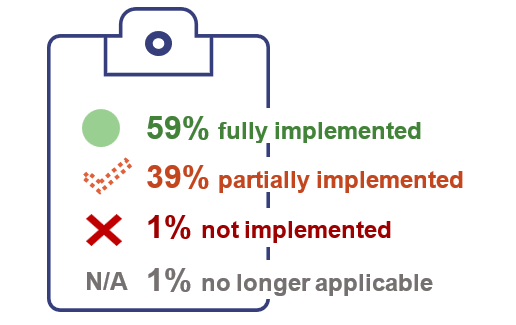
Note: Figure shows the status of recommendations relating to reports tabled in 2024–25 and recommendations outstanding from previous years.
Queensland Audit Office, using data self-reported by entities.
The following 6 departments reported fully implementing all recommendations included in this year’s assessment:
- Department of Customer Services, Open Data and Small and Family Business
- Department of Natural Resources and Mines, Manufacturing and Regional and Rural Development
- Department of Primary Industries
- Department of State Development, Infrastructure and Planning
- Department of Transport and Main Roads
- The Public Trustee of Queensland.
The other 17 departments reported at least one outstanding recommendation. Figure 2G shows the status of their recommendations.
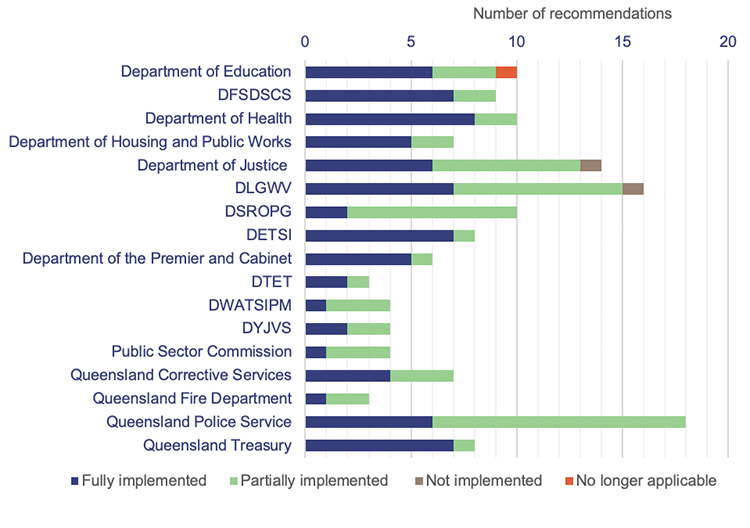
Note: DFSDSCS – Department of Families, Seniors, Disability Services and Child Safety; DLGWV – Department of Local Government, Water and Volunteers; DSROPG – Department of Sport, Racing and Olympic and Paralympic Games; DETSI – Department of the Environment, Tourism, Science and Innovation; DTET – Department of Trade, Employment and Training; DWATSIPM – Department of Women, Aboriginal and Torres Strait Islander Partnerships and Multiculturalism; DYJVS – Department of Youth Justice and Victim Support.
Queensland Audit Office, using data self-reported by entities.
Departments reported that 40 per cent (63) of their 158 recommendations remain outstanding. Forty-six per cent (29) of the 63 recommendations are from reports tabled in 2022–23, while 29 per cent (18) are from reports tabled in 2024–25 and 16 per cent (10) from reports tabled in 2023–24. The remaining 6 recommendations are from reports tabled before 2022–23.
As in last year’s report, Queensland Police Service (QPS) had the largest number of outstanding recommendations, with 12 partially implemented recommendations across 6 reports.
Five of these recommendations are from Improving grants management (Report 2: 2022–23). They relate to governance, controls, monitoring, and performance evaluation of grant programs. QPS reported providing quality assurance over grant information and reviewing its grants management policy, including risk management processes across its grant programs. QPS did not explain what work remains, why these recommendations are still outstanding, or when it expects to complete them.
Another QPS recommendation, from Delivering forensic services (Report 21: 2018–19), has remained outstanding for almost 7 years. At the time of tabling Delivering forensic services, QPS indicated it would implement this recommendation by December 2020. The recommendation relates to processes for collecting, transporting, and destroying illicit drugs. QPS reported updating its procedures manual and establishing an electronic interface to strengthen triage and prioritisation. It was also working with Forensic Science Queensland to examine whether legislative changes could streamline drug-related processes.
The Department of Local Government, Water and Volunteers had the second-highest number of outstanding recommendations, with 9. It reported 8 as partially implemented and one as not implemented. Seven of these 9 recommendations are from Managing Queensland’s regional water quality (Report 7: 2024–25). The department indicated it would start implementing the recommendations from Managing Queensland’s regional water quality in November 2024, with 3 recommendations to be implemented by July 2025. The department did not provide a specific completion time frame to implement the remaining 4 recommendations, but indicated implementation would be ongoing.
One of these recommendations relates to improving the department’s risk-based approach to assessing and managing water service providers. The department reported developing an automated machine-learning tool using annual data to assign a risk category to each service provider. At the time of its self-assessment, the department was testing the tool.
Hospital and health services
We made no new recommendations to hospital and health services (HHSs) in reports tabled in 2024–25. We asked 12 HHSs to self-assess 21 outstanding recommendations relating to 4 reports from previous years.
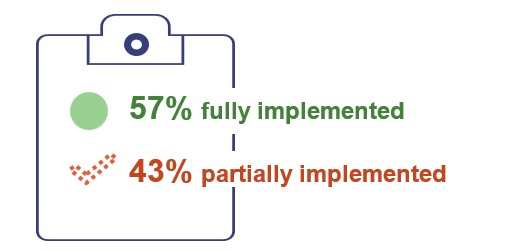
HHSs reported fully implementing 57 per cent (12) of the 21 recommendations. Figure 2H summarises their self-assessed implementation status.
Note: Figure shows the status of recommendations outstanding from previous years.
Queensland Audit Office, using data self-reported by entities.
The following 7 HHSs reported fully implementing all recommendations included in this year’s assessment:
- Cairns and Hinterland Hospital and Health Service
- Gold Coast Hospital and Health Service
- Mackay Hospital and Health Service
- Metro North Hospital and Health Service
- Metro South Hospital and Health Service
- South West Hospital and Health Service
- Townsville Hospital and Health Service.
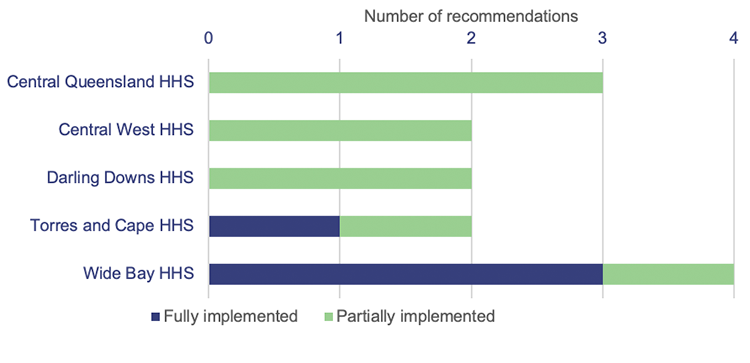
Figure 2I shows the 5 HHSs with at least one outstanding recommendation.
Queensland Audit Office, using data self-reported by entities.
HHSs reported that 43 per cent (9) of the 21 recommendations remain outstanding. These recommendations relate to 3 reports. The largest concentration of outstanding recommendations is in Planning for sustainable health services (Report 16: 2020–21), which accounts for 4 of the 9 outstanding recommendations. HHSs reported one of the 5 recommendations from this report as fully implemented and 4 as partially implemented.
In Planning for sustainable health services, we recommended that HHSs develop integrated plans incorporating environmental actions and align them with statewide HHS planning frameworks. Some HHSs reported developing sustainability strategies and governance arrangements. Further work remained to integrate environmental actions into their planning arrangements. The 3 HHSs with outstanding recommendations from this report did not provide a time frame indicating when they planned to implement the recommendations. They have indicated full implementation is expected in 2026–27.
Local governments
We asked 77 local governments (councils) to self-assess 400 recommendations. These comprised:
- 349 recommendations relating to 2 reports tabled in 2024–25
- 51 recommendations that were outstanding from previous years from 5 reports.
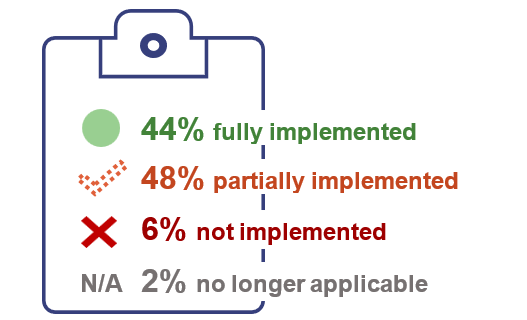
Councils reported fully implementing 44 per cent (176) of the 400 recommendations. Figure 2J summarises councils’ self-assessed implementation status.
Note: Figure shows the status of recommendations relating to reports tabled in 2024–25 and recommendations outstanding from previous years.
Queensland Audit Office, using data self-reported by entities.
The following 10 councils reported fully implementing all recommendations included in this year’s assessment:
- Brisbane City Council
- Carpentaria Shire Council
- Etheridge Shire Council
- Fraser Coast Regional Council
- Gold Coast City Council
- Moreton Bay City Council
- Redland City Council
- Scenic Rim Regional Council
- Toowoomba Regional Council
- Western Downs Regional Council.
The other 67 councils reported at least one outstanding recommendation.
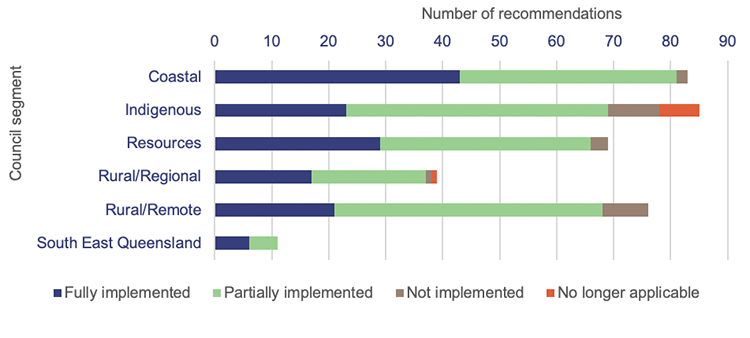
Councils vary in size, location, and the range of community services they provide. We grouped them into the 6 council segments used by the Local Government Association of Queensland: Coastal, Indigenous, Resources, Rural/Regional, Rural/Remote, and South East Queensland.
Figure 2K shows implementation status across these segments. Appendix E provides the detailed status of recommendations by council.
Queensland Audit Office, using data self-reported by entities.
Councils reported that 54 per cent (216) of their 400 recommendations remain outstanding. Of these, 81 per cent (175) relate to 2 reports, with recommendations applying to multiple councils:
- Managing Queensland’s regional water quality (Report 7: 2024–25)
- Insights on audit committees in local government (Report 10: 2024–25).
Seven councils provided status updates for only some recommendations in these reports and did not describe the actions supporting their reported status. This limits the information available about their progress in addressing those recommendations.
Chapter 1 discusses the main issues councils reported in implementing recommendations from Managing Queensland’s regional water quality. For Insights on audit committees in local government, one recommendation asked councils to assess their audit committees and identify opportunities to improve their effectiveness. Some councils reported completing self-assessments and developing improvement plans, while others reported that they had not yet completed their self-assessment.
Outstanding recommendations from previous years
Councils continue to report outstanding recommendations from 4 previous local government sustainability audits:
- Forecasting long-term sustainability of local government (Report 2: 2016–17)
- Managing local government rates and charges (Report 17: 2017–18)
- Managing the sustainability of local government services (Report 2: 2019–20)
- Improving asset management in local government (Report 2: 2023–24).
There are 33 outstanding recommendations from these 4 reports. We are currently conducting an audit on Improving the sustainability of local governments, the fifth audit in our local government sustainability series. We are examining how the Department of Local Government, Water and Volunteers supports councils to manage their financial sustainability. We are also gathering information from councils about how they manage their own sustainability.
We plan to table this report in 2026–27. Recommendations made through this audit may replace the outstanding recommendations from the 4 reports above. We will report entities’ self-assessed progress in implementing any new recommendations through our usual status reporting process.
Statutory bodies and other entities
We asked 12 statutory bodies to self-assess 17 recommendations. These comprised:
- 3 recommendations relating to one report tabled in 2024–25
- 14 recommendations that were outstanding from previous years from 7 reports.
We also asked 3 other entities to self-assess 10 recommendations outstanding from previous years. These entities are already included in the overall count of 124 entities under other categories, so we do not count them again here. For security reasons, we do not identify these 3 entities and 2 of the 12 statutory bodies in this section, as they were not named in our report to parliament.
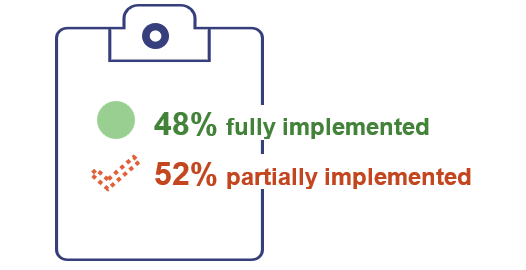
Together, the 27 recommendations in this section were self-assessed as 48 per cent (13) fully implemented and 52 per cent (14) partially implemented. Figure 2L summarises their self-assessed implementation status.
Note: Figure shows the status of recommendations relating to reports tabled in 2024–25 and recommendations outstanding from previous years.
Queensland Audit Office, using data self-reported by entities.
The following entities reported fully implementing all recommendations included in this year’s assessment:
- Queensland Curriculum and Assessment Authority
- Queensland Reconstruction Authority
- Queensland Rural and Industry Development Authority
- TAFE Queensland
- Entity I.
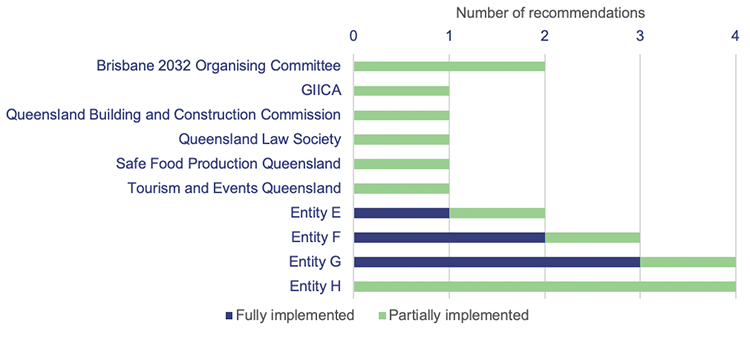
Figure 2M shows the statutory bodies and other entities with at least one outstanding recommendation.
Notes: GIICA – Games Independent Infrastructure and Coordination Authority. Some entities are not named because they were anonymised in Responding to and recovering from cyber attacks (Report 12: 2023–24) for security reasons.
Queensland Audit Office, using data self-reported by entities.
Entities reported that 52 per cent (14) of the 27 recommendations remain outstanding and are partially implemented. Three of these relate to Preparing for the Brisbane Games (Report 5: 2024–25). The recommendations focus on strengthening risk management and clarifying how sustainability outcomes will be defined, measured, and reported.
The entities reported developing their own risk management programs, with further implementation and refinement planned. They also reported developing a sustainability and impact strategy to guide the delivery of sustainability outcomes for the Games. We are currently conducting Cross-entity governance and preparedness for the Brisbane Games, the second audit in our Brisbane Games series. This audit will provide a more detailed assessment of entities’ progress against these recommendations. We plan to table this report in 2026–27.
The Queensland Building and Construction Commission (QBCC) has one outstanding recommendation from Licensing builders and building trades (Report 16: 2019–20). We made this recommendation more than 5 years ago. At the time of tabling the report, QBCC said it would implement this recommendation by September 2020.
The recommendation required QBCC to implement its quality assurance framework and a program of quality assurance reviews across all business units the framework covers. QBCC reported developing guidance and templates to support quality assurance practices. It also reported that more than half of its teams had implemented quality assurance programs, with the remaining teams actively developing their assurance programs.
QBCC did not explain why implementation remains incomplete and has not indicated when it expects to fully implement the recommendation. It said operational teams will continue implementing quality assurance programs, updating procedures, and conducting independent quality control checks.
3. Assessing entities’ reported implementation progress
Our reporting on the status of recommendations relies on entities’ self-assessment processes. This year for the first time, we selected 2 previous performance audit reports to assess whether entities had sufficient and adequate evidence to support their self-assessed progress. In this chapter, we report the results of this work and identify broader lessons from these assessments and previous audits.
In addition to this status report, we usually select one previous performance audit for a detailed follow-up audit each year. In these audits we often find discrepancies between entity assessment of fully implemented and our independent assessment of their implementation of our recommendations.
For this reason, we have decided to complement our follow-up audit program with a limited assurance assessment of selected reports as part of our status of Auditor-General’s recommendations process.
What did we assess?
We selected 2 reports for further assessment:
- Regulating firearms (Report 8: 2020–21), in which we made 13 recommendations to Queensland Police Service (QPS)
- Minimising gambling harm (Report 9: 2023–24), in which we made 10 recommendations to the then Department of Justice and Attorney-General. The department is now the Department of Justice, which we refer to as ‘the department’ in this chapter.
For these recommendations, we assessed whether evidence the entities provided supported their reported implementation progress, and whether their actions addressed the recommendations’ intent.
This approach allowed us to make a limited assurance assessment over the entities’ reported progress.
We did not assess whether the actions taken achieved their intended outcomes. Appendix D explains our selection approach, assessment criteria, procedures, and the level of assurance we provided.
A limited assurance engagement involves less extensive procedures than a reasonable assurance engagement. For our conclusion, this means sufficient work was performed to identify matters reported on, but not as much work as to provide the higher level of confidence received with a reasonable assurance engagement.
Our limited assurance conclusions
Based on the procedures performed and evidence obtained, our conclusions are set out below and apply to the self-assessments for the following 2 reports.
Regulating firearms – Queensland Police Service
For 7 of the 13 recommendations, QPS’s reported assessment was supported by appropriate evidence and its actions align with the recommendations’ intent.
For the remaining 6 recommendations, QPS’s assessment that they were fully implemented was not supported by evidence. We assessed each of these as partially implemented.
Overall, our limited assurance conclusion under Australian Auditing Standards indicates that, for 7 of 13 recommendations, nothing has come to our attention to indicate QPS’s reported status assessments are not supported by appropriate evidence. Nor has anything come to our attention indicating its actions do not address the recommendations’ intent.
Minimising gambling harm – Department of Justice
For all 10 recommendations, the department’s reported assessment was supported by appropriate evidence. Its actions align with the recommendations’ intent.
Our limited assurance conclusion under Australian Auditing Standards is that nothing has come to our attention to indicate the department’s reported status assessments are not supported by appropriate evidence. Nor has anything come to our attention indicating its actions do not address the recommendations’ intent.
Figure 3A summarises where our assessments aligned with entities’ self-assessments for 17 of the 23 recommendations.
Report | Entity | Recommendations assessed | Entity self-assessment | Our assessment | Status aligned |
|---|---|---|---|---|---|

Regulating firearms | Queensland Police Service | 13 |
|
| 7 of 13 |

Minimising gambling harm | Department of Justice | 10 |
|
| 10 of 10 |
Note: The self-assessment results reflect the Department of Justice’s reported progress as at May 2026 and the Queensland Police Service’s progress reported between August 2023 and May 2024.
Queensland Audit Office, using self-reported data and evidence provided by the entities.
Implementation status for Regulating firearms
Regulating firearms (Report 8: 2020–21) examined whether QPS effectively regulates how firearms are accessed, used, stored, and disposed of to keep the community safe. We made 13 recommendations to QPS across 3 main areas:
- access – strengthening firearm licensing decisions to ensure only suitable people can access firearms
- monitoring – improving monitoring of licence holders and their ongoing suitability and compliance with firearm requirements
- regulation – strengthening oversight of firearms dealers and monitoring the movement of firearms.
QPS does not have evidence to support all of its conclusions
QPS reported fully implementing all 13 recommendations in previous status of Auditor-General’s recommendations reports – 10 in 2023 and the remaining 3 in 2024.
QPS provided sufficient evidence to support its reported progress for 7 recommendations. For the remaining 6 recommendations, QPS has taken significant action, but important elements remain incomplete.
The remaining areas still to complete relate to integrating information for licence-holder monitoring, risk-based inspections, follow-up of non-compliance, oversight of shooting ranges, electronic transaction notifications, and interstate firearm transfers.
QPS has strengthened how it decides who can access firearms
Recommendation focus | Our assessed status | Aligns with QPS’s self-assessment | |
|---|---|---|---|
| Access |
| Fully implemented | ✓ |
| Fully implemented | ✓ | |
| Fully implemented | ✓ | |
| Fully implemented | ✓ |
Note: We have summarised the recommendation wording in this figure. See the original audit report for the full recommendations. A tick indicates our assessed status aligns with the entity’s self-assessment. A cross indicates it does not.
Queensland Audit Office, using self-reported data and evidence provided by QPS.
Recommendations 1 to 4 addressed closely related issues about how QPS decides who can access firearms. We discuss these recommendations together. The original audit found:
- the firearms register was outdated
- licensing controls had weaknesses
- legislative provisions were open to interpretation
- QPS did not always balance procedural fairness with community safety.
We recommended that QPS evaluate options for a replacement firearms register, strengthen licensing controls, review legislation, and clarify how public safety should guide decisions.
QPS evaluated options for replacing its firearms register in 2023. It later decided to replace the register and contracted a vendor in 2026 to develop the new system. The replacement register is scheduled for release in mid-2027 and is intended to centralise weapons licensing information and improve data accuracy and reliability. Recommendation 1 focused on evaluating system options, rather than requiring the replacement register to be operational.
QPS also established a dedicated role to check the quality and consistency of licensing decisions and updated guidance and processes for reviewing licensing decisions. QPS provided weekly and monthly reports as evidence that these quality assurance checks are occurring. We did not assess the quality or accuracy of the checks.
QPS reviewed the Weapons Act 1990, and amendments passed in 2024 strengthened restrictions on people considered unsuitable to possess firearms. It also updated licensing policies, procedures, and training to place greater emphasis on public safety and whether licence holders remain suitable to possess firearms. The updated guidance addresses how staff should balance procedural fairness, public interest, and community safety when assessing licence applications.
We assess recommendations 1 to 4 as fully implemented. The evidence supports QPS’s reported actions and our assessment that these actions address the recommendations’ intent.
QPS has strengthened monitoring of firearm licence holders, but some elements remain incomplete
Recommendation focus | Our assessed status | Aligns with QPS’s self-assessment | |
|---|---|---|---|
| Monitoring |
| Partially implemented | × |
| Partially implemented | × | |
| Fully implemented | ✓ | |
| Partially implemented | × | |
| Partially implemented | × |
Note: We have summarised the recommendation wording in this figure. See the original audit report for the full recommendations. A tick indicates our assessed status aligns with the entity’s self-assessment. A cross indicates it does not.
Queensland Audit Office, using self-reported data and evidence provided by QPS.
In our 2020–21 audit, we found QPS had limited visibility of whether firearm licence holders remained suitable to possess firearms. Its monitoring was not risk-based, and most licence holders were not inspected. Identified non-compliance was also not consistently followed up.
We recommended that QPS strengthen how it monitors firearm licence holders. This included better system integration, risk-based inspections, ongoing suitability monitoring, timely action on non-compliance, and stronger oversight of shooting ranges.
QPS has made significant progress. We assess recommendation 7 as fully implemented. For recommendations 5, 6, 8, and 9, important elements remained incomplete when QPS reported them as fully implemented.
Recommendation 5 – QPS has improved access to firearms information, but some underlying data and integration risks remain
This recommendation called for QPS to better integrate weapons licensing information with QPRIME, its police information system. QPRIME is the main repository and source of information and intelligence for police on patrol, responding to incidents, and conducting investigations. The original audit found QPRIME and the weapons licensing system were not fully interfaced and contained incomplete, outdated, and conflicting information. This limited QPS’s ability to provide police officers with up-to-date and accurate information to monitor licence holders effectively.
QPS has developed a dashboard that brings information from multiple systems together and produces reports to support licence-holder monitoring. This has improved access to information. However, QPS plans to explore opportunities to improve the interface between QPRIME and a replacement weapons licensing system as part of its work to replace the existing system. Further system-integration work remains. QPS also did not demonstrate how it assures the accuracy and completeness of the information brought together in the dashboard. We assess recommendation 5 as partially implemented.
Recommendation 6 – Risk-based inspections remain incomplete
This recommendation called for QPS to supplement random inspections with risk-based inspections of higher-risk licence holders. QPS developed dashboard reports and staff guidance to support this approach.
However, the evidence did not show QPS was conducting risk-based inspections when it reported the recommendation as fully implemented in 2023. QPS subsequently commenced a one-off statewide risk-based inspection operation in 2025. It is still developing a broader risk-based inspection strategy. We assess recommendation 6 as partially implemented.
Recommendation 7 – QPS has broadened how it monitors whether licence holders remain suitable to possess firearms
Recommendation 7 sought to broaden QPS’s monitoring of whether firearm licence holders remain suitable to possess firearms. QPS previously focused mainly on compliance with firearm storage requirements.
QPS introduced a new process that assesses suitability for both new applications and renewals. It considers criminal history, domestic violence, mental health, and other factors. The evidence shows QPS now considers a broader range of information when assessing whether people remain suitable to possess firearms. We assess recommendation 7 as fully implemented.
Recommendation 8 – Follow-up of non-compliance remains incomplete
This recommendation sought to ensure all identified non-compliance and licence-holder suitability concerns are monitored, reported, and actioned within a reasonable time frame. QPS established time frames for retrieving weapons and developed reports highlighting offences that may indicate higher-risk licence holders. It also provided examples showing it followed up some non-compliance identified during firearm storage inspections.
However, QPS did not demonstrate it consistently monitors and follows up non-compliance and suitability concerns across inspections. It also did not demonstrate that it centrally tracks identified issues, actions taken, and follow-up. As a result, QPS did not demonstrate that all identified issues are monitored, reported, and actioned within a reasonable time frame. We assess recommendation 8 as partially implemented.
Recommendation 9 – Oversight of shooting ranges has improved, but an electronic register has not been established
This recommendation focused on proactively inspecting shooting ranges and developing an electronic register to support vetting of people using firearms at those ranges. QPS established procedures and checklists and provided evidence that inspections are occurring. These inspections check whether range operators hold valid permits and whether operators verify the licences of people using firearms. QPS also developed an online tool to check whether a person holds a valid firearm licence.
However, QPS has not developed the electronic register or an alternative process that provides broader oversight of people using firearms at shooting ranges. It has not demonstrated that it can identify people who may otherwise be unsuitable to use firearms at those ranges. QPS is exploring an electronic interface as part of work to replace its weapons licensing system. We assess recommendation 9 as partially implemented.
QPS has strengthened dealer oversight and tracking of firearm movements, but has not fully implemented improvement recommendations
Recommendation focus | Our assessed status | Aligns with QPS’s self-assessment | |
|---|---|---|---|
| Regulation |
| Partially implemented | × |
| Fully implemented | ✓ | |
| Partially implemented | × | |
| Fully implemented | ✓ |
Note: We have summarised the recommendation wording in this figure. See the original audit report for the full recommendations. A tick indicates our assessed status aligns with the entity’s self-assessment. A cross indicates it does not.
Queensland Audit Office, using self-reported data and evidence provided by QPS.
In our original audit, we found QPS did not proactively regulate firearms dealers. Its monitoring of firearm movements also relied heavily on manual processes. These processes contributed to backlogs and outdated information in the firearms register. QPS was also not verifying interstate firearm transfers against its register.
We recommended that QPS introduce an electronic firearm transaction system, strengthen dealer compliance monitoring, monitor interstate transfers, and eliminate its backlog of firearm transfer forms. QPS has strengthened dealer compliance monitoring and cleared the transfer-form backlog. Further work remains on electronic notifications and interstate transfer monitoring.
We assess recommendations 11 and 13 as fully implemented, and recommendations 10 and 12 as partially implemented.
Recommendation 10 – Electronic notification of firearm transactions remains incomplete
This recommendation called for QPS to ensure it is immediately notified electronically of firearm sales, transfers, and disposals, including by requiring dealers to use electronic systems. The Weapons Regulation 2016 was amended in 2022 to allow QPS to specify how dealers provide transaction information, including online.
QPS requires electronic notification for incoming transactions under the National Firearms Amnesty but all other dealer transactions must still be notified by registered post within 14 days. Using registered post delays QPS’s receipt of transaction information and increases the risk that notifications are not received. We assess recommendation 10 as partially implemented.
Recommendation 11 – QPS has strengthened its compliance monitoring of firearm dealers
This recommendation focused on developing a proactive program of dealer audits and inspections. Our original audit found QPS lacked a structured approach to dealer regulation.
QPS has established a dedicated role to coordinate and oversee dealer inspections and an annual dealer compliance program. Supporting guidance sets an annual inspection schedule, roles and responsibilities, inspection procedures, and processes for reviewing and following up inspection outcomes.
QPS provided evidence that it conducts dealer inspections. We did not assess the effectiveness of individual inspections or QPS’s follow-up of identified non-compliance. We assess recommendation 11 as fully implemented.
Recommendation 12 – Monitoring of interstate firearm transfers remains incomplete
This recommendation called for QPS to monitor interstate transfers so its register accurately records the location and ownership of firearms. Our original audit found QPS did not compare interstate transfer information with its firearms register. This limited its ability to verify whether transfers were accurately recorded.
QPS now compares its interstate transfer records with New South Wales’ records. It has not demonstrated equivalent arrangements with other jurisdictions. QPS reported that broader interstate monitoring depends on its new firearms register and national arrangements for sharing firearm movement information. As these broader arrangements remain incomplete, QPS has not demonstrated comprehensive monitoring of interstate firearm transfers. We assess recommendation 12 as partially implemented.
Recommendation 13 – QPS has addressed its backlog of firearm transfer forms
This recommendation sought to eliminate the backlog of firearm transfer forms so the firearms register remained current and accurate. QPS introduced additional resources and changed its processes to reduce the backlog.
Weekly reporting shows the backlog identified in our original audit has been cleared. QPS also provided information on how it currently manages incoming transfer forms. The evidence supports our assessment that QPS has addressed the identified backlog. We assess recommendation 13 as fully implemented.
Recommendation 1 We recommend that Queensland Police Service reopens the recommendations from Regulating firearms (Report 8: 2020–21) that we assessed as partially implemented and continues implementation until it has addressed the remaining elements. |
Implementation status for Minimising gambling harm
Minimising gambling harm (Report 9: 2023–24) examined whether the Department of Justice and Attorney-General, now Department of Justice (the department), effectively minimised and prevented gambling-related harm in Queensland. We made 10 recommendations across 3 main areas:
- protecting consumers and communities from harm – strengthening research, prevention, support, and self-exclusion arrangements
- regulation – strengthening risk-based regulation and oversight of gambling providers
- governance and evaluation – strengthening governance, monitoring, and evaluation of harm minimisation strategies.
Our assessments aligned with the department's reported statuses for all 10 recommendations
The department reported 5 recommendations as fully implemented, 4 as partially implemented, and one as not implemented. Since our original audit, the department has strengthened its research, support services, regulatory practices, governance, and evaluation arrangements.
In May 2026, it released the Gambling Harm Action Plan 2026–28, which now guides its harm minimisation activities. Further work remains on research and prevention initiatives and on exploring options for a centralised system for people to exclude themselves from multiple gambling venues. The department is also considering the future direction and enforcement of the responsible gambling code while some evaluation measures are still being established.
Research and support have strengthened, but further prevention and self-exclusion work remains
Recommendation focus | Our assessed status | Aligns with the department's self-assessment | |
|---|---|---|---|
| Protection |
| Partially implemented | ✓ |
| Fully implemented | ✓ | |
| Partially implemented | ✓ | |
| Fully implemented | ✓ | |
| Not implemented | ✓ |
Note: We have summarised the recommendation wording in this figure. See the original audit report for the full recommendations. A tick indicates our assessed status aligns with the entity’s self-assessment.
Queensland Audit Office, using self-reported data and evidence provided by the department.
Recommendations 1 to 5 focused on implementing strategies to protect consumers and communities from gambling harm. In our original audit, we identified that the department had outdated information about gambling prevalence and limited Queensland-specific research. It also needed more prevention initiatives for at-risk groups and more accessible gambling help services.
Recommendation 1 – Research and data collection have strengthened
This recommendation focused on improving and sustaining the department’s understanding of gambling-related harm and its prevalence in Queensland. The department has since strengthened its research and data collection through targeted studies and several surveys.
This has provided more current information about gambling behaviour, harm, and groups experiencing greater risk. However, the department has not yet fully established its ongoing research arrangements. It plans to explore developing a research plan focused on priority issues, subject to funding. We assess recommendation 1 as partially implemented.
Recommendation 2 – The department has assessed its longer-term funding needs
This recommendation called for the department to assess its need for long-term funding to deliver its harm minimisation plans. The department assessed its longer-term funding needs through the budget process. In 2024–25, it secured $8.06 million in additional ongoing funding for the Gambling Help Service System. This system provides counselling and other support services for people affected by gambling harm. We assess recommendation 2 as fully implemented.
Recommendation 3 – The department has implemented initiatives for at-risk groups, with further work planned
This recommendation focused on developing initiatives targeting at-risk groups to prevent gambling harm. The department has expanded prevention initiatives for First Nations people, multicultural communities, young people, and people affected by sports betting. It continued sports partnerships and developed targeted materials for multicultural communities, while progressing resources for First Nations communities.
It delivered gambling harm training to frontline First Nations health and community workers. Some initiatives remain in development or evaluation under the Gambling Harm Action Plan 2026–28. We assess recommendation 3 as partially implemented.
Recommendation 4 – The department has implemented the 2021 gambling help services review recommendations
This recommendation called for the department to complete implementation of the recommendations from the 2021 review of gambling help services. The department mapped each review recommendation to its actions and provided supporting evidence showing how it addressed them. Actions included specialist services, financial counselling, community education, First Nations resources, training, and stronger performance measures. We assess recommendation 4 as fully implemented.
Recommendation 5 – Development of a self-exclusion system remains incomplete
This recommendation focused on developing, with industry, a centralised system allowing people to exclude themselves from multiple gambling venues. The department has not implemented the centralised multi-venue self-exclusion system. The proposed system reached the design stage, but most development had not occurred before industry paused the project in 2024. The department is considering alternative options, including an industry proposal. It advised that data and privacy risks also remain under consideration. It is monitoring approaches, learnings, and challenges in other jurisdictions. We assess recommendation 5 as not implemented.
Regulatory oversight has strengthened, but a review of the responsible gambling code is still in progress
Recommendation focus | Our assessed status | Aligns with the department's self-assessment | |
|---|---|---|---|
| Regulation |
| Partially implemented | ✓ |
| Fully implemented | ✓ | |
| Fully implemented | ✓ |
Note: We have summarised the recommendation wording in this figure. See the original audit report for the full recommendations. A tick indicates our assessed status aligns with the entity’s self-assessment.
Queensland Audit Office, using self-reported data and evidence provided by the department.
The Queensland Responsible Gambling Code of Practice is a voluntary set of standards for gambling providers. Our original audit found this limited the department’s ability to influence industry behaviour. Regulatory activities were not risk-based, and regulatory oversight needed strengthening.
Recommendation 6 – Gambling code of practice reforms have progressed, but the enforcement approach remains under consideration
This recommendation called for the department to review its Queensland Responsible Gambling Code of Practice and establish a mechanism to enforce it. The department has completed substantial work to review the code. The future policy direction, including whether requirements will be mandatory or voluntary, remains under consideration. We assess recommendation 6 as partially implemented.
Recommendation 7 – The department has established a risk-based compliance approach
This recommendation focused on implementing a comprehensive, risk-based approach to assessing and managing gambling-related risks. The department has strengthened its risk-based compliance approach. For hotels and clubs, it uses a risk-ranking tool to prioritise compliance activity based on assessed gambling-harm risks.
Risk rankings are refreshed monthly, and venues are targeted according to their assessed level of risk. Casinos are treated as high-risk venues under a separate compliance program. The department also uses national regulatory arrangements to support its oversight of online wagering providers. We assess recommendation 7 as fully implemented.
Recommendation 8 – Regulatory oversight of the gambling industry has strengthened
This recommendation focused on strengthening the department’s regulatory oversight of the gambling industry, including harm-focused inspections, officer training, and performance monitoring.
The department has strengthened its regulatory oversight through harm-focused inspection checklists, officer training, and regular reporting. The evidence shows updated checklists are in use. Training records show officers completed relevant training between April 2024 and April 2026. The department also reports on regulatory performance and compliance activity. We assess recommendation 8 as fully implemented.
Governance and monitoring have strengthened, but some evaluation measures are still being established
The original audit identified weaknesses in the department’s governance, oversight, performance monitoring, and reporting processes.
Recommendation focus | Our assessed status | Aligns with the department's self-assessment | |
|---|---|---|---|
| Governance |
| Fully implemented | ✓ |
| Partially implemented | ✓ |
Note: We have summarised the recommendation wording in this figure. See the original audit report for the full recommendations. A tick indicates our assessed status aligns with the entity’s self-assessment.
Queensland Audit Office, using self-reported data and evidence provided by the department.
Recommendation 9 – The department has established governance and performance monitoring arrangements
This recommendation sought to strengthen governance and performance-monitoring arrangements for delivering the harm minimisation plan. The department has strengthened governance and oversight of its gambling harm activities. It formalised a governance framework covering roles, reporting, risk management, conflicts of interest, and changes to annual plans. It also developed supporting project governance guidance and uses a reporting dashboard to monitor implementation and project risks. Quarterly reporting provides additional oversight of progress.
The department completed an external mid-term review of the Gambling Harm Minimisation Plan 2021–25, in May 2024. It also strengthened conflict-of-interest arrangements for the Safer Gambling Advisory Committee. The evidence supports our assessment that these governance and monitoring arrangements have been established. We assess recommendation 9 as fully implemented.
Recommendation 10 – The department has strengthened its evaluation framework, but some measures are still being established
This recommendation focused on improving how the department evaluates the effectiveness of its strategies and their impact on gambling prevalence and harm. The department has strengthened how it measures and evaluates gambling harm initiatives. It developed an outcomes and evidence framework with measurable performance indicators and introduced regular survey-based data collection.
The new survey provides baseline information for several outcome measures. The department also completed a final evaluation of the 2021–25 plan in October 2025. In July 2026, the department approved an initial set of targets for gambling harm strategies. However, some benchmarks, baseline data, and ongoing monitoring arrangements are still being established. We assess recommendation 10 as partially implemented.
Entities should address underlying issues and report implementation progress accurately
Closing a recommendation before the underlying issue is resolved can leave important risks unmanaged. It can also mean intended improvements in efficiency or effectiveness have not been achieved.
Entities should assess implementation based on completed and remaining work, whether actions address the recommendation’s intent, and whether the underlying risk has been addressed. They should support the status they report with sufficient evidence.
Together, our limited assurance work and findings from earlier follow-up audits point to several broader lessons.
Completing actions does not always mean the underlying issue is resolved
Our follow-up and other audits often find that entities report a recommendation as fully implemented, yet the underlying issue is not addressed. They show that entities can complete significant work while important elements of the underlying issues remain unresolved.
In 3 previous follow-up audits where we could identify entities’ earlier self-assessments, entities had reported 12 recommendations as fully implemented. Our follow-up assessments found 7 were fully implemented and 5 were not. We could not identify comparable earlier self-assessment information for the other follow-up audits we reviewed.
Other audits that revisited earlier recommendations also identified similar issues. In Managing invasive species (Report 1: 2023–24), we assessed implementation of recommendations from an earlier audit of Biosecurity Queensland. Biosecurity Queensland’s management of agricultural pests and diseases (Report 12: 2016–17) made 5 recommendations to the Department of Agriculture and Fisheries. Before our 2023–24 audit, the Department of Agriculture and Fisheries had reported all 5 recommendations as fully implemented. We assessed 3 of the 5 recommendations as partially implemented. The Department of Agriculture and Fisheries has since been renamed to the Department of Primary Industries.
In Protecting our threatened animals and plants (Report 9: 2022–23), we assessed 5 of 7 recommendations as partially implemented. Further work remained across species listing and assessment, and monitoring.
Implementing a new system, framework, or process does not necessarily mean a recommendation is fully implemented. Entities need sufficient evidence to demonstrate that changes address the underlying issue and are operating as intended.
Dependencies on other entities can delay full implementation
Our report Appointing and renewing government boards (Report 17: 2021–22) found weaknesses in how entities appointed and renewed government board members. These included identifying required skills, attracting diverse candidates, and filling vacancies within reasonable time frames.
We recommended that the Department of the Premier and Cabinet (DPC) develop a whole-of-government framework for appointing and renewing board members. We also recommended that 4 entities adopt and implement the framework.
The 4 entities reported this recommendation as fully implemented, although DPC's framework is not yet in place. They cited the recommendation’s age, their dependency on DPC, and plans to monitor the framework’s release.
The recommendation to DPC remains outstanding. Over the past 3 years, DPC updated its guidance and developed a draft appointments framework. DPC reported that the draft framework is awaiting government consideration. This dependency limits what the 4 entities can do. However, they cannot fully implement the recommendation until the framework is available and they have adopted it.
Reporting a recommendation as fully implemented before these actions occur can overstate implementation progress.
Implementation approaches can change
Circumstances, policy settings, and delivery approaches can change after we make a recommendation. Entities do not need to follow the original approach if an alternative approach still addresses the underlying issue and the recommendation’s intent.
Where an entity changes its approach, it should assess whether the alternative still addresses the recommendation’s intent. It should document that assessment and retain evidence supporting its conclusion.
Entities should have sufficient evidence before closing recommendations
Before assessing a recommendation as fully implemented, entities should consider whether:
- the underlying issue and associated risks have been addressed, and their actions address the recommendation’s intent
- all important elements of the recommendation have been addressed
- changes have been implemented and are operating as intended
- any alternative approach still addresses the recommendation’s intent
- sufficient evidence supports the assessed status.
Audit committees should challenge closure decisions
Audit committees should actively monitor implementation of audit recommendations and challenge whether evidence supports decisions to close them. The level of assurance should reflect the significance and risk of the underlying issue. This may include internal audit or other independent testing where appropriate.