
Overview
Our annual report summarises our performance, operations, and business highlights for 2025–26. It contains our financial statements, including the opinion of the independent external auditor. It complies with the Financial Accountability Act 2009, Financial and Performance Management Standard 2019, and the detailed requirements set out in the Annual report requirements for Queensland Government agencies. We also recognise our peoples' achievements, and thank our clients and stakeholders for their work with us this year.

Auditor-General’s message
This year has reinforced for me the vital role that independent assurance has in contributing to government performance and maintaining public trust. At the Queensland Audit Office (QAO), our work helps parliament and the community have confidence that public funds are being managed appropriately and that public sector entities remain accountable for the services they deliver.
The significance of our role continues to attract talented, valued professionals and audit service providers who share our commitment to better public services. This year, we launched a refreshed employee value proposition that clearly articulates what we stand for as an employer and what our people can expect in return for their contribution. It reflects our purpose, values, and strategic objectives, while recognising the diverse needs and aspirations of a high-performing workforce.
Our Executive Leadership Team has remained focused on developing our people and capability. We strengthened initiatives to build public sector expertise, expand pathways for female leadership, and advance our commitment to inclusion through a neurodiversity strategy. These investments help us attract, develop, and retain the talent needed to deliver high-quality audit and assurance services.
I remain impressed by our people’s commitment to audit quality, learning, and public sector outcomes. Every day, they bring integrity, professionalism, and curiosity to their work. Their dedication is the foundation of our success. I am also grateful for the strong partnerships we maintain with private sector audit firms that support the delivery of our financial statement audit program under our direction.
Just as importantly, QAO remains a rewarding place to work. Our employee surveys reflect our positive culture, supported by strong connections across the organisation. Our social club has been in existence since the early days of QAO and more than half of our staff celebrated at our recent 50th annual gala event. Our social events are a reminder of the enduring spirit of the QAO community.
Over the past 2 years, we have renewed our focus on what it means to be a public sector auditor and strengthened our engagement with the public sector to understand the emerging challenges and risks entities face. The insights we gain from these conversations help shape our forward work plan, ensure our services remain relevant, and inform the supporting resources and events we provide.
We are proud of the strong relationships we have built, but we are not complacent. We continue to seek feedback and act on it. I thank our clients, stakeholders, and parliamentarians for their openness and engagement. This year, we received positive results from our independent surveys with our audit clients, exceeding our benchmarked targets and improving on last year.
Trust is central to everything we do. Maintaining our independence and objectivity is critical, as is protecting the information entrusted to us. As new technologies, including artificial intelligence, continue to reshape the public sector, we are ensuring our practices and governance arrangements keep pace.
This report outlines how we achieved our objectives and fulfilled our mandate this year. Challenges and opportunities face us as they do the entities we audit. We set ourselves ambitious bodies of work, fuelled by our motivation to deliver value-for-money services. We hold ourselves to the same high standards we ask from the public sector.
I look forward to the year ahead as we continue to deliver independent assurance, trusted insights, and positive outcomes for Queenslanders.
Rachel Vagg
Auditor-General
1. About QAO
Our role
The Auditor-General is Queensland Parliament’s independent auditor of state and local government public sector entities.
The Queensland Audit Office (QAO) supports the Auditor-General under the Auditor-General Act 2009 (the Act). The Act identifies our responsibilities and provides the legal basis for QAO’s powers, such as access to information.
Our work provides independent assurance to the Queensland Parliament that there is appropriate stewardship over public sector entities and how they manage public resources. The Queensland Parliament provides our office with appropriation to report our findings and recommendations.
QAO promotes transparency and accountability, acting as a safeguard for the Queensland community by asking if public sector entities are managing risks to service delivery and if services are meeting or improving outcomes for Queenslanders.
Our clients
The large number and wide range of entities we audit include state government departments, government owned corporations, statutory bodies, controlled entities, and Queensland’s 77 councils.
What we do
- Through financial audits, provide an independent opinion on whether public sector entities have prepared their financial statements accurately and reliably.
- Through performance audits, examine if government programs and services are achieving value for money, including if they are effective – meeting objectives and efficient – using resources well, and economical – avoiding unnecessary costs.
- Produce publicly available reports to parliament on the results and conclusions of our audits which highlight issues, risks, good practices, and opportunities for improvement, along with industry-wide insights.
- Provide recommendations during our audits and within our reports and resources on how entities can improve their performance and financial management.
- Share our observations and learnings with our clients, professional networks, industry, and peers.
- Conduct investigations into claims of financial waste and mismanagement.
| Our work supports public trust in the system of government by: |
|
Our history
The role of Auditor-General has been part of Queensland’s parliamentary framework for over 165 years. The first Auditor-General was appointed in 1860, one year after Queensland became its own independent colony. In 1993, the Queensland Audit Office was born, following and preceding other legislative changes that protect the independence of our unique position and enable us to service parliament and our audit clients. We continue to evolve and modernise, while reflecting on our proud history and what it means for Queensland.
Our vision and values
Our vision – Better public services | Our purpose – Independent valued assurance and insights |
Our values

| 
|

| 
|
Strategic plan 2025–2029
Our strategic plan outlines our objectives, risks, organisational strategies, and indicators of achievement, aligned to our vision and purpose.
The plan is founded on our understanding of the needs and expectations of our clients, our stakeholders, and the broader community. It provides an overarching framework and sets the strategic direction for our operational and workforce planning, forward work plan, and service delivery statement. It guides how we prioritise resources, deliver valued services, and measure our performance.
Trusted, impactful work Foster trust through products, advice and engagements that add value. | Contemporary, quality audits Embrace innovation and evolve our systems, tools and ways of working. | Capable, empowered people Invest in our people and culture to maintain a workforce that meets our needs. | |
|---|---|---|---|
| Strategies |
|
|
|
| Performance indicators |
|
|
|
| Risks |
|
|
|
2. The year in review
Our performance highlights
| 414 audit opinions on financial statements issued and 17 reports tabled in parliament | |
| 9 parliamentary committee briefings, and QAO’s work was referenced 46 times by members during parliamentary discussions and hearings | Reported on 79 entities’ self-assessed progress on 362 recommendations in the 2025 status of Auditor-General’s recommendations report |
Average time to produce audit reports: Performance – 8.5 months (target 12) Financial – 6.4 months (target 9) | Average cost of audit reports: Performance audit – $534,736 (target $500,000) Financial audit – $241,159 (target $190,000) |
| 49 recommendations in our reports to parliament | Finalised 156 requests for audit |
| Audit client satisfaction: overall – 83 index points (target 80) | 76 per cent member of parliament satisfaction with our services |
| Client satisfaction with our financial audits remained steady at 83 points, and significantly increased for performance audits – up from 72 to 83 points | 160 total number of engagements by the Auditor‑General with audit clients, parliamentarians, and peers |
| 103,525 web views of reports to parliament | 23 blogs, fact sheets, and better practice guides (target 20), seeing 6,998 views |
‘QAO plays an important role in overseeing how public sector entities, such as government departments, manage public funds and deliver programs. The committee, in turn, oversees the work of QAO.’ ‘I thank the Auditor-General, Rachel Vagg, and her team at the Queensland Audit Office for the crucial insights, independent advice and assessment they always provide.’ – Governance, Energy and Finance Committee, Report No. 18, February 2026.
Our workforce
| 218 full-time equivalent employees | |
| 33 per cent of our employees were born overseas | 65 per cent overall engagement from the Working for Queensland survey |
| 9 per cent of our employees identify as neurodivergent. We launched our first neurodiversity strategy and resource group | 51 per cent of our workforce are women. We launched our women in leadership employee resource group in March 2026 |
| 90 per cent of our financial audit staff have professional qualifications or are studying towards one, with the remaining including graduates and undergraduates, preparing to start their studies | 66 training and development hours per auditor 9 staff received CPA or CA qualifications |
Our finances
| We continue to be financially sustainable through appropriate spending and investment | |
Total income from continuing operations: $61.4 million | Total expenses from continuing operations: $60.3 million |
3. Our performance
During 2025–26, QAO delivered strong performance across its services, achieving positive results against timeliness and stakeholder satisfaction measures.
We operated productively and efficiently while delivering trusted audit services and we performed strongly compared to peer audit offices nationally.
We exceeded our service delivery statement (SDS) targets and improved on last financial year results for client satisfaction; demonstrating continued and improving confidence in the quality, value, and impact of our work.
We improved how quickly we delivered our financial and performance audits and reports, providing timely assurance for parliament, our audit clients, and the Queensland community. The average cost of our audits increased due to parliament-approved increases to charge-out rates, the growing complexity of audit work, and our commitment to better stakeholder engagement.
Our performance framework
Our performance framework enables us to monitor and measure what we have delivered against our targets and the priorities in our strategic plan.
This includes our outputs, how efficiently and effectively we operated, the outcomes or impact from our services, and how our workforce functions.
We assess our performance against:
- the benchmarked averages of other Australian audit offices, where available, via the Australasian Council of Auditors-General (ACAG)
- our strategic and operational objectives, using a range of measures developed through corporate planning and budgeting processes.
Our performance targets are outlined in our SDS.
Comparison to our peer audit offices
Comparing our performance to organisations that see similar challenges and opportunities helps us understand our results and progress.
We assess our results against data available from other audit offices via ACAG. This year, QAO performed well nationally compared to our peer audit offices.
| QAO performance against peer audit offices |
| We charged a higher percentage of total (whole of office) paid hours to audit work – 54.7 per cent compared to the ACAG average of 46 per cent. |
| Our average cost for each hour charged to audits was $191.9 compared to the ACAG average of $204.63. |
| Our average time to produce reports for performance audits was 8.5 months in 2025–26 compared to the ACAG average of 11.1 months. |
| Our average life cycle cost of reports on performance audits was $534,736 in 2025–26 compared to the ACAG average of $502,318. |
Cost and timeliness of audits and reports
We aim to use our resources efficiently and effectively to deliver our client services.
Timely delivery of our audits and reports to parliament remains a focus for us, so we can facilitate responsive action by entities and give parliament and the Queensland community well-timed assurance. While we aim to improve each year, the average time for us to deliver this year’s reports was significantly faster than last financial year.
We measure the timeliness of our financial audit reports from the end of our clients’ financial year to the tabling date of the report in parliament. We measure the timeliness of our performance audit reports from the start of the audit to the tabling date. We compare results to the targets in our SDS.
| Financial audit results | |
| Average cost of financial audits – state entities | $123,056 in 2025–26 compared to $108,000 in 2024–25 SDS target: $115,000–140,000 |
| Average cost of financial audits – local government entities | $109,146 in 2025–26 compared to $102,000 in 2024–25 SDS target: $99,000–105,000 |
| Average time to produce financial audit reports | 6.4 months in 2025–26 compared to 8.4 months in 2024–25 SDS target: < 8 months |
Like many professional organisations, we have experienced increases in the cost of delivering our financial audit services, including the need to provide competitive wages and invest in fit-for-purpose technology. Over the past 2 years, we have progressively implemented an increase in the base charge out rate for our financial audits. This rate was approved by parliament and reflects the cumulative impact of increased costs, which we manage within our productive and efficient operating environment.
The complexity of some of our audits has also increased, resulting in more audit activity, engagement, and reporting. We also have fewer smaller entities to audit because of the reduction in the number of council-controlled entities. These aspects are reflected in the average cost of our audits.
| Performance audit results | |
| Average life cycle cost of performance audits | $534,736 in 2025–26 compared to $461,000 in 2024–25 SDS target: $500,000; ACAG average: $502,318 |
| Average time to produce performance audit reports | 8.5 months in 2025–26 compared to 12.2 months in 2024–25 SDS target: < 12 months |
The increase in costs of our tabled performance audit reports is due to several reasons, including:
- additional effort necessary for providing parliament with reasonable assurance in all tabled reports
- the increasing complexity of audit topics, including our first audit on public sector use of artificial intelligence
- an increase in regional travel and engagement of subject matter experts
- our improved engagement during the audit and report preparation process, including earlier and more frequent briefings on audit findings and draft reports
- increased charge out rates for our services approved by parliament.
Client satisfaction with our services and products
We focus on enduring relationships with our audit clients, underpinned by objectivity, integrity, and independence, to ensure our services are high quality and responsive.
Via annual, independent surveys, we ask departments, government owned corporations, statutory bodies, and local governments for feedback on our processes and reports, and the value of our services. We use the results to identify trends and address issues, and how we can strengthen our client relationships. We also consider feedback from our clients when we meet with them or visit their work sites.
Through this year’s surveys, our clients are telling us they are satisfied with our work. We exceeded our benchmark scores for both our financial audits and performance audits, achieving an overall result of 83 out of a possible result of 100, using an index points system. Our target for both service areas was 80. Compared to last financial year, our overall financial audit client satisfaction results remained steady at 83, and our overall performance audit results increased significantly from 72 to 83.
Many of our clients noted the professionalism and conduct of our auditors – both QAO and audit service providers. Some clients thanked us for addressing their feedback in our previous year’s survey. And some noted an increased responsiveness from senior audit staff.
The survey results highlighted areas for improvement, including better knowledge-sharing when a client’s audit team changes, earlier communication from our audit teams, and consideration of the impact that late changes to the audit timeline or process can have on the entity or individual.
In the survey, one client shared: ‘The relationship is one of collaboration, and respect for each party’s views even though at times we may not agree. I am also impressed with the openness of the QAO engagement team to work through any challenges, to land on the best outcome for both parties.’ – Client satisfaction survey, September 2025.
Another shared: ‘The Queensland Audit Office is professional, well‑informed about our business, and pragmatic in its approach, with a clear understanding of sector challenges and a focus on constructive recommendations.’ – Client satisfaction survey, March 2026.
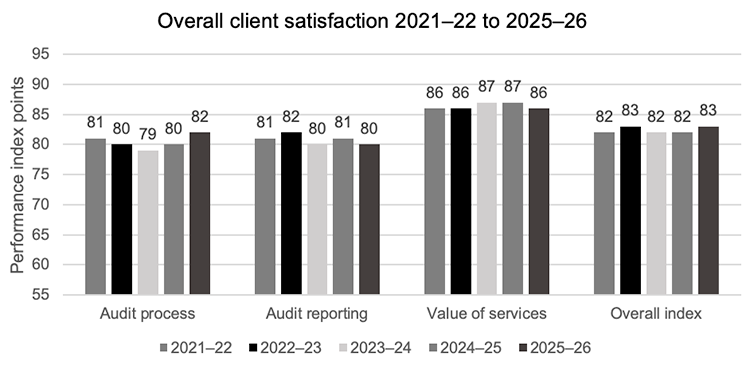
Results for our financial audits
This year’s results remained consistent with last financial year, with minor shifts in individual survey categories across our financial audit services.
| Key highlights – financial audit | |
| Our overall result of 83 index points, the same as last year (83) and exceeding our overall target of 80 | We received: 82 for our audit process (2024–25: 81) 80 for reporting (2024–25: 81) 87 for the value of our services (2024–25: 88) |
A client shared: ‘QAO takes a detailed, comprehensive yet pragmatic and efficient approach in getting across any significant accounting matters. QAO’s transparent and collaborative approach to addressing any accounting and audit matters during the audit is very much appreciated!’ – Client satisfaction survey, September 2025.
Results for our performance audits
We saw a significant increase in overall scores this year from our performance audit clients, recognising our concerted efforts to improve our engagement during our performance audits, and improvements to our audit processes and the report to parliament.
| Key highlights – performance audit | |
| Our overall result of 83 index points was higher than last year (72) and over our target of 80 | We received: 85 for our audit process (2024–25: 70) 83 for reporting (2024–25: 75) 81 for the value of our services (2024–25: 71) |
Feedback from a surveyed performance audit client on one of this year’s reports to parliament: ‘The Audit was professionally conducted, the auditors were highly engaged and communicated well throughout the audit. The audit report was comprehensive, accurate and fair.’ – Client satisfaction survey, November 2025.
Parliamentary stakeholder engagement
We aim to help parliament understand public sector entities’ financial management and performance, to support its accountability role.
Our main parliamentary stakeholders include Queensland’s parliamentary committees – members of parliament (MPs) and secretariat; other MPs; portfolio ministers; and the Office of the Speaker and Table Office regarding the tabling of reports.
Our reports to parliament are each referred to the respective committee that will be responsible for reviewing it. This year, 17 reports were referred to committees – 16 reports to parliament and our annual report. One report from 2025–26 will be referred in 2026–27 following its June 2026 tabling. We provided 9 briefings to committees on our reports where we highlighted our findings, insights, and recommendations, and we attended an oversight hearing by the Governance, Energy and Finance Committee (GEFC) on our Annual report 2024–25.
Parliamentary committees finalised 13 inquiries, including 10 reports referred in previous years; 2 referred in 2025–26; and our Annual report 2024–25.
We advise the GEFC and the other relevant committee/s of our upcoming reports prior to tabling day.
Regarding our reports State entities 2024 (Report 11: 2024–25) and Managing Queensland’s debt and investments 2024 (Report 12: 2024–25) – a member of the Governance, Energy and Finance Committee said in August 2025 in its inquiry:
‘The work of the Auditor-General is obviously very important to the operation of government here in Queensland.’
‘I think one of the most valuable contributions the Queensland Audit Office has made over recent years is to draw our attention to potential deficiencies in control systems.’ – August 2025.
| Throughout the year, the Auditor-General, QAO, and 14 of our reports were referenced on 46 occasions by members of parliament during parliamentary discussions and estimates hearings. |
Each year, we host a forum for parliamentary committee members and secretariat staff. This year, we discussed our forward work plan, the status of Auditor-General’s recommendations report, and themes emerging from QAO’s work, such as technology and cyber security risks. The event provides an opportunity for questions from chairs and staff on our work, and for us to receive feedback.
We remained responsive to parliamentarians’ requests for audits by carefully and objectively examining the information that they sent to us, per our mandate. We publish all requests from elected members on our website to ensure transparency: www.qao.qld.gov.au/audit-program/requests-audits.
During and following our audits, we engage directly with the ministers whose entities are involved in an audit. We offer to meet with ministers throughout the year to ensure they understand our aims, to raise awareness of our recommendations, and to receive feedback.
Per section 64(3) of the Auditor-General Act 2009, we give ministers the opportunity to provide written comments on our draft reports, within 21 days. If we receive a response, we include it, or a fair summary, in the tabled report.
This year, we wrote to the MPs newly elected in by-elections to inform them about our services and provide an overview of our recent and upcoming work, as related to the entities they oversee.
We consulted early with committees and ministers as we developed our new forward work plan for their feedback on our audit topics and timings, and to calibrate our analysis of the key risks facing public sector operations.
Members of parliament satisfaction with our services
Via an independent researcher, we survey MPs twice during each parliamentary term and use the results to understand how our services, reports, and engagement can provide value. We ask members for feedback on our work, how they see our role, and how they use and perceive our reports and resources.
This year, overall satisfaction was 76 per cent, down from 97 per cent in our last 2022–23 survey.
Twenty-five of 93 surveyed MPs responded to our survey, and this response rate can impact the level of insight this mechanism provides. Results tended to be lower due to more respondents selecting a response category of neither agree or disagree. This year also saw an increased proportion of new MPs – 36 per cent had been MPs for less than one term – and they may have had less familiarity with QAO’s role and services at this point in time. Satisfaction levels were less among new members at 69 per cent compared to those who had been an MP for more than one term at 81 per cent.
Eighty-five per cent of MPs said they think QAO’s reports improve public sector administration, with 84 per cent saying the reports informed them about public sector performance and 81 per cent saying the reports were easy to understand. Most respondents – 93 per cent – said the responsiveness of the Auditor-General was good or very good.
No respondents marked they were dissatisfied or very dissatisfied with our services.
Our results indicate that we need to increase parliamentarians’ understanding of QAO’s role and the value our reports and products can give them.
4. Our services
Delivery of audit services
Our audit approach is risk-based, meaning we focus on the key challenges we see our clients and the public sector facing.
We communicate matters identified directly to our clients during our audits and the significant matters to parliament through our reports.
Experienced and qualified audit professionals deliver our audit services. We use public sector-specific methodologies for financial statement audits and performance audits. We also use methodologies for sustainability assurance engagements that align with applicable professional standards.
A strong quality framework underpins our performance, which supports contemporary service delivery that meets regulatory requirements and client expectations.
Financial audit
Our financial audits provide an objective and independent opinion on state and local government entities’ financial statements.
Each year, we deliver more than 400 audit opinions for our clients across Queensland, giving us valuable insights from a range of entity types and sectors. We engage contracted audit service providers (ASPs) to support our financial audit delivery, and they are a critical part of our workforce. In 2025–26, ASPs delivered 31 per cent of our audit work (by revenue).
We tabled 8 reports to parliament summarising the results of our audits, highlighting key insights, and challenges and opportunities for the sector.
New report to parliament – Information systems 2025 (Report 6: 2025–26) |
We tabled our first report to parliament on information systems controls, designed to recognise the collective need across government for more focus on the risk of information technology (IT) systems and data. In our report, we summarise the results of our audits, assess the quality and effectiveness of related internal controls, and highlight key insights and opportunities from across our work. The report includes a chapter specifically on legacy systems and the risks they bring. We made recommendations to remedy control deficiencies directly to the entities we audited. We also drew attention to the recommendations in our State entities 2024 (Report 11: 2024–25) report to parliament that require further action by entities. We further shared our findings at our client and industry events and via our blog. As of 30 June 2026, it had been viewed 2,539 times on our website. |
We deliver our financial audit program through an industry‑based leadership model, enabling us to build deeper expertise on our audit clients and the sectors in which they operate. Ahead of the financial year, we conducted detailed planning for each industry. This includes outlining our engagement approach for key clients and stakeholders, sector-specific risks and developments, our audit focus areas, the strategy for the report to parliament, and our collaboration with our ASPs.
Engagement highlight – Local government sector |
Our local government audit services and engagement form a large and important part of our work, given councils’ presence across Queensland and role in delivering critical services for the community. We aim to maintain and strengthen our relationships with the many stakeholders who support councils, including the Local Government Association of Queensland, the Local Government Finance Professionals, Queensland Treasury Corporation, and accounting and auditing standards boards. In 2025–26, we worked with councils on several initiatives. We:
One of our local government audit clients shared in our annual satisfaction surveys: ‘We value the assurance that the QAO audit process brings. We value QAO's professionalism, their pragmatic and collaborative approach.’ – Client satisfaction survey, December 2025. Another commented: ‘We have received a lot of value from the audit process this year – the approach was extremely collaborative, with a view to improvement, not punitive. We’ve been given advice on how we can improve our processes to make things easier for us next time, and the audit issues raised were fair and reasonable – our organisation will be better off for implementing these changes.’ – Client satisfaction survey, December 2025. |
In prioritising our relationships with our clients, our audit teams travel across Queensland to deliver our services on the ground where possible to better understand the unique environments our clients operate in. Ongoing dialogue with our clients helps us better anticipate emerging issues, tailor our audit approach, and focus our efforts on areas where independent assurance and insights could deliver the greatest impact and public value.
In our client satisfaction survey, an audit client shared: ‘The audit was well conducted, and I appreciated regular engagement and updates from QAO occurring throughout the audit. This provided the department with opportunity to clarify each issue, sometimes with additional information to support the audit process and sometimes to assist with the auditor's understanding of the situation.’ – Client satisfaction survey, December 2025.
Engagement highlight – Health sector |
We continued to highlight significant risks affecting the delivery of health services across Queensland, particularly relating to ageing infrastructure and governance arrangements. A key challenge is that many health assets – including hospital buildings and supporting infrastructure – are ageing and maintenance is being deferred. This can affect the efficiency of operations, and the safety and quality of care. Our Health 2025 (Report 9: 2025–26) report built on our prior year findings, noting ongoing challenges in maintaining and renewing assets. For the first time, we gave our clients new, valuable data on the relationship between their asset maintenance backlog and their funding sources. Throughout the year, we discussed risks and issues with a range of stakeholders across the sector including our clients, their audit committees and boards, and at industry forums. We identified emerging risks associated with recent legislative changes and shared our advice on how entities can strengthen their governance arrangements directly with our clients, via our report to parliament and a blog article. The parliamentary committee responsible for our Health 2025 (Report 9: 2025–26) report said in its review: ‘The Queensland Audit Office once again demonstrates its ongoing commitment to providing Parliament with fearless, frank and independent assessments of government performance. The Auditor-General's work plays a vital role in promoting accountability, transparency and continuous improvement across the public sector. This report provides valuable insights into both the challenges confronting Queensland Health and the opportunities available to strengthen service delivery for Queenslanders.’ – Health, Environment, and Innovation Committee, Report No. 26, June 2026. Health 2025 (Report 9: 2025–26) has been viewed 3,161 times by external users as at 30 June 2026 since it tabled in January 2026. |
In our financial audit reports to parliament, refreshed chapter snapshots and callout boxes more clearly highlight sector-wide messages, emerging trends, key issues, and opportunities identified across the public sector and local government sectors. These highlights make it easier for readers to quickly understand the most significant findings and their implications, supporting informed decision-making and action.
Engagement highlight – Energy sector |
QAO’s Energy 2025 (Report 7: 2025–26) report highlights risks and insights for the sector. These include controls for information systems, financial pressures from volatile energy prices, rising costs, and ageing assets. The sector is also dealing with changes in government policies, transition risks, and new climate reporting requirements. To support our clients, via our audits and engagement, we focused on these risk areas to provide advice and recommendations around improving controls, governance of major projects, and financial performance, while drawing attention to new or emerging risks. Our engagement included dedicated, discussion-based forums for our energy, ports and water, sector clients, and ASPs. We held discussions with audit committees and key government departments, including Queensland Treasury. We also supported some clients in this sector in their preparation of climate reporting for the first time. Our work helped entities mature their internal controls over their information systems, resulting in a 50 per cent reduction in deficiencies, and we saw entities address the majority of the recommendations we made to them in the prior year. Energy 2025 (Report 7: 2025–26) has been viewed 1,491 times by external users as at 30 June 2026, since it tabled in December 2025. |
In our 2025 independent satisfaction survey with Members of Parliament, 91 per cent of respondents who shared their feedback said QAO’s reports and services provide valuable information on public sector performance, and 81 per cent said our reports communicate issues clearly.
Sustainability assurance
This year, large government companies commenced their mandated climate-related financial disclosures; preparing reports under the Australian Sustainability Reporting Standards issued by the Australian Accounting Standards Board. We are providing limited assurance on these 9 sustainability reports. The scope and extent of these audits will increase over future years.
By the end of 2027–28, we expect to grow our sustainability audits to 18 entities in line with legislative requirements. To support the new disclosures and reports, QAO developed methodology, training, and workpaper templates to guide our staff.
The approach allows our audit professionals to identify and respond to sustainability reporting risks in a consistent manner that still encourages them to exercise professional judgement.
We engaged assurance practitioners who specialise in sustainability assurance engagements to support our new approach, developed an internal working group to share knowledge between our teams, and reviewed our engagements while they were underway to assess for quality.
We also shared advice and updates on our approach at QAO events and via a number of blog articles.
Performance audit
We provide independent assurance on the efficiency, effectiveness, and economy of government entities to parliament and public sector entities through our performance audits.
This year, we conducted 8 performance audits, tabling the resultant reports with our findings, conclusions, and recommendations. Our audits examined a range of topics of interest to parliament and the public, from managing the ethical risks of artificial intelligence, to supporting industry development, and attracting and retaining teachers in regional and remote Queensland. We also tabled one report on the status of Auditor-General’s recommendations.
Of the 46 recommendations we made to 19 entities in our performance audit reports, 100 per cent were agreed to by entities; meeting our target. Some of the recommendations we made were directed to all public sector and local government entities, increasing the reach and value of our work.
We write our performance audit reports to be factual, objective, and easily understood by a wide range of stakeholders. We expanded our plain language approach to include more context in the report to allow readers to better understand our findings and recommendations.
Our conclusion chapter now more clearly answers the report objective. We shortened and refreshed our report summary to include headings for the reader such as ‘what is important to know about this audit’, which provides subject matter context, and we added a section called ‘what entities need to do’. This also assists parliament in understanding our recommendations.
Impactful report – Managing third-party cyber security risks (Report 13: 2025–26) |
Cyber security risks associated with third parties are a growing challenge for the public sector. While the use of third parties by entities can enable innovation and efficiency, they can bring additional cyber threats. Incidents can have significant consequences, including loss of privacy, financial loss, reputational damage, and disruption to critical services. For this performance audit, we combined traditional assurance techniques with hands-on testing. Using technical specialists, we simulated real-world attack scenarios to strengthen our findings. We addressed the complexity of this topic by implementing a structured methodology aligned to recognised better practice frameworks, international standards, and relevant benchmarks. Entities were receptive and engaged throughout our audit, with some taking immediate action to address issues we identified during our fieldwork. They reported strong value from the technical testing, which identified vulnerabilities, validated controls, and raised awareness of cyber risks. To accompany our report to parliament we developed a checklist of key questions all entities can consider when managing their third-party cyber security risks. We further shared our insights through targeted engagement, including presentations to the Digital Leaders Group, entity audit and risk committees, cyber security forums, and QAO events, helping to strengthen the management of third-party cyber risks across government. We also highlighted lessons in our blog. As of 30 June 2026, the report had been viewed 3,161 times. |
We invested in our engagement with the entities we audit, aiming to be transparent and open in validating our findings with them. This gave entities the opportunity to provide timely feedback and supporting evidence to our teams.
We continued to test our findings by providing a draft of our reports to audited entities, ahead of sending them the proposed report for formal response. Overall, we progressed how we capture, assess, and respond to entity feedback throughout the audit and reporting phase. We engaged entity senior leadership throughout the audit.
Regarding one of our performance audits, in our client surveys, one client shared:
‘The audit team was very professional and communicated really well during the audit process so there were no surprises. For a performance audit, it was quite constructive and helpful, rather than a 'gotcha' piece which they can sometimes feel like. That came down to the QAO staff that really tried to understand the issues and think about how QAO could value add in improving outcomes into the future.’ – Client satisfaction survey, November 2025.
Another shared regarding a performance audit report to parliament:
'Audits can often feel aggressive. For this audit, the auditor's appreciative inquiry approach, strong listening skills, regular and clear communication, reporting back at key milestones and effective consultation on preliminary findings and draft recommendations, meant that my experience of this audit felt highly collaborative. Moreover, the auditors showed respect for the department’s operating environment and demonstrated a practical understanding of our delivery pressures and resource constraints, leading to meaningful findings and achievable recommendations being contained in the report. I commend the auditors on this collaborative engagement approach.' – Client satisfaction survey, June 2026.
In addition to reports to parliament, the performance audit team contributed to the development of our Forward work plan 2026–29 and 2025 status of Auditor-General’s recommendations (Report 3: 2025–26).
We are strengthening capability and expertise within our performance audit team to support delivery on our forward work program. Through identifying the critical skills and knowledge necessary for future audits, we are growing our team, increasing access to specialist expertise, and implementing a tailored professional development program.
We built a specialised team to deliver our upcoming Brisbane 2032 Olympic and Paralympic Games audit series.
Data and analytics
Our data and analytics program supports our cost-effective financial products by allowing us to embrace innovation and use more refined tools. These tools are designed to increase our efficiency by reducing the time our audit teams spend on manual data analysis and administrative tasks. Our overall approach contributes to a culture that challenges our people to seek ways to better serve our clients.
This year, we:
- introduced new data solutions for larger audit clients to support efficient and consistent risk response processes
- confirmed new data agreements with all clients regarding our data supply to strengthen data governance and ensure transparency on what we collect and how we use it in our audits
- started a major initiative to further optimise our data pipelines using the latest in cloud-based data engineering services
- launched a new search solution that streamlines and automates aspects of how we identify key client management personnel conflicts.
Future priorities include exploring how artificial intelligence-based functionality can add value to our business outcomes, clients, and our people.
We also continue to focus on attracting talent to support our growing work in data and analytics, including targeted graduate recruitment.
How data and analytics solutions support our audits |
| Several new audit-driven analytics solutions continued to reduce the hours our people spend on manual audit calculations and analysis. We designed our work with the premise of streamlining data exploration and diagnostics to give our audit professionals more time on audit strategy and insight. |
| We used data analysis to better understand the composition of teachers across Queensland by experience and level of remoteness for our report to parliament Attracting and retaining teachers in regional and remote Queensland (Report 5: 2025–26). Our analysis identified a higher proportion of unqualified teachers and graduate teachers in remote areas compared to inner regional areas, outer regional areas, and large cities. This type of evidence-based support informs QAO’s development of targeted recommendations for entities. |
Readership of our reports to parliament
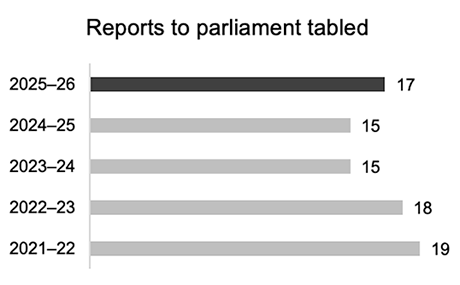
We tabled 17 reports to parliament on the results of our audits, our insights, key facts, and our recommendations – 2 more than in 2024–25.
Our reports included 49 recommendations to public sector entities about how they can improve their performance and service delivery.
Readership of our reports and resources shows us whether we are increasing exposure to our insights. It also helps us understand which audit topics are of most interest.
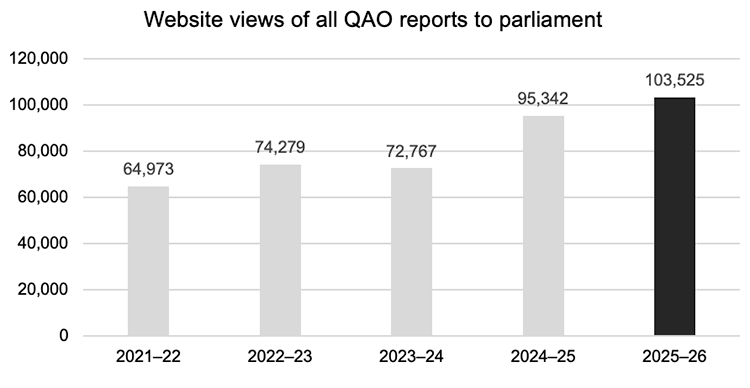
This year, our reports were viewed 103,525 times (compared to 95,342 times in 2024–25) on our website. The 3 highest-viewed reports tabled in this financial year were:
- Managing the ethical risks of artificial intelligence (Report 2: 2025–26)
- Major projects 2025 (Report 8: 2025–26)
- Health 2025 (Report 9: 2025–26).
Supporting outcomes from our reporting
Many of the learnings from our audits and in our reports to parliament are relevant to entities beyond those to which we make direct recommendations. We support the improvement of public sector entities by sharing our insights broadly. Wider learnings from each report are included in our audit committee briefing papers, event presentations, and thought leadership.
QAO-hosted events enable the connection of public sector finance professionals and leaders with each other, our staff, and our wider areas of focus. The events provide an avenue for sharing information, generating discussion, and building on our relationships. This year we covered topical matters ranging from the common challenges entities are facing, advice on information systems and cyber security, technical and accounting updates, and our upcoming work.
Our valued relationship and collaborative work on whole‑of‑government accounting and financial reporting matters with Queensland Treasury continued to help us promote our advice.
In March 2026, Queensland Treasury presented at our client technical update event for public sector finance officers. The presentation covered developments in accounting and financial reporting, and updates on emissions reporting.
The event attracted 577 attendees, up from 525 in 2024–25. In the post-event survey, one respondent said: ‘A great event as always, with an excellent leading speech from the Auditor-General [AG]. The event covered all of the important areas that matter for good public sector stewardship.’ – Client technical update survey, March 2026.
We also engaged closely with the chief finance officers of departments throughout the year, including through a tailored forum we hosted at QAO in March 2026.
We continued our active engagement with industry and professional forums and we invest in our staff attending and presenting at events. The Auditor-General presented at a range of industry conferences throughout the year to share the insights and recommendations from our work and discuss topical issues, including for the Interdepartmental Accounting Group, Local Government Finance Professionals, the Government Innovation Showcase, Australasian Council of Public Accounts Committee, and the Accounting and Finance Association of Australia and New Zealand.
Sharing insights with audit committees |
Audit committees support accountable officers, chief executives, and boards by providing oversight of and insights into financial reporting and internal controls. They also play a key role in monitoring entities’ progress in implementing our recommendations. Our attendance at audit committee meetings enabled us to share learnings and insights, and ensured committees had visibility of emerging risks. We continued to share learnings in our briefing papers for audit committees for all our audit clients, and at a range of QAO-hosted and external event presentations. Our engagement activities included 2 dedicated briefings to audit committee chairs in December 2025 and May 2026, attended by approximately 80 chairs each. We shared key learnings from our work, and updates on recent and upcoming reports to parliament. Discussions centred on risk management, particularly across areas such as cyber security, information systems, governance, and compliance. A surveyed attendee shared: ‘I very much appreciated the insightful presentations and found the online format worked well. Thank you for offering this option.’ Another shared feedback on our Status of Auditor-General’s recommendations interactive dashboard: ‘Just how much available information there exists on the QAO site for us - templates etc - unquestionably helpful. The online tool is a great initiative.’ We developed a new section on our website to curate reports and resources that are of particular value for audit committee members, providing one website location for faster access to information. |
Resources for our clients
QAO has developed significant resources to support the improvement of the public sector. The resources – including models, guides, and fact sheets – are available for free on our website. We encourage parliamentarians, public sector entities, and the public to access, discuss, and use the resources.
Our supporting resources, mapped against audit areas of focus in our forward work plan, provide practical ways for entities to action our recommendations, assess their approaches, and support their governance decisions. Collectively, our better practice guides were viewed 7,099 times – compared to 7,176 views in 2024–25.
We illustrate some of our audit results via interactive data dashboards to help users understand financial performance results for entities based on where they live, and share other interesting information such as demographic data.
QAO’s blog is a key thought leadership channel, where we share our informed perspectives and points of view, along with practical advice drawn from our audit work and the expertise of our people. It plays an important role in translating complex issues into accessible, timely content for our clients and stakeholders; explaining why our insights and guidance matters. In 2025–26, we published 19 blogs, attracting a total of 6,323 views, compared to 7,083 in 2024–25 across 21 blogs. On blog pages, we ask readers ‘Was this blog post valuable?’ – with 99 per cent of respondents indicating yes.
We also produce fact sheets that explain our role, services, processes, and specific topics in more depth. Total views of our fact sheets were 2,461, up from 1,233 last year. This year, we refreshed our fact sheet on financial reporting in uncertain times to support our clients in the wake of global events.
Our forward work plan
Each year, we publish a 3-year plan that describes our planned performance and financial audits, with an overview of each by parliamentary committee and audit focus area.
Our plan supports our delivery of insightful and timely reports to parliament and helps ensure we are auditing the right matters at the right time. It increases transparency around our work for parliament, our clients, and the public. It also helps our clients anticipate and prepare for our audits.
This year, we published our Forward work plan 2026–29 on 29 June 2026. Users can read about the individual topics across the 7 audit focus areas guiding our work:
- Services – delivering essential services for Queenslanders
- Communities – long-term planning and economic outcomes for thriving communities
- Infrastructure and transport – delivering and maintaining fit for purpose and cost-effective infrastructure and transport
- Environment and resources – managing our natural resources to support current and future generations
- Digital – safely leveraging data and technology
- Public service – ensuring the accountability, transparency, and sustainability of government
- Brisbane 2032 Olympic and Paralympic Games – effectively and efficiently preparing for the games and securing lasting benefits for Queensland.
A summary of the plan is available at Appendix B.
In developing the plan, we considered the range of strategic risks facing public sector entities and local governments. We have a robust methodology for prioritising potential topics based on their impact and importance, and the influence we can have over improvements to entity performance.
We prioritise the topics that can provide the greatest coverage and value to the Queensland Parliament and governments. We include a topic in the 3-year plan or on our list of alternate potential topics, because we have identified it as an area of significant risk or one where we can have a positive impact.
A key part of developing our plan is engaging proactively with clients and stakeholders throughout the process. We consulted with parliamentary committees, ministers, and the leaders of departments, local governments, statutory bodies, government owned corporations, hospital and health services, and universities. We seek their input or feedback on the key risks they see facing their public service delivery, our proposed topics, focus areas, and audit timing.
We report to parliament throughout the year on the results of the audits, our recommendations to entities on how they can improve performance, and on industry-wide insights.
Over the next 3 years, we will include new or updated audits that respond to emerging risks, and any changes to government priorities and strategies.
Monitoring the implementation of our recommendations
Each year, we monitor the progress entities are making on implementing our recommendations by asking them to self-assess their progress.
This enables us to gather key information for parliament, our clients, and the community on the public sector’s commitment to performance improvement. In particular, it is a useful departmental engagement tool for parliamentary committees.
Our report to parliament brings together entities’ self-reported status results, and highlights the most common types of recommendations we make and those that entities are finding more challenging to implement. This provides insights on enduring or common challenges across government that entities need to focus on or need support on. The insights we glean also help inform the follow-up audits and resultant reports to parliament we undertake each year as set out in our forward work plan.
We tabled our report 2025 status of Auditor-General’s recommendations (Report 3: 2025–26) in parliament on 8 October 2025, which included gathering information from 79 entities’ self-assessments of their progress in implementing 362 recommendations from 36 reports to parliament.
Our report includes an accompanying data dashboard that allows users to explore entities self‑assessments and search by entity, year, report name, parliamentary committee, and implementation status. It is also a useful tool for entities that have undergone machinery of government changes, as they can see the latest progress their entity has made.
This year, we conducted some deeper analysis of the timeliness of entities’ implementation of our recommendations to give parliament greater insights on the longer-standing recommendations that have not yet been fully implemented. This responded to some specific queries from parliamentary committees at our report briefings.
2025 status of Auditor-General’s recommendations (Report 3: 2025–26) | |
| We followed up entities we made recommendations to in 36 reports to parliament tabled between 2016–17 and 2023–24. | |
| 79 entities reported fully implementing 43 per cent of the total outstanding recommendations. | 31 of the 40 reports to parliament have outstanding recommendations. |
| Entities reported fully implementing 45 per cent of the 270 outstanding recommendations from the 2024–25 report. | 15 of the 79 entities reported fully implementing our recommendations. |
In our status of Auditor-General’s recommendations report for 2026, we intend to validate and provide further, deeper insights on entities’ progress on 2 of our reports to parliament.
Managing requests for audits
QAO welcomes information on public sector performance and requests for audits from members of the public, elected representatives, public sector and local government employees, and other integrity bodies.
We received 154 requests this year and finalised 156 requests. This is a significant increase to the number of new requests of 87 in 2024–25, and 79 the year before in 2023–24. The most common topics or themes for the requests related to procurement, project management, and conflicts of interest.
Requests for audits |
154 new requests for audits, including 3 requests from elected members. 12 requests were assessed as high priority, meaning the topic may have a significant impact, reflect a widespread issue across public sector service delivery, or relate to significant financial waste and mismanagement. |
Thirty-seven of the requests we received led to us conducting investigations. We finalised 29 investigations, and via 10 of these, made 22 recommendations directly to the related entities’ management on strengthening their internal controls. Two of this year’s requests related to audit topics on our prior Forward work plan 2025–28, and will result in a report to parliament. Currently underway is our audit on implementing the new child safety and youth justice case management system (Unify), and planned for 2027–28 is our audit on delivering victim support services.
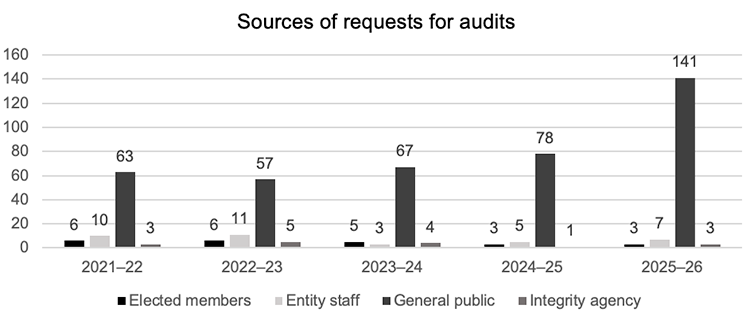
We improved the timeliness of our approvals of our preliminary assessments of the requests and of our detailed responses to referrers, and our internal collaboration and documentation to support responsiveness. The average duration for finalising requests was 14 weeks, compared to 16 weeks in 2024–25.
To be transparent, we publish requests from members of state parliament and local government councillors on our website: www.qao.qld.gov.au/audit-program/requests-audits.
Peer and industry collaboration
We value our professional relationships with peers and our exchange of information and insights.
Australasian Council of Auditors-General (ACAG)
The Auditor-General is a member of ACAG, alongside other offices in Australia, New Zealand, Papua New Guinea, and Fiji. ACAG’s objective is to strengthen public sector auditing in Australasia through leadership, collaboration, and advocacy. We work closely with it through committee meetings, discussion papers, and by contributing to standard-setting boards.
This year, the Auditor-General and members of the Executive Leadership Team attended and hosted various ACAG committees and meetings. The Auditor-General is the chair of ACAG’s Financial Reporting and Accounting Committee (FRAC), and QAO’s Assistant Auditor-General – Financial Audit is the chair of ACAG’s Heads of Financial Audit Committee. We also held industry-specific ACAG forums to discuss common issues from across Australia and the region.
Integrity bodies
We engage with other Queensland integrity bodies, as permissible under legislation, and have regular discussions on public sector risks. While we operate with independence, we value our relationships with other integrity bodies. Throughout the year, the Auditor-General meets with leadership of integrity bodies regarding our work.
A QAO representative worked alongside integrity agencies and the Department of Local Government, Water and Volunteers regarding local government related integrity matters.
We referred any suspicion of corrupt conduct matters to the Crime and Corruption Commission Queensland and provided it with audit information to assist with its investigations.
Professional bodies
We contribute to work programs or sit on project advisory boards for the Australian Accounting Standards Board and Auditing and Assurance Standards Board. We focus our liaison on public sector financial reporting-specific matters and applicability to help guide standard setting as well as our own application of the existing standards.
We are actively involved in the work of professional accounting bodies, Certified Practising Accountant (CPA) Australia and Chartered Accountants Australia and New Zealand.
Our audit staff obtain professional qualifications and attend or present at events hosted by these bodies. In 2025–26, this included the:
- CPA Australia International Women’s Day Breakfast panel on 11 March 2026
- CPA Congress on 14–16 October 2025, with a presentation by the Auditor-General.
Celebrating our connection with professional bodies |
David Hardidge, Technical Director, was appointed Queensland Divisional Council President for CPA Australia in November 2025. Damon Olive, Assistant Auditor-General, was recognised for his 30-year CPA membership. Darren Brown, Assistant Auditor-General, was admitted to the Australian Institute of Company Directors. Jackie Thornley, Director, is a Committee Member of the CPA Queensland Public Sector Committee. |
5. Our corporate governance
Leadership
Our structure promotes strategic and accountable oversight of our operations. The Executive Leadership Team (ELT) supports the Auditor-General in meeting QAO’s responsibilities under the Auditor-General Act 2009 and governs QAO’s strategic direction.
ELT membership and activities
The ELT is led by the Auditor-General and has shared responsibility for audit excellence, innovation, and operational performance. The Deputy Auditor-General and each of the Assistant Auditors-General are also members of the ELT.
The ELT determines QAO’s strategy and budget; leads us in achieving our objectives; and helps to optimise, monitor, and report on our performance and risks. The group meets twice per month, with QAO’s Chief Financial Officer also attending relevant sections of the meetings.
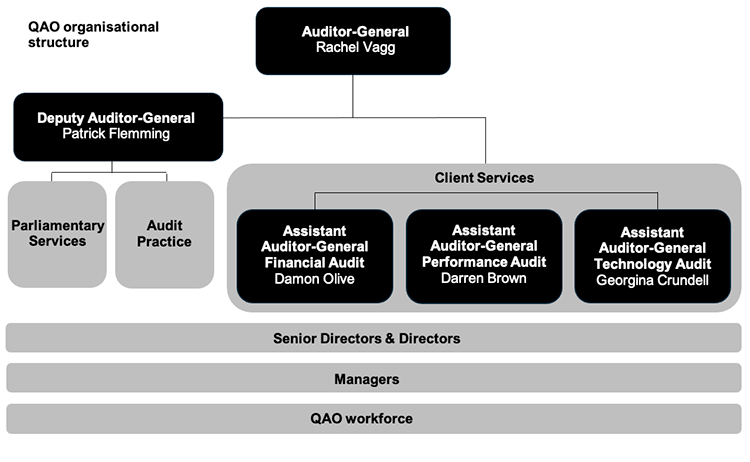
Rachel Vagg – Auditor-General
Rachel is Queensland's 24th Auditor-General and leads QAO as its chief executive and accountable officer. She brings broad and extensive experience as an Assistant Auditor-General and in other key leadership roles within QAO across our client services, technical advice, and treasury product areas. This is combined with private sector expertise in risk, governance, and compliance. The Auditor-General is an independent officer of Queensland’s parliament.
Patrick Flemming – Deputy Auditor-General and Chief Operating Officer
Patrick is an experienced audit and finance executive, having held leadership roles in QAO financial audit and a range of senior accounting and treasury positions with multinational organisations. He leads QAO’s parliamentary services and audit practice, overseeing strategic relationship management, parliamentary engagement, communications, governance and risk, people and culture, information technology, finance, audit quality and methodology, and requests for audit.
Damon Olive – Assistant Auditor-General, Financial Audit
Damon is an experienced public sector audit leader, having held key leadership roles in financial audit, quality assurance, industry engagement, and in developing audit software for QAO. As QAO's professional lead for financial audits, he is responsible for the delivery and quality of financial audit services and reports, client engagement, and oversight of QAO’s audit service providers.
Darren Brown – Assistant Auditor-General, Performance Audit
Darren has extensive experience in performance and assurance auditing, management, and investigations, with prior experience in the justice system. He leads QAO's performance audit program, overseeing service delivery, engagement quality, and reports to parliament, as well as QAO’s annual forward work plan.
Georgina Crundell – Assistant Auditor-General, Technology Audit
Georgina is a technology strategist and leader with more than 2 decades of experience in cyber security, emerging technologies, and risk management, including as a partner at a global assurance firm. She leads QAO’s core and rapidly advancing technology audit function and continues to share expertise with a range of organisations as a committee advisor.
Governance framework
Our governance arrangements promote effective and accountable management.
Our governance committees monitor our risks and actions, and endeavour to model best practice in oversight and compliance.
Audit and Risk Management Committee
The Audit and Risk Management Committee (ARMC) is an advisory committee to the Auditor-General. It is comprised of 3 independent members who bring expertise from other industry environments.
The ARMC provides oversight of QAO’s risk, control, and fiscal responsibilities underpinning our corporate governance. It met 4 times in 2025–26. Details of committee membership are included in Appendix C. Our charter details the committee’s responsibilities and appropriateness of the members’ skills, and includes that the committee must assess and report to the Auditor-General on its performance.
Sub-committees of the ELT
Sub-committees of the ELT monitor and make recommendations about QAO’s primary risks.
| Business activity | |
|---|---|
| Information and Cyber Governance Committee |
|
| QAO Initiatives Program Board |
|
| Workplace Health and Safety Committee |
|
| Audit quality and performance | |
|---|---|
| Quality Management Committee |
|
| Technical Issues and Major Transactions Committee |
|
| Modified opinions panel |
|
Update on the 2023 strategic review of our office
In 2023, a strategic review of QAO was conducted by an independent reviewer, appointed by the Governor in Council, with the final report tabled in parliament on 15 February 2024. This review provided insights into how well we are operating and fulfilling our mandate. The 2023 strategic review report and QAO’s response is available on our website.
Overall, the report concluded that:
- the preceding 5 years have been a tumultuous period, domestically and internationally, and that QAO has navigated these challenges and served the state well
- Queensland gets good value from its investment in QAO
- QAO performs its functions economically, effectively, and efficiently.
We report our implementation progress to QAO’s ELT and ARMC, and the parliamentary Governance, Energy and Finance Committee. We are also keeping our staff informed of our actions and updating our clients and stakeholders at events and meetings, as relevant.
Overview of QAO’s implementation of 2023 strategic review recommendations
| Recommendation type | In progress | Not started | Closed | Total |
|---|---|---|---|---|
| Made to QAO | 18 | - | 29 | 47 |
| Made to external parties | - | 8 | 1 | 9 |
| No further follow-up required | - | - | 2 | 2 |
| Subtotal | 18 | 8 | 32 | 58 |
External audit of QAO
QAO’s financial statements are independently audited. Our external auditors provide assurance that the information in our financial statements can be relied upon, and that the statements are free from material misstatement and comply with relevant legislation.
Internal audit
Internal audit conducts independent and risk-based assurance activities aimed at improving QAO’s operations.
Internal audit works in line with a strategic and annual audit plan, and its charter aligns with the Institute of Internal Auditors’ International Professional Practice Framework, including the Global Internal Audit Standards and other professional standards. The internal audit function also validates the actions we have taken to address strategic review recommendations before we close them.
QAO engaged Bellchambers Barrett to deliver its internal audit program.
The results and recommendations of the internal audits and QAO’s subsequent actions are monitored and followed up by the Head of Internal Audit and reported to the Auditor-General, ELT, and ARMC.
The internal audit assessments for QAO in 2025–26 covered our:
- data and records management
- audit quality, specifically our client engagement strategy
- risk management framework and approaches
- workplace health and safety approach
- Information Security Management System (ISMS) maturity, including the ‘Essential Eight’.
Legislative environment
Public Sector Ethics Act 1994
QAO is an integrity body and ethics are a deeply ingrained focus in all that we do. Our internal policies, procedures, and practices align with our ethical principles and values. Our auditors also apply the Code of Ethics for Professional Accountants, as issued by the Accounting Professional and Ethical Standards Board.
QAO also adheres to the whole-of-government public service Code of Conduct, established under the Public Sector Ethics Act 1994.
Human Rights Act 2019
Under the Human Rights Act 2019, we fully support the rights of people to be treated with dignity and respect. We reflect this in our values and throughout our internal communications.
We adhere to all requirements of the Human Rights Act 2019 and have received no complaints.
Recordkeeping
Following the introduction of the Public Records Act 2023, QAO continued preparing for new recordkeeping standards expected in 2026, including aligning our security incident and data breach processes with emerging requirements. We addressed recommendations from a 2024–25 internal audit and continued work to improve electronic recordkeeping maturity.
We maintain a controlled disposal program and transfer permanent records to Queensland State Archives. No records were damaged or lost in 2025–26. All employees complete mandatory recordkeeping training and acknowledge QAO's policy requirements.
Information privacy
Significant privacy reforms announced in 2024–25 came into effect from 1 July 2025.
We continued to act on the new requirements, which include the mandatory notification of data breach scheme. Our actions included aligning our security incident, event, and data breach management plan to the 5 incident response stages provided via the requirements, and setting key performance indicators to help us meet the new time frames.
We refreshed our data sharing agreements so we only source specific, personal information necessary for the respective audits. As part of this, we also reviewed our internal collection and access to QAO personal information.
Complaints
As an integrity agency, QAO takes complaints from our clients and stakeholders about us as an entity or our workforce seriously. We are committed to handling all complaints confidentially, fairly, ethically, and objectively. Complaints can be made directly to QAO via the contact information on our website. Further information is availed in our supporting fact sheet on our website.
In terms of complaints against other organisations, individuals have the right to make complaints to QAO under the Public Interest Disclosure Act 2010 (PID Act), where we are a proper authority to receive them. QAO is a proper authority under the PID Act to receive complaints about:
- the conduct of QAO staff and our contractors (complaints can be made by anyone external to or within QAO)
- the substantial misuse of public resources by a public sector entity (complaints can be made by a public officer).
Our key risks and responses
QAO’s integrated risk management approach encompasses our culture, processes, and structures for identifying, responding to, and controlling existing and emerging risks.
Our risk focus areas include our mandate, the quality of our audit services, security, people, finance, and technology.
Our risk management framework, updated annually, informs our strategic and business planning, and we apply it to our operations, projects, and business decisions. It provides a clear representation of our accountabilities and responsibilities for managing our strategic and operational risks.
Our risk policy covers how we identify our risks and actively manage them to acceptable levels.
Our risk register records our strategic and operational risks, along with causations, controls, risk ratings, and any additional treatments. It highlights any key dependencies, risks on our watchlist, and actions to bring risks within appetite. We regularly source information from leaders across the business to capture or review operational risks and confirm mitigating actions and controls.
We also assess our risk maturity using QAO’s risk management maturity model – available externally to all entities – focusing on the efficiency and effectiveness of our risk management internal controls.
We continue to monitor our operational risks in line with business, environmental, technical, and legislative changes. We made changes to QAO’s forthcoming strategic plan for the next financial year, including reflecting new operational risks that are also in our risk register.
An internal audit of risk management was performed in 2025–26. Overall, the internal audit found QAO’s risk management framework is designed and operating effectively and is aligned with better practice risk management principles. Minor areas for improvement included further enhancing the clarity, transparency, and usefulness of risk management documentation. To address these recommendations, QAO updated its risk documents and provided them to its ARMC and ELT. We report quarterly to the ARMC and ELT on our risks and responses.
Confidentiality and protecting information
Protecting confidential information remains a core responsibility for QAO and we are committed to continually improving our governance arrangements and practices to maintain the integrity, confidentiality, and security of information entrusted to us. We regularly review and strengthen our internal policies, procedures, and controls to support the secure management of sensitive information.
Section 53 of the Auditor-General Act 2009 imposes significant penalties for the inappropriate disclosure of protected information and applies to both QAO employees and our audit service providers (ASPs).
Due to previous external concerns relating to the unauthorised disclosure of confidential information within the consulting sector, we strengthened our contractual requirements for all our ASPs. This included implementing an initial acknowledgement of their legislative and contractual obligations for confidentiality, as well as an annual confirmation.
We are actively managing the contractual arrangements for an external firm undergoing investigation regarding its inappropriate sharing of their client’s information. QAO has obtained written assurance from the firm that the incident does not relate to QAO clients or operations, and the firm has confirmed its compliance with our obligations for protecting confidential information on the audits its conducts on our behalf.
The independence and integrity of ASPs and their personnel are key considerations in our selection processes. We review their independence before contracting them to undertake audits on our behalf and review their independence yearly.
We do not engage ASPs to undertake financial audits of Queensland government departments, integrity agencies, or performance audits. We also do not allow our ASPs to provide non-assurance services to their QAO clients without prior written approval from the Auditor-General.
We ensure our staff and ASPs are aware of our requirements and their responsibilities per the Code of Conduct and on our mandate. QAO staff undertake further annual training on ethical decision making.
Audit quality
Maintaining audit quality is a priority for QAO. We aim to perform our audits consistently to a high standard to meet the expectations of our clients and regulatory requirements.
We have well-established controls, processes, and governance in place for all our audits, including those delivered by ASPs, to ensure we meet audit responsibilities and emerging risks by:
- focusing on key public sector-specific risks
- identifying changes in entities’ control environments and methods for preparing financial statements, including the use of artificial intelligence. We are specifically identifying its use and the extent of human review
- using risk-based audit methodologies that meet the requirements issued by the Australian Auditing and Assurance Standards Board. This year, we also implemented our methodology for sustainability assurance audits
- using engagement quality officers on high-risk financial and performance audits, to provide an objective evaluation of the significant judgements made by the engagement team
- deploying an annual quality assurance program that targets higher-risk audit jobs, including for new sustainability assurance engagements. This year, we reviewed areas of significant judgement to ensure our conclusions were supported by audit evidence
- developing our refreshed competency framework that helps guide our recruitment and performance management, along with targeted training programs for all staff
- reviewing our ASP’s performance and their systems of quality management
- implementing more effective resource allocation, ensuring we align our people’s competencies and experience with our clients’ needs.
The Auditor-General Auditing Standards describe how we perform our audits and underpin our quality focus. The standards outline our public sector-specific auditing objectives and adopt the auditing standards issued by the Auditing and Assurance Standards Board.
Each year, as at 30 June, we undertake an evaluation of our system of quality management, as required by the Australian auditing standards. We include the results in our yearly transparency report. This report:
- highlights whether our system of quality management is effective
- explains our quality program and results
- outlines how we seek to improve our audit practices
- describes our systems of quality management.
We published our Transparency report 2024–25 on our website on 25 September 2025: www.qao.qld.gov.au/reports-resources/reports-parliament/transparency-report-2024-25.
Complaints management
QAO takes all complaints seriously and manages them in line with our policies and best practice from the Queensland Ombudsman.
We actively monitor our client relationships and prepare action plans to ensure that we address any issues.
This year, QAO received 5 complaints, compared to 4 in 2024–25, with 4 finalised and one in progress. These complaints related to our audit processes and recruitment processes.
Cyber and information security
Cyber security is a risk for all organisations globally, and at QAO we continued to address any emerging risks and threats. Our controls help us monitor and act on risks before they become an issue and will support our response and recovery from an incident.
This year, we continued to strengthen our security posture by improving our controls, staff awareness and governance. We maintain a comprehensive framework of policies and procedures to protect the confidentiality, integrity, and availability of our information. We applied our risk-based approach to new technologies, including artificial intelligence, ensuring we have appropriate controls in place before commencing use.
We also enhanced our information security management system in line with ISO 27001 and progressed our implementation of the ‘Essential Eight’. We achieved our target maturity level in 6 of the 8 strategies, with the remaining 2 at our achievable level due to our risk-based approach to these strategies.
Our expanded training program for staff and ASPs reinforces their responsibilities under the Auditor‑General Act 2009. This includes clear expectations around handling protected information, maintaining proper records, and promptly reporting any breaches or concerns.
Our AI Journey |
We adopted artificial intelligence (AI) tool Copilot Chat to enhance our work within a secure environment, and within the parameters of our legislative obligations. We commenced our AI journey by analysing our business needs and updating our policy which governs our approach. All staff undertook mandatory training before we delivered the tool, and users can access resources and ongoing training on how to leverage the benefits the tool can bring to our business. Some examples of how our people are using AI include analysing publicly available information, summarising content, writing more clearly, and designing graphics and visuals. We are not using these tools on protected information or personal information per related legislation and QAO policies. We continue to update our AI strategy to identify and capture opportunities for innovative and appropriate AI use across QAO, to inform our solutions-oriented framework for the future. |
Workforce capacity and capability
Professional auditors are in demand for their highly sought after skills and experience. The skills required from auditors are also changing, with organisations competing for employees with new proficiencies.
Our strategic plan articulates that we will invest in our people and culture to maintain a workforce that meets our needs. To address these risks, we:
- continued strategic workforce planning to understand our current and future needs and develop our talent pipeline
- positioned our organisation as an employer of choice, including by formalising our employee value proposition with the themes of leadership, meaningful work, workplace culture, professional growth, and wellbeing as its mainstays
- expanded our learning and development programs to address emerging risks, technologies, and stakeholder expectations – exceeding mandatory training requirements for professional qualifications
- collaborated with our peers and wider industry on specialist matters, such as sustainability assurance
- managed peak audit periods by prioritising forward planning and resourcing support to help reduce pressure on our teams.
Our talent capability and capacity |
We have focused on maintaining an appropriate talent capability mix with a balance of core audit professionals, technical specialists, and subject matter experts, supported by strong foundational roles. Since 2022, we have successfully maintained a stable financial audit workforce, which is the largest part of our business representing 60 per cent of our full-time equivalent positions. Experienced managers can be the most difficult to attract from the external market. Our long‑term strategy to strengthen the sustainability of our workforce has included increasing our graduate intake numbers and developing our own future managers. Growing our staff from entry level supports a strong internal pipeline and reduces reliance on external recruitment. It helps preserve organisational knowledge, as employees who progress within our organisation build deep knowledge of our unique role, and support the continuity of client service delivery. Investing in our staff allows us to deliberately shape the technical and professional capabilities we need in our leaders, and supports better retention through clear career pathways. During this time, we successfully recruited additional, skilled resources in information systems audit to meet the Australian Auditing and Assurance Standards Board (AUASB) requirements for high‑quality IS audits. This also supports our response to the growing cyber and information technology (IT) risks our clients are facing. In response to recommendations in the 2023 Strategic Review of the Queensland Audit Office, we have strengthened capacity, and built specialist capability, within our performance audit team. We also recognised the need for increased performance audit services as Brisbane prepares to host the 2032 Olympic and Paralympic Games. Additionally, our investment in our audit quality teams is helping us prepare for the increasing requirements related to sustainability reporting, and replacement staff in our IT team is strengthening QAO’s information and cyber security posture. |
6. Our people
Our workforce
We recognise that our people are our greatest asset and we value their diverse perspectives and experiences.
We aim to reflect the community we serve to strengthen our delivery of innovative and effective services and solutions.
| Highlights | |
| Maintained a similar score for employee engagement in the 2025 Working for Queensland survey: | 65 per cent in 2025–26 compared to 68 per cent in 2024–25 |
| Delivered focused and contemporary training our people, outside of on-the-job training: | 66 hours per auditor compared to 71 hours per auditor in 2024–25 |
| Supported our people’s achievement of their professional audit qualifications: | 9 staff received CPA or CA qualifications in 2025–26 compared to 6 staff in 2024–25 |
| Acted on workforce capacity risks: | 10 graduates hired compared to 8 in 2024–25 11 per cent separation rate compared to 13 per cent in 2024–25 |
Diversity and inclusion
Under our Diversity, equity and inclusion action plan 2024–26, we are committed to creating and sustaining a culture of respect and belonging.
Our leadership remains steadfast in its commitment to improving representation and fostering a culture of inclusion. This enables us to harness the benefits of a diverse workforce, ensuring we are well-positioned to meet the evolving needs of our organisation and the broader community.
| Who we are | |
| 218 full-time equivalent employees | 90 per cent of our financial audit staff have professional qualifications or are studying towards one, with the remaining including graduates and undergraduates preparing to start their studies |
| The average age of our multi-generational workforce is 39 years | 33 per cent of our employees were born overseas, and 27 per cent speak a language other than English at home |
| 51 per cent of our staff are women | 0.4 per cent of our staff identify as non-binary |
| 4 per cent of our people identify as having a disability | 41 per cent of our leadership positions are held by women |
To measure our performance in equity and diversity, QAO uses a combination of internal workforce targets, Queensland public sector diversity targets, and external benchmarking sources.
We comply with the Public Sector Act 2022, which establishes obligations for chief executives to actively promote equity, diversity, respect, and inclusion within their entities. This year, QAO conducted an equity and diversity audit for a more complete view of our workforce composition, trends, and progress towards QAO’s diversity, equity, and inclusion goals.
Over 33 per cent of our employees were born overseas, with 20 per cent from non-English speaking countries, and 27 per cent speak a language other than English at home, exceeding the public sector CALD benchmark of 12 per cent.
We currently have no employees who identify as Aboriginal and Torres Strait Islander, falling short of the Queensland Government target of 4 per cent. QAO is committed to providing client services in a way that shows cultural awareness, inclusivity, and respect towards First Nations people. In 2025, we established our First Nations awareness project to establish the behaviours and workplace practices in support of this commitment and delivered training for all our staff on First Nations cultural awareness and education.
Some of our employees, 4 per cent, disclosed living with disability in our human resources employee management system, and 12 per cent indicated they live with a disability in the 2025 Working for Queensland survey. The Queensland Government target is 12 per cent.
| In the 2025 Working for Queensland survey, 53 per cent of neurodiverse employees said they feel included and 40 per cent responded neutrally. This year, QAO launched its first neurodiversity strategy, which outlines guiding principles to strengthen inclusion for neurodiverse employees. In phase 1 of the strategy’s delivery, we established a resource group, including members with lived experience. We commenced preparation of our first QAO neurodiversity guide, offering practical advice for neurodivergent employees, their colleagues, and managers, and provided awareness training for all staff. |
Our workforce gender balance is 51 per cent women, compared to 53 per cent in 2024–25. Female representation at both our director level and in overall leadership roles increased from 40 per cent to 41 per cent. We continue to work on improving gender parity in our Senior Director roles, for which female representation is 27 per cent. Forty per cent of our Executive Leadership Team are women.
This year, QAO established its Women in Leadership Employee Resource Group, as part of its strategy for creating an inclusive and supportive workplace for all women, leaders, and emerging leaders.
QAO’s gender pay gap of 6 per cent is outside of the Australian Government’s Workforce Gender Equality Agency’s range of -5 per cent to +5 per cent. We continue to work towards equitable remuneration.
‘Working for Queensland’s first female Auditor-General in an organisation that champions equal opportunities for women makes me proud to be a part of QAO.’ – Shannyn Baty, Assistant Manager, March 2026.
Employee value proposition
This year, QAO formalised its employee value proposition (EVP) to capture the compelling set of benefits, experiences, and values our organisation offers employees. The EVP is structured around pillars that reflect the values, expectations, and aspirations of current and prospective employees. The pillars of the EVP include:
- leadership – our strong, strategic, and visible leadership, which models our values, supports our peoples’ wellbeing, and drives performance
- meaningful work – our shared understanding of why our organisation exists and why our people’s work matters
- workplace culture – our determination to create an inclusive, respectful, and collaborative culture anchored by our values
- professional growth – our commitment to providing learning opportunities, career progression, and recognising success
- work–life balance – our efforts to support the diverse needs of our workforce, and harness flexibility to promote productivity and wellbeing.
Leadership and meaningful work for our people
Our organisation prioritises values-based leadership, clear communication, and teamwork.
This pillar of our EVP supports a workplace where employees feel empowered to contribute to our vison and mission. It reinforces our unique value as an employer where we offer work that is intellectually engaging, socially impactful, and aligned with a broader public purpose.
We introduced new leadership coaching to help build confident, capable, and people-focused leaders, and enhance team engagement and performance. Individual and group coaching equips our managers and leaders to better manage workloads, support their team’s development, model our values, and deliver outcomes from their work.
At the core of QAO’s purpose is our contribution to public accountability, transparency, and the responsible use of public resources. Employees derive a strong sense of professional pride from the knowledge that their work can support community outcomes.
Three staff seminar events and regular leadership updates reinforced our organisational priorities and helped employees understand how their work contributes to our organisation’s broader objectives.
| In our April 2026 staff pulse survey, 80 per cent of our people strongly agreed our leaders communicate a clear direction with clear priorities. Ninety per cent agreed or strongly agreed they understand their work contributes to strengthening public sector accountability. And 83 per cent agree or strongly agree the work they do is meaningful. |
Workplace culture
By cultivating a positive culture, we ensure our people – both employees and contracted ASPs – are equipped to deliver high-quality outcomes for parliament and our clients.
Our culture is underpinned by our 4 core values, which inform how we work with our clients and each other.
Our shared objectives, behaviours, and practices help our employees feel respected, empowered, and motivated to do their best work.
In line with this pillar of the EVP, a whole-of-office team building event in June and our 3 seminars fostered stronger collaboration and cross-team communication.
In our April 2026 staff pulse survey, 74 per cent of our people agreed or strongly agreed that our organisation has a positive culture, and 73 per cent agreed or strongly agreed that they would recommend our organisation as a great place to work.
Celebrating our staff |
Each year, our QAO Award recognises employees who bring our values to life by going above and beyond in the pursuit of excellence at QAO, and in supporting better public services for Queensland. In 2025, the QAO Award was presented to Audit Manager, Nicholas Dow. Nick was recognised for his leadership, professionalism, and strong support of his teams. He consistently provides guidance and shares knowledge with a calm, positive demeanour, creating an environment where team members feel supported to grow and succeed. Nick maintains integrity in decision-making, encourages collaboration, and strives towards high‑quality outcomes for his clients. His dedication to fostering a positive and accountable culture made him a deserving recipient of this year’s award. |
Professional growth
Continuous learning is central to our performance, to modernising our audit approaches, and to ensuring we can deliver valued services.
This pillar of our EVP means we enable our employees to build deeper professional knowledge, access targeted development opportunities, and strengthen capability in responding to emerging public-sector risks, trends, and stakeholder needs.
This year, we provided 66 training and development hours per auditor.
We developed refreshed competency frameworks to provide greater clarity, consistency, and support for career development across QAO. Our technical frameworks for financial audit, performance audit, and technology audit are tailored to the specific requirements of an audit role, and our core competency framework applies to all employees. Together, these frameworks establish clear expectations for performance and professional growth at each career stage and strengthen alignment between individual capability, organisational priorities, and future workforce needs.
Our ASPs are a key part of our workforce, so it is important we offer them the same learning opportunities and share expertise. This year we offered our ASPs tailored training on asset valuation and local government audits, and a range of auditing and accounting matters via our annual workshops.
We ask ASPs for feedback on these sessions. One shared: ‘Additional training in recent years in relation to Local Government and specific issues has been greatly appreciated and beneficial.’
Professional qualifications
Professional audit qualifications are a requirement for our financial audit staff as they progress their careers. Ninety per cent currently hold these qualifications or are studying towards one, and our graduates and undergraduates are preparing to commence theirs in their second year with QAO.
Professional qualifications and other credentials are important across our organisation. For example, our information systems staff seek specialised qualifications such as Certified Information Systems Auditor (CISA) or Certified Information Security Manager (CISM), and our performance audit staff hold a range of qualifications, reflecting diverse backgrounds and expertise.
QAO funds our employees to obtain their CPA or CA designations, and this year 9 achieved these qualifications. QAO also funds related staff to obtain their Certified Information Systems Auditor and Certified Information Systems Security Professional designations. We reimburse the cost of professional memberships, including CPA Australia memberships for audit staff and Chartered Accountants Australia and New Zealand.
We again supported our people to attend key industry conferences, such as those hosted by CPA Australia, Chartered Accountants Australia and New Zealand, and the Committee for Economic Development of Australia. These opportunities help our staff to maintain a contemporary view of the sectors and environments our clients operate in.
International experiences for our people
Our relationships with audit offices in other jurisdictions support the transfer of expertise, and strengthen our global perspectives on audit challenges, methods, and opportunities. The opportunity further reinforces our commitment to professional career growth for our people by broadening their practical experience.
This year, our people participated in international secondments. In September 2025, 3 staff went to The Audit Office in New Zealand for a 6-week secondment, and in April 2026, 2 staff travelled to the Office of the Auditor-General of British Columbia (OABC) for 6 weeks.
As a reciprocal arrangement, we were delighted to welcome 2 people to the QAO team from OABC, and 4 from The Audit Office in New Zealand for 6 weeks.
| ‘My time in British Columbia was a unique and highly rewarding experience that strengthened my skills, exposed me to different audit methodologies and allowed me to build meaningful relationships with auditors across the Pacific.’ – Sam Kelly, Assistant Manager, QAO. |
| ‘The international secondment I had at QAO was invaluable. Spending 6 weeks working at a public sector audit institution within Australia was a great opportunity to broaden my knowledge and continue to foster the strong relationship between The Audit Office in New Zealand and QAO. Some of the benefits of working at the QAO for this short time was seeing their extensive use of Power BI and how they have worked with audited entities to achieve very tight audit timeframes’. – Sabel Wiliam, Audit Senior, The Audit Office (New Zealand). |
Our graduate program
Our graduate program remains a key source of talent for our future workforce, as we offered placements to 10 graduates and 3 undergraduates from across Australia to our team. We received 286 graduate and 100 undergraduate applicants for our program.
To broaden the talent pool this year we included candidates with working rights visas, enabling us to attract a more diverse range of emerging professionals and respond to a competitive labour market. We increased our graduate intake within information systems audit, recognising a key capability we need to support the evolving technology and digital risk environments across the public sector.
| ‘My favourite thing about my role is getting to see how a variety of different clients manage their IS environments. IT is a huge and constantly evolving area with many challenges, so seeing where they prioritise their efforts and why is very interesting’. – Jacob Sutton, Graduate Auditor. |
| ‘It’s a truly fulfilling job. The work you do has genuine impacts that help to make a difference by improving valuable services for the public.’ – Sarah Natera, Graduate Auditor. |
Visibility of our graduate program and recognition of QAO as a preferred employer is key to attracting the right candidates. We built on past success and promoted our program with engaging content across digital channels and graduate recruitment platforms. We increased sponsorship and connections with local university groups.
Key features of our graduate program include comprehensive on-the-job coaching, a dedicated buddy system to support integration and wellbeing, tailored learning pathways, and monthly graduate forums that encourage peer connection. Graduates are also exposed to a range of audit work areas.
Consistent with leading graduate programs across the public and private sectors, QAO’s program emphasises practical learning, continuous feedback, and career advancement. We appoint our graduates to permanent roles – giving them stability and long-term capability building.
Work-life balance
Recognising the importance of our people’s wellbeing, we support work-life balance through flexible work arrangements.
Reflecting this pillar of our EVP, we allow hybrid work principles where our people work from client sites, our head office, and home where appropriate. This approach acknowledges the diverse needs of our workforce, supports focused work, and reflects our commitment to being a responsive employer.
The auditing profession operates within strict legislative deadlines for delivering audit services, which can result in periods of increased workload and additional hours for staff at certain times of the year. To support employee wellbeing, we actively monitor leave balances and accrued time, and we encourage all staff to take appropriate breaks. Throughout this financial year, all employees successfully used their accrued time, reflecting our efforts to maintain a sustainable and balanced work environment.
While flexibility is embedded in how we work, we recognise the importance of in-person engagement with our clients, maintaining connection across dispersed teams. By fostering knowledge-sharing and a strong sense of belonging, we ensure our people remain engaged.
For each work area across QAO, our Workplace Health and Safety (WHS) Committee introduced wellbeing contact officers to share important WHS information directly with their teams.
Feedback from our employees
It is important we track how engaged our people feel, how they view our leadership group, and how satisfied they are with their jobs.
Every year, we participate in the annual Queensland Government Working for Queensland (WfQ) survey.
Whilst we are not a government entity, we compare our results to benchmarked data of smaller public sector offices (less than 500 staff).
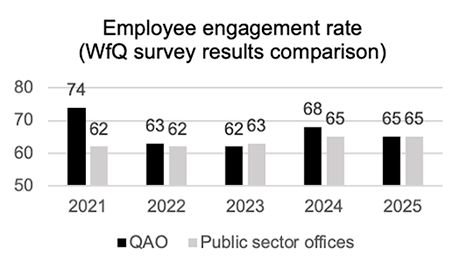
| Areas where we are performing well |
| 89 per cent of staff agree they have the flexibility they need to manage work and life demands, similar to 90 per cent in 2024–25. |
| 89 per cent of our people understand the value QAO delivers to clients and external stakeholders and 87 per cent understand how their work contributes to QAO’s objectives, slightly down from 94 per cent, and in line with 88 per cent in 2024–25 respectively. |
| 87 per cent of staff agree their job gives them the opportunity to utilise their skills and knowledge, in line with 85 per cent 2024–25. |
| 82 per cent of our people feel respected at work, compared to 79 per cent who felt included in 2024–25. |
| Areas where we need to improve |
| 27 per cent of our people reported experiencing the need to work long hours, increasing from 24 per cent in 2024–25. |
| 19 per cent of our people reported being overloaded with work always or often, similar to 18 per cent in 2024–25. |
| 35 per cent of our people discuss ways to promote wellbeing within their team, improving from 31 per cent in 2024-25. |
We will continue to build and implement activities to address areas for improvement and share progress with our people and governance committees. Targeted actions are underway to strengthen manager support, fill resourcing gaps, and address workload allocation within our communities.
Feedback from our audit service providers
Our contracted ASPs are an important part of our delivery, and the way we work with them helps ensure we are delivering more consistent client services.
For the past 6 years, we have captured ASP feedback via a survey conducted by an independent researcher.
This year, ASPs gave us an overall satisfaction score of 79 index points, remaining the same as 2024–25. We asked them how well they understand our expectations, if we provide useful and timely performance feedback, whether we work collaboratively to present a united audit team, and about the conduct of our auditors.
We received positive results regarding our provision of information and guidance, and for our professionalism, communication, collaboration, and adding value to their work. They also appreciated and are interested in our sector-specific training. Our areas for improvement relate to our templates and some audit processes. Overall, ASPs reported largely positive experiences working with QAO.
| Feedback from our ASPs |
| ‘It is a privilege to work with the QAO and I enjoy working with the QAO directors and managers that I've worked with in the past and at present. They are always willing to collaborate and improve the work that we do to service the clients better.’ |
| ‘I’m grateful to be working with awesome people at QAO. I appreciate the feedback from the ASP manager and signing director. In my experience, all of them are genuinely collaborative and easy to work with. That is why I wanted to specialise in doing public sector work; mainly because of the people I work with at QAO, and also the clients.’ |
| ‘The relationship between our firm and QAO is strong and I appreciate and value the collaboration we have.’ |
| ‘Generally, I have very positive praise for the QAO team I have worked with recently. They have all been very pleasant to work with and always very helpful when needed, or if unsure of something, they have queried internally and come back with a timely response.’ |
7. Overview of our financial position
QAO remained financially sustainable in 2025–26, generating sufficient income to meet operating costs while continuing to invest in capability, systems, and future service delivery. Our financial performance reflects a productive workforce, effective management of resources, and cost recovery.
The majority of our revenue is generated through fees charged for financial audit services; provided on a full cost-recovery basis. These fees represented 86 per cent of QAO's total revenue. Revenue from audit fees totalled $52.8 million, exceeding the budget of $49.8 million by $3 million.
Our audit fees are directly linked to the scope and complexity of our work. While we continue to deliver audits efficiently and in accordance with standards, fee revenue can increase when clients undertake significant transactions, implement major reforms, experience growth, or when additional entities become subject to audit.
In addition to audit fee revenue, QAO received parliamentary appropriation funding of $8.3 million under the Appropriation Act 2024. This supports the functions we undertake on behalf of parliament, including reporting and advice to parliament, performance audits and assurance activities, development of our forward work plan, assessment of requests for audits, and remuneration of the Auditor-General.
Total expenses from continuing operations were $60.3 million – $2.3 million above the budget of $58 million. Employee expenses remained our largest cost, at $34.1 million.
QAO achieved a positive operating result through efficient and effective financial management and audit program delivery. Improved planning and scheduling of audit work, particularly for large and resource intensive engagements, enabled us to increase workforce utilisation and reduce reliance on external contractors outside peak audit periods.
We continued to invest in our future capability and capacity. We expanded our performance audit team to increase the number of performance audit reports we can deliver and strengthen expertise. This will support QAO to meet its legislative mandate and respond to increasing expectations from parliament, including additional scrutiny associated with the Brisbane 2032 Olympic and Paralympic Games.
QAO's employees are supported by audit service providers to deliver the audit program. Expenditure on these services was approximately $17 million. We maintain a balanced delivery model that combines internal capability with external support to ensure we meet client needs while appropriately managing audit quality and risk. Appendix D provides details of providers paid during 2025–26.
Other operating expenses primarily related to accommodation and office services, information technology and systems, minor office equipment, and employee learning and development programs. During the year, QAO also continued planning and investing in essential system upgrades to support future service delivery and organisational sustainability.
The Governance, Energy and Finance Committee approved an increase to QAO's basic rates of fees and charges, effective from 1 October 2026. The approved increase, which is below the consumer price index, was incorporated into QAO's 2026–27 budget and will help support the long-term financial sustainability of the office.
QAO's financial statements and the independent auditor's report are presented from page 41 of this annual report.