
Overview
Legal aid refers to publicly funded legal services that support people experiencing financial disadvantage, ensuring they can access legal assistance. This includes grants of aid for legal representation. Without this support, individuals may struggle to navigate complex legal matters. This can lead to unfair outcomes and unnecessary delays. Legal Aid Queensland is the largest of many publicly funded legal services in Queensland.
Tabled 30 June 2026.


Report summary
This report examines whether Legal Aid Queensland is effectively enabling access to legal representation for people in need.

| What is important to know about this audit? |
Legal Aid Queensland is the state’s largest provider of publicly funded legal services. It aims to make legal services available to financially disadvantaged people who might otherwise be unable to access that support and promote confidence in the justice system.
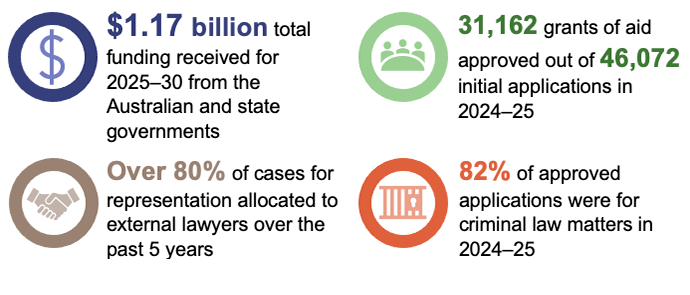
To access legal representation services, people must meet Legal Aid Queensland’s eligibility criteria, which encompasses a means test, an assessment of the legal merit of the case, and whether it is a priority matter. Figure 1 shows key statistics for Legal Aid Queensland.
Queensland Audit Office using data from Legal Aid Queensland and publicly available sources.

| What did we find? |
Legal Aid Queensland is providing access to representation services for those who meet its eligibility criteria, but needs to improve the quality and timeliness of its assessment decisions
Legal Aid Queensland is effectively enabling access to representation services for people who meet its eligibility criteria. The criteria applied is similar to models used in other jurisdictions nationally and in other Commonwealth countries, and provides Legal Aid Queensland with a structured framework for allocating grants of aid. Despite managing current application volumes for legal representation services, it can improve the quality and timeliness of its assessment decisions. It is not processing applications within target time frames, and an increasing number of decisions to reject applications are being overturned, largely through Legal Aid Queensland’s internal review processes.
Demand for legal aid services is forecast to grow. Increasing cost and delivery pressures could impact Legal Aid Queensland’s ability to provide effective access into the future
Legal Aid Queensland is forecasting an increase in demand for its services and associated costs in forward periods. It is also facing growing challenges in engaging private sector law firms to undertake representation work on its behalf to meet demand. While it has implemented temporary measures to address immediate pressures, Legal Aid Queensland needs to consider alternative longer-term solutions to address future challenges.
Legal Aid Queensland plans to consider these through a business transformation project that it started in December 2025. If successful, this will allow it to better inform government of the risks and options available to meet future demand and its ability to effectively deliver services into the future.
Means test thresholds have not kept pace with economic development
The eligibility means test thresholds the Legal Aid Queensland uses to assess financial disadvantage, have not kept pace with broader economic developments. As a result, there may be an increasing cohort of people who do not meet Legal Aid Queensland eligibility criteria and who are unable to afford representation.
Income thresholds have not been updated since 2018 and home equity thresholds remain at the level set by Legal Aid Queensland in 1997. Since this time, minimum wages, poverty indexes, house prices, and other measures of economic growth have all increased.

| What do entities need to do? |
We recommend that Legal Aid Queensland:
analyses options and risks to meet expected growth in demand and future access to representation services
reviews its quality and timeliness targets and processes, and addresses performance challenges.
1. Audit conclusions
Legal Aid Queensland is effectively enabling access to legal representation for people in need, based on its eligibility criteria and definition of financial disadvantage. While this meets legislative requirements, the proportion of people in need who meet this definition is likely to reduce.
It is managing current application volumes for legal representation, but Legal Aid Queensland needs to analyse long-term solutions to reduce service delivery pressure and meet projected future demand growth. This will support it in continuing to meet its legislative requirements and intent, and in providing services for financially disadvantaged people.
2. Recommendations
We have directed the recommendations in the report to Legal Aid Queensland.
| Working more effectively within available resources | Entity responses |
| Agree |
| Supporting future access to legal representation services | Entity responses |
| Agree |
Reference to comments
In accordance with s. 64 of the Auditor-General Act 2009, we provided a copy of this report to the relevant entity. In reaching our conclusions, we considered their views and represented them to the extent we deemed relevant and warranted. Any formal responses from the entity are at Appendix A.
3. Legal aid in Queensland
What is legal aid?
Legal aid, also referred to as legal assistance, refers to publicly funded legal services that help people experiencing financial disadvantage access legal representation and justice. Legal aid is available to a range of people, including victims, people involved in family law proceedings, and people accused of breaking the law. In Australia, legal aid is provided by legal aid commissions, such as Legal Aid Queensland.
Why legal aid matters
Legal aid exists to support fair access to justice for people who cannot afford professional legal help. Without proper support, people may need to represent themselves and may struggle to navigate complex laws. This can lead to unfair case outcomes and have negative consequences on people’s lives.
Legal aid also helps courts and the legal system run efficiently. This is achieved through reducing the number of people who self-represent, which supports better preparation for court matters, minimises unnecessary delays, and can bring matters to resolution faster. This also reduces the potential for poor outcomes, which can contribute to court delays.
Legal aid Queensland is the largest of many publicly funded legal services in Queensland
The Department of Justice is the administrator of state and federal funding for publicly funded legal services in Queensland. It coordinates how services should work together to achieve them, and provides funding to service providers, including Legal Aid Queensland. Service providers have distinct but complementary roles in delivering legal services.
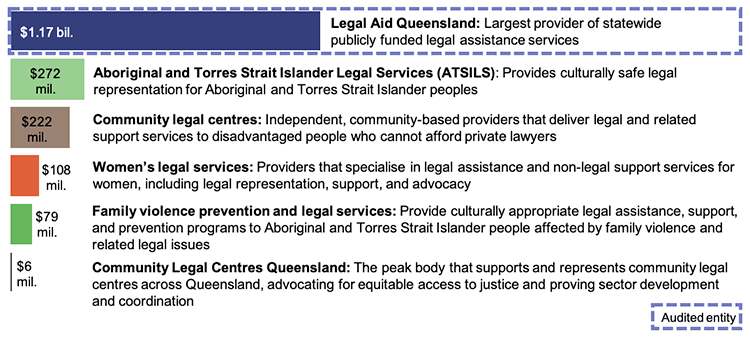
Figure 3A summarises the role of key entities in Queensland’s publicly funded legal sector. It shows the total amount of Queensland and Australian Government funding allocated to service providers for the period 1 July 2025 to 30 June 2030. Appendix C provides a further breakdown of funding allocations.
Queensland Audit Office using publicly available information.
National Access to Justice Partnership agreement
Australian Government funding for legal assistance services is tied to the National Access to Justice Partnership 2025–30 agreement between the Australian Government and all states and territories. A key purpose of the agreement is to provide access to legal services for people experiencing:
- financial disadvantage, who are unable to afford private legal services
- vulnerability, who are more likely to experience legal problems, less likely to seek assistance, or less able to access services for a range of reasons. These cohorts of people, referred to as national priority client groups, are listed in Appendix D.
About Legal Aid Queensland
Legal Aid Queensland is a statutory authority operating under the Legal Aid Queensland Act 1997 (the Act). The Act has 2 objectives, which are to:
- provide legal assistance to financially disadvantaged persons in the most effective, efficient, and economical way
- pursue innovative commercial arrangements, including legal assistance arrangements, to deliver legal assistance at a reasonable cost to the community and on an equitable basis throughout the state.
Legal Aid Queensland’s funding and services
Both the Queensland and Australian governments fund legal services provided by Legal Aid Queensland. Legal Aid Queensland’s legal services are defined in the Act and also through an agreement with the Department of Justice, which incorporates the Australian Government requirements.
It receives a set amount of funding over 5 years to deliver services, with the Queensland Government providing 69 per cent of its $1.17 billion of funding for the period 1 July 2025 to 30 June 2030. Legal Aid Queensland also receives time-limited funding to deliver additional programs required by the Queensland or Australian governments to address specific priority areas, clients, or services. Examples of these include domestic and family violence, child protection, and youth justice. Australian Government funding must be prioritised for the delivery of frontline legal assistance services to meet the legal needs of individuals, with a specific focus on priority clients.
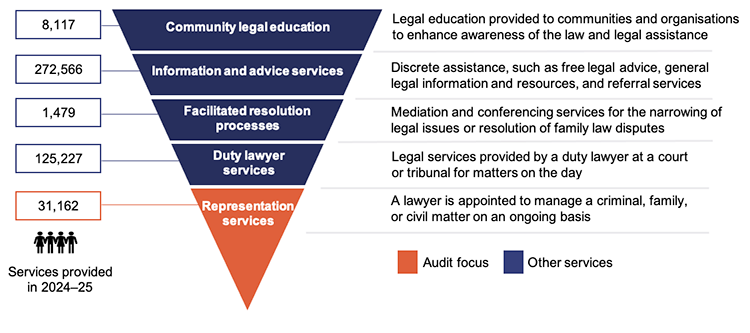
Demand for Legal Aid Queensland’s services is variable and can be influenced by factors outside of its control. To help it meet demand, Legal Aid Queensland designs access to its services in line with the level of funding it has available. The type and volume of legal services delivered by Legal Aid Queensland is summarised in Figure 3B.
Queensland Audit Office using information from Legal Aid Queensland.
It prioritises early intervention services, such as education, information, and advice, to help people understand their rights and options. These services are accessible to everyone and aim to resolve issues sooner and avoid the need for further legal action, which can be expensive, time consuming, and distressing for people involved. This audit focused on ongoing legal representation services, which are for serious or complex matters and require the most resources.
Who is eligible to access legal representation services?
About legal representation services
Legal representation services refer to a lawyer acting on a person’s behalf to deal with a legal problem in an ongoing capacity. Legal Aid Queensland delivers representation services through:
- its own lawyers
- an approved panel of private law firms
- some community legal centres.
This mixed service delivery model provides Legal Aid Queensland with the flexibility to meet demand for legal representation and the needs of eligible people across Queensland.
Eligibility for legal representation
Legal Aid Queensland decides whether to provide publicly funded legal representation services by assessing applications for grants of aid against its eligibility criteria. Grants of aid are provided for each step of a legal matter. For matters that involve multiple steps, a person, through their lawyer, can apply for extensions to the original grant to cover the ongoing legal costs.
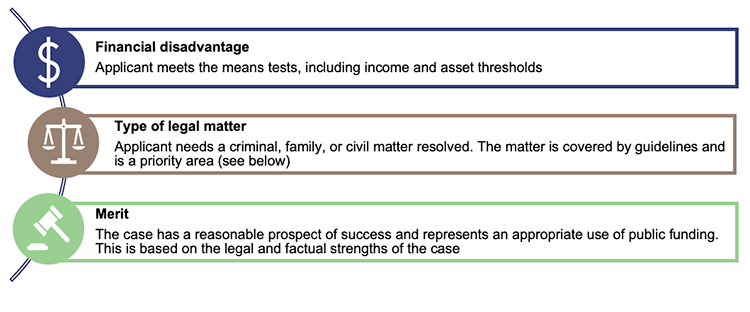
Legal Aid Queensland designed its criteria to direct its fixed funding to people with the greatest need and to matters where representation is considered necessary to support fairness and safety. Depending on their circumstances, applicants must meet some or all eligibility requirements, which are summarised in figure 3C.
Note: The means test does not apply under some circumstances, such as when the applicant is aged 17 years or less. Special consideration may be given to applicants who experience multiple disadvantages where their assets exceed the limit set out in the means test.
Queensland Audit Office using publicly available information.
Legal Aid Queensland developed guidelines for each matter type. These reflect government priorities, risk, and the seriousness of outcomes. For example, criminal matters involving a risk of imprisonment, child protection proceedings, and domestic and family violence matters are generally prioritised. Lower‑risk civil disputes may only be funded in specific circumstances.
When assessing applications, Legal Aid Queensland considers whether alternative services may be appropriate. For example, advice, dispute resolution, or providing guidance on how applicants can manage the matter themselves. This helps to reserve legal representation services for cases where the absence of a lawyer would significantly compromise fairness or safety.
Snapshot of legal representation
In 2024–25, Legal Aid Queensland received 46,072 applications for initial grants of aid. Of these, it approved 31,162. It also approved 73,911 extensions to grants of aid from the 85,306 applications received during the period.
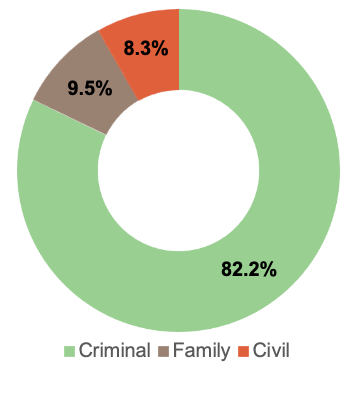
As shown in Figure 3D, criminal law matters made up 82 per cent of approved applications. Criminal law matters are initiated by the state or the Commonwealth, usually by police or prosecutors, rather than the individual choosing to take action. This means the accused person must respond.
Queensland Audit Office using data from Legal Aid Queensland.
The Australian Government funds family law matters, which represent the second highest proportion of approved applications at 9.5 per cent. These include parenting cases and property proceedings, which depend on individuals bringing matters before the court.
Civil law matters represented the lowest portion of approvals. Examples of civil law matters include domestic and family violence, child protection, sexual harassment in the workplace, and discrimination law.
What did we audit?
In this audit, we assessed whether Legal Aid Queensland is effectively enabling access to legal representation for people in need.
Appendix B provides further detail on our audit scope and methodology.
4. Access to legal representation services
In this chapter, we report on Legal Aid Queensland’s effectiveness in providing access to legal representation services. We also consider how it is planning to meet demand into the future.
Legal Aid Queensland is effectively granting access to eligible people
Assessment frameworks are fit-for-purpose and appropriately designed
Legal Aid Queensland provides access to legal representation services for people who meet its eligibility criteria. Depending on their circumstances, applicants must meet some or all of the following 3 tests:
- means – assesses financial disadvantage through income and asset thresholds (not applicable for applicants aged 17 years and under)
- merit – considers the strength of the case and whether it is an efficient use of funding
- guideline – determines whether the matter falls within a funded policy priority area.
Its eligibility criteria is similar to models used nationally and in some other Commonwealth countries, and provides a structured framework for allocating grants of aid. This design supports the objects of the Legal Aid Queensland Act 1997 and reflects state and federal funding priorities.
Legal Aid Queensland operates under a fixed funding model. Given this, having appropriate eligibility criteria and thresholds is critical to helping it direct services to those who need it most within available funding and resources.
Legal Aid Queensland is managing current application volumes, but needs to improve the quality and timeliness of assessment decisions
In 2024–25, Legal Aid Queensland approved 31,162 applications for initial grants of aid for legal representation, and a further 73,911 extensions of aid. The key reasons applicants were not successful were because they did not meet Legal Aid Queensland’s eligibility criteria or did not provide sufficient information to inform the assessment.
While Legal Aid Queensland is managing current application volumes, it can improve the quality and timeliness of its assessment decisions. It does not conduct a formal review of its decisions to approve or reject an application for legal representation before communicating the decision to applicants. Additionally, Legal Aid Queensland’s grants audit and compliance team only reviews a limited selection of assessment decisions.
The proportion of applicants being incorrectly refused grants of aid is increasing
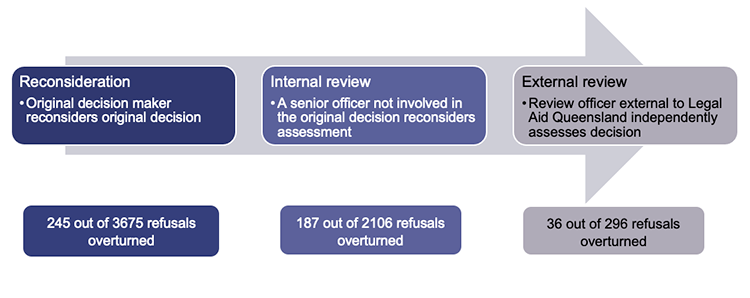
Applicants who Legal Aid Queensland refuses legal representation can ask for the decision to be reviewed. In 2024–2025, Legal Aid Queensland received 6,077 requests to reconsider refused applications, making up 23.3 per cent of all refused applications. This included both applications for initial grants of aid and extension requests.
Legal Aid Queensland overturned 7.7 per cent of the reviewed applications, approving funding for 468 applicants even though no new information was provided. This rate has increased from 5.3 per cent in 2020–2021. Legal Aid Queensland has not investigated why these decisions were overturned without requiring additional information or the root causes of the increased rate.
The review process is summarised in figure 4A.
Queensland Audit Office using information and data provided by Legal Aid Queensland.
In its annual report, Legal Aid Queensland reports on the percentage of application refusals referred to the external review process, where the refusal decision is overturned. This measure does not provide a complete view of all overturned decisions, including those overturned through reconsideration or internal review.
Legal Aid Queensland is not meeting its application processing time frames
In 2024–25, applications for legal representation exceeded Legal Aid Queensland’s target processing times. Legal Aid Queensland aims to assess about 80 per cent of applications within 5 days, but it only processed 58 per cent of applications within this time frame. Delays in processing legal aid applications increase the risk of court inefficiencies and delays, and harm to applicants due to prolonged stress.
Legal Aid Queensland monitors the timeliness of its application assessment decisions against internal targets across each matter type. However:
- internal targets range from 6 to 9 days for criminal, civil, and family law matters and therefore all exceed the 5-day processing time frame communicated to clients in the application form
- over the past 4 years, it has consistently failed to meet these targets
- internal targets measure the time it takes to process applications for aid from the point an application is entered into the system until a decision is made about eligibility for aid. The measure does not take into account the date the application is lodged.
Across matter types, around 2 thirds of applications were processed within the target time frame. Family law applications generally took longer to process, averaging 12.1 days against the 9-day target. This is due to the complexity and sensitivity of these cases, and the need for detailed evidence and thorough assessment.
Legal Aid Queensland has identified that its outdated information technology system has impacted the efficiency of its processes. The table in figure 4B shows average application processing days by matter type.
Matter type | Target days | LAQ’s average processing days for grant decisions | QAO’s calculation of average days to decision from lodgement | QAO's calculation of % of applications processed within target time frame |
|---|---|---|---|---|
Civil law | 8 | 7.4 | 8.9 | 65.8% |
Criminal law | 6 | 5.8 | 6.4 | 68.6% |
Family law | 9 | 6.7 | 12.1 | 66.4% |
Note: Average processing days for grant decisions are calculated from the date Legal Aid Queensland enters the application into the system to when a decision is made. Average days to decision from lodgement are calculated from the date Legal Aid Queensland receives an application to the date a decision is made.
LAQ – Legal Aid Queensland
QAO – Queensland Audit Office
Queensland Audit Office using data provided by Legal Aid Queensland.
Recommendation 1 We recommend that Legal Aid Queensland:
|
New approaches are being trialled to improve access to representation services
Legal Aid Queensland delivers services and initiatives that aim to improve access to justice for financially disadvantaged people across Queensland. These include local outreach services in regional areas, community legal education initiatives, and partnerships with other service providers to raise awareness and direct people to representation services.
Legal Aid Queensland uses data to understand barriers faced by applicants, and trials new approaches to address these. For example, it is redesigning its application form to address a growing trend of applications being refused due to incomplete or absent information. It is also implementing a pilot to more effectively follow up incomplete applications submitted by First Nations applicants, who are a priority client group, as shown in Figure 4C.
| Pilot to improve application outcomes |
|---|
Despite work to make its application form more accessible, Legal Aid Queensland recognises that it can be confronting and difficult for some applicants to complete. This can create a barrier to accessing representation services, particularly for people in priority client groups. To address this, Legal Aid Queensland implemented a 6-month pilot in September 2025. This involved adding an additional step to its assessment process to further follow up incomplete or incorrectly prepared applications. The trial focused on First Nations applicants as the selected priority client group. During the trial, assessing case officers followed up on 135 applicants who had already received a letter requesting further information. Thirty-two applicants responded to Legal Aid Queensland. Of these:
Legal Aid Queensland plans to determine whether it will apply the revised process to all applications and priority client groups once it has finalised the remaining applications. It will consider this in the context of available resources and other priorities to improve access for eligible people. |
Queensland Audit Office using information provided by Legal Aid Queensland.
Legal Aid Queensland faces challenges in meeting future demand
While Legal Aid Queensland is effectively meeting current application volumes, its ability to continue to do so may be impacted by changes to demand into the future.
Demand for services and costs are forecast to increase
In 2023, Legal Aid Queensland established a funding model to forecast future demand and funding needs. The model includes demand indicators, such as police interactions and enforcement and court lodgements. It also includes an index for rates of pay to preferred suppliers.
Legal Aid Queensland estimates that in the period 1 July 2026 to 30 June 2028 it will have increased demand for non-discretionary services, including representation services. It estimates that, without any changes to its delivery model, additional funding of approximately $63.4 million would be required to meet increases in costs as well as additional demand. This gap is based on current service levels, which assumes that the current means test thresholds are adequate to meet people’s legal needs in Queensland.
Legal Aid Queensland has started to analyse alternative options to support future access to services
While Legal Aid Queensland has undertaken some analysis to date, much of this has focused on receiving increased funding from the state and federal governments. If the cost of services and demand continues to grow as predicted, this could delay or prevent people who are currently considered to be financially disadvantaged from getting legal help when they need it.
Legal Aid Queensland may need to consider options, such as:
- changes to its service delivery model
- finding efficiencies in services delivery, such as greater use of technology
- further limiting access by making other changes to eligibility requirements
- amending the scope, range, or number of services.
Legal Aid Queensland is reliant on a decreasing number of private law firms to meet growing demand
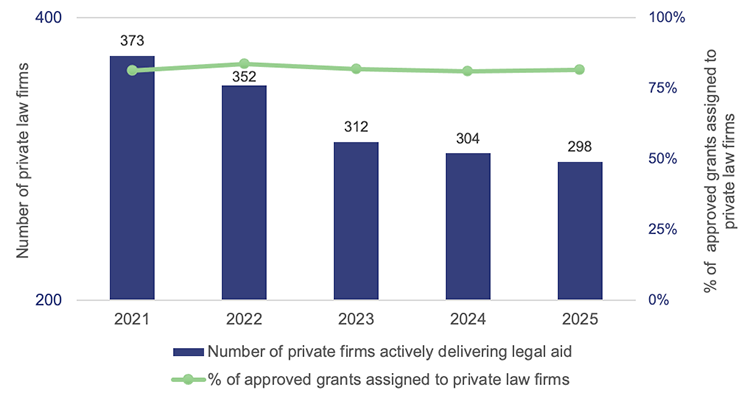
Legal Aid Queensland uses a mixed service delivery model, which involves both in-house lawyers and a network of private law firms and sole practitioners, delivering representation services to clients throughout Queensland. In 2024–25, it allocated 82 per cent of approved applications for initial grants of aid for legal representation to private law firms. The percentage of cases allocated to private law firms has been stable, at just over 80 per cent, over the past 5 years.
Between 1 July 2021 and 1 July 2025, the number of private law firms actively providing legal representation services on Legal Aid Queensland’s behalf decreased by 20.1 per cent, from 373 to 298. This is shown in figure 4D below.
Queensland Audit Office using data provided by Legal Aid Queensland.
Legal Aid Queensland has continued to meet service demand under this model. However, ongoing reductions in private law firms presents the risk of limiting the availability and coverage of legal representation services across the state.
Legal Aid Queensland has identified that the hourly rate it pays to private law firms is leading to a decrease in the number of private law firms delivering legal aid work. It currently pays $153 per hour for private lawyers, which is the same hourly rate that it charges for its in‑house lawyers.
This has been recognised as a challenge nationally, with the Legal Aid Private Practitioners 2024 Census reporting low fees as the most common reason practitioners did not intend to continue legal aid work in the next 12 months. In recent years, Legal Aid Queensland has responded to the challenge of declining private law firm numbers by:
- introducing a temporary, 4-year funding increase of 2 per cent with the state government in 2022–23
- flying in-house and private lawyers from South East Queensland based lawyers to deliver representation services in regions with private law firm shortages
- enhancing its communication and engagement strategy in 2024 to better attract and retain private law firms that provide legal aid services across the state.
While these measures have helped, the number of law firms delivering legal aid continues to decline. Legal Aid Queensland has requested additional funding to assist in managing this challenge, but needs to consider other longer-term solutions to manage these risks. This includes reviewing the appropriateness of its current service delivery model.
In November 2025, the Standing Council of Attorneys-General agreed to a review of the legal aid private lawyer model.
Legal Aid Queensland has commenced projects to enhance internal efficiency
Legal Aid Queensland is in the process of replacing its technology system to improve efficiency. It plans to explore other efficiency measures as part of its business transformation project, which commenced in December 2025.

| Work in progress – Legal Aid Queensland business transformation project In December 2025, Legal Aid Queensland commenced a business transformation project to set a 5 to 10‑year vision and modernise its service delivery. A key aim of the review is to help Legal Aid Queensland better support its clients while meeting legal requirements for efficient and effective service delivery. It will consider key elements such as the decision-making framework and areas such as the appropriate work mix to support delivery of Legal Aid Queensland services. Legal Aid Queensland plans to identify key priorities aligned with Queensland Government goals and agreement obligations under the National Access to Justice Partnership 2025–30 agreement. The project will also consider future services and introduce a service catalogue to help identify where Legal Aid Queensland should focus service design work. |
Recommendation 2 We recommend that Legal Aid Queensland identifies long‑term solutions to support sustainable service delivery. This should consider:
|
The number of people who can access legal representation services may be reducing
Legal Aid Queensland is responsible for setting its own eligibility criteria. Within a fixed funding model, these thresholds become an effective way to manage demand within the available funding.
As highlighted earlier in this report, the assessment framework Legal Aid Queensland applies is consistent with other jurisdictions, however the requirements set within each test heavily influences the number of people who can access legal representation services.
Means test thresholds to assess financial eligibility may not accurately reflect cost of living or home equity increases
In 2024, a Legal Aid Queensland internal review noted in relation to its means test, that:
- the base home equity threshold – the difference between the market value of a property and the balance of the owner's mortgage – was set as $146,000 in 1997. Since this time, there has been a significant increase in house prices.
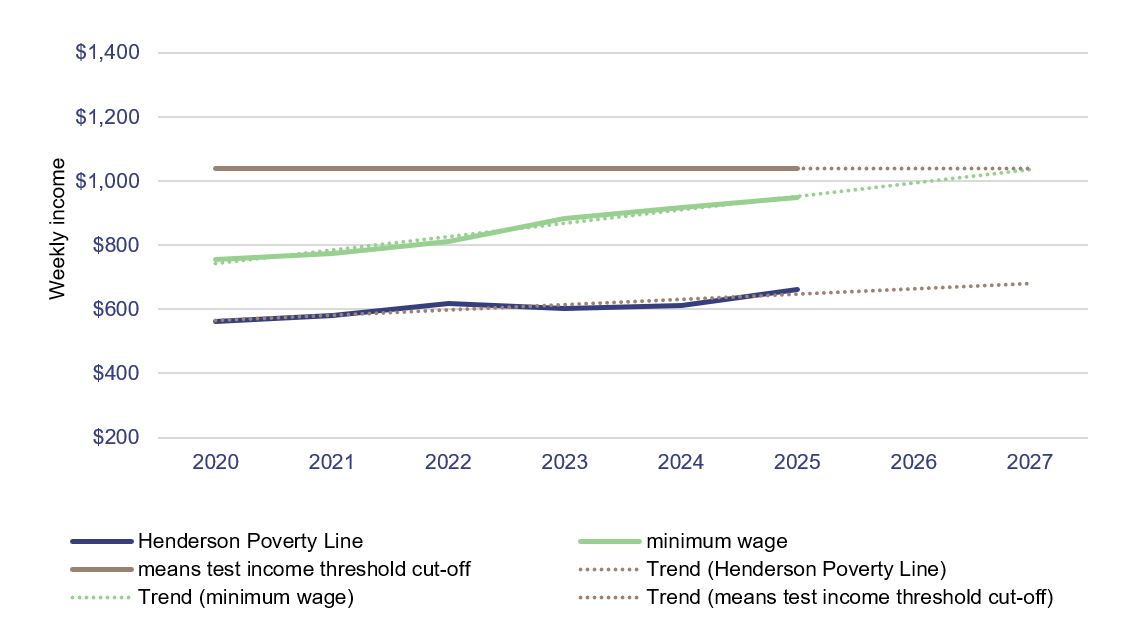
- income thresholds have not increased since 2018 and are not benchmarked against socio-economic factors such as housing or cost of living pressures.
While the minimum wage and Henderson Poverty Line have increased over time, Legal Aid Queensland’s income threshold has not increased, as shown in Figure 4E. Over time, this could result in more people being ineligible for publicly funded legal representation and facing challenges sourcing private representation. Applicants who receive full Centrelink payments remain eligible, and these payments are indexed annually. Legal Aid Queensland also offers some exemptions to the means test. For example, it does not apply when the applicant is aged 17 years or under. Special consideration may also be given to applicants in limited circumstances, however, most people must meet all parts of the means test.
Over time, not changing income and home equity test thresholds has resulted in the means test increasingly functioning as a demand management tool, rather than a reliable measure of financial disadvantage. Over the past 5 years, application approval and refusal volumes have remained constant.
Note: The Henderson Poverty Line reflects net disposable income. The means test income threshold cut-off and minimum wage reflect gross income.
Queensland Audit Office using publicly available information.
The Henderson Poverty Line is a benchmark for measuring poverty in Australia. It estimates the minimum income a person or household needs to achieve a basic standard of living. It originated from the 1972 Commission of Inquiry into Poverty and is regularly updated to reflect changes in living costs.
Better analysis should be undertaken to inform decisions around eligibility criteria
Legal Aid Queensland has previously identified and requested additional funding to accommodate the cost of increasing and indexing its means test. Its funding submission highlighted risks of keeping thresholds unchanged, however, it has not yet analysed the impacts of these risks to inform decisions about future service delivery. If Legal Aid Queensland changes the means test, more people will be eligible to access legal representation services. Changes must therefore be considered in the context of other priorities and pressures, such as service gaps, eligibility criteria, and unmet need across the publicly funded legal system. Consideration should also be given to Legal Aid Queensland’s operational constraints, such as the availability of in-house lawyers and private law firms and other partners to meet increased demand for representation services.
| In addressing Recommendation 2, Legal Aid Queensland should incorporate risk analysis relating to access to services and impacts of potential changes to eligibility thresholds. |
Legal Aid Queensland has made refinements to how it assesses financial eligibility
Over time, Legal Aid Queensland has made adjustments to the way it applies the means test and to make requirements more targeted to people with the greatest need. These changes are summarised in Figure 4F.
- Income and asset test applied to all applicants
- Regular updates to income and asset thresholds from 2004 until 2009
- Other sources of income incorporated into means test, including partner’s income
- Some applicants required to contribute financially to the cost of legal assistance, based on income thresholds
- Asset threshold for home equity increased from $146,000 to $255,000 in 2008. These reverted back to $146,000 in 2009 due to a surge in demand and financial constraints
- Periodic means test introduced after receiving grant of aid to ensure ongoing eligibility
- Reinforced requirement to notify Legal Aid Queensland of changes to financial circumstances
- Income test amended to ensure clients with an income below the Henderson Poverty Line were not required to pay an initial contribution
- Increased income thresholds by 3 per cent
- Clear rules set to ensure that clients who no longer need financial assistance pay back costs
- Adjusted the contribution policy to ensure the first $2,000 of an applicant's cash savings were exempt from the assets test
- Standardised how the means test was applied across all types of applicants and legal matters
- Made it clearer that, in exceptional circumstances, people could still receive legal aid even if they were over the asset thresholds, such as cases of serious hardship or vulnerability
- Streamlined means testing for people receiving full Centrelink benefits
Queensland Audit Office using information provided by Legal Aid Queensland.
While Legal Aid Queensland has made several changes to its means test, there are other approaches it can consider to assess financial eligibility. Appendix E shows the approaches that 3 other states adopt in assessing financial eligibility requirements.