
Overview
Delivering effective and targeted rehabilitation and reintegration services for prisoners can help prevent crime, reduce reoffending, and promote long-term social safety and wellbeing. It involves addressing the root causes of offending behaviour and preparing prisoners to successfully reintegrate back into the community.
Tabled 7 July 2026.


Report summary
This report examines how effectively Queensland Corrective Services (QCS) plans for and facilitates the rehabilitation and reintegration of prisoners.

| What is important to know about this audit? |
Corrective services contribute to preventing crime, lowering the number of future victims, and promoting long-term social safety and wellbeing by reducing reoffending. QCS aims to achieve this through the delivery of effective and targeted rehabilitation and reintegration services.
QCS is responsible for rehabilitating prisoners in Queensland. Prisoner rehabilitation involves providing prisoners with education, job training, meaningful activities, and a structured day and programs, which collectively address the root causes of their offending behaviour.
QCS is also responsible for helping prisoners reintegrate back into the community after their release. This transitional support involves connecting prisoners to the right services and ensuring they have the right support.
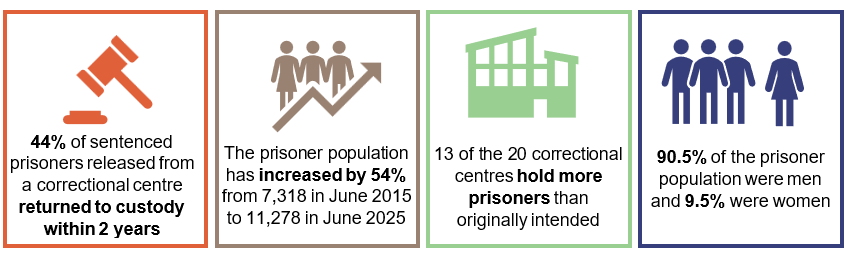
Note: The 44 per cent reflects prisoners released from a correctional centre who returned with a new sentence within 2 years. The 20 correctional centres include Lockyer Valley Correctional Centre which opened in September 2025.
Queensland Audit Office compiled using public information.
Better practice, including the Guiding Principles for Corrections in Australia, places effective case management at the centre of prisoner rehabilitation. It involves assessing prisoner risks and needs, and planning and facilitating access to the programs and services they need. This includes rehabilitation and wellbeing programs, education, employment, reintegration, and structured routines.

| What did we find? |
A more effective delivery model for case management is needed to support achievement of QCS rehabilitation and reintegration strategies
QCS has designed its strategies with key elements of an effective approach to rehabilitation and reintegration but has not effectually operationalised or delivered against them. Its case management framework aligns with better practice and provides the foundation for delivering against its strategies and operational plans.
QCS is using its case management framework in 9 of its 20 correctional centres but lacks data to determine how effectively it is being applied. Case management only occurs in limited and varying circumstances in the remaining 11 centres. While QCS sought to fully implement case management across all centres, it has been unable to do so due to factors such as prisoner numbers, resourcing, and funding constraints. This means those prisoners who do receive case management do so more based on location and circumstance rather than risk or potential for successful outcomes. QCS has not identified a preferred alternative delivery model, such as a risk and cohort-based implementation, to target delivery across centres and optimise the benefits of case management.
Without effective case management QCS cannot tailor interventions to provide structure and address rehabilitation and reintegration risks and needs
QCS has a suite of evidence-based rehabilitation programs, however, only some prisoners are completing these programs. Its limited use of case management has compromised its ability to assess and develop individual plans for most prisoners tailored to their risk behaviours and needs. This means they do not get the integrated structure, programs, education, and employment tailored to their rehabilitation and reintegration needs. The increasing prisoner population and limited infrastructure has further impacted QCS’s ability to deliver the programs, education, and employment that prisoners need.
QCS does not have an effective approach to reintegration
Preparing prisoners to reintegrate back into the community needs to start from the time a prisoner enters custody, but this planning is not occurring across many correctional centres. For suitable low-risk prisoners, transitioning to low security centres can be an important bridge between custody and reintegration into the community. However, QCS is yet to plan for how it can safely and effectively use low security correctional centres to their capacity.
Less than half of all prisoners that left custody in 2024–25 received pre-release support, such as help setting up bank accounts and support accessing services and legal advice. This impacts QCS’s ability to help prisoners successfully reintegrate back into the community. QCS can more effectively monitor its reintegration services to determine if they are achieving their intended outcomes.

| What do entities need to do? |
We make 5 recommendations to QCS. These focus on the following themes:
- strengthening its planning approach
- monitoring and overseeing performance
- case management
- data capture and reporting
- reintegration services.
1. Audit conclusions
Queensland Corrective Services (QCS) does not effectively plan for and facilitate the rehabilitation and reintegration of its prisoners.
This is because it has not developed an effective delivery model to implement its strategies and case management framework across the correctional system.
Strengthening its planning approach and delivery of case management will be important for achieving its rehabilitation and reintegration strategies and objectives. This will also be necessary to overcome inherent challenges such as increasing prisoner numbers and demand on staff and facilities. If done effectively, this can contribute to community safety with fewer prisoners reoffending after release.
2. Recommendations
| Planning approach | Entity responses |
We recommend that Queensland Corrective Services:
| Agree |
| Monitoring and overseeing performance | Entity responses |
We recommend that Queensland Corrective Services:
| Agree |
| Case management | Entity responses |
We recommend that Queensland Corrective Services:
| Agree |
| Data capture and reporting | Entity responses |
We recommend that Queensland Corrective Services:
| Agree |
| Reintegration services | Entity responses |
We recommend that Queensland Corrective Services:
| Agree |
Reference to comments
In accordance with s. 64 of the Auditor-General Act 2009, we provided a copy of this report to the relevant entity. In reaching our conclusions, we considered its views and represented them to the extent we deemed relevant and warranted. Any formal response from the entity are at Appendix A.
3. Prisoner rehabilitation and reintegration in Queensland
This chapter explains the purpose of prisoner rehabilitation and reintegration, and outlines who is responsible for this in Queensland.
What is prisoner rehabilitation and reintegration?
Prisoner rehabilitation is the process of providing prisoners with education, job training, meaningful activities, a daily routine, and programs to address the root causes of their offending behaviour. Assessing a prisoner’s risks and needs helps guide their case management and prioritise the programs and services they need while they are in custody and when reintegrating into the community.
Rehabilitating a prisoner prepares them to successfully reintegrate into the community. A key part of a prisoner’s rehabilitation is preparing them to transition from a correctional centre back into the community. It involves connecting prisoners to the services they require, such as housing and employment, and ensuring they have the right support, including positive family and community relationships.
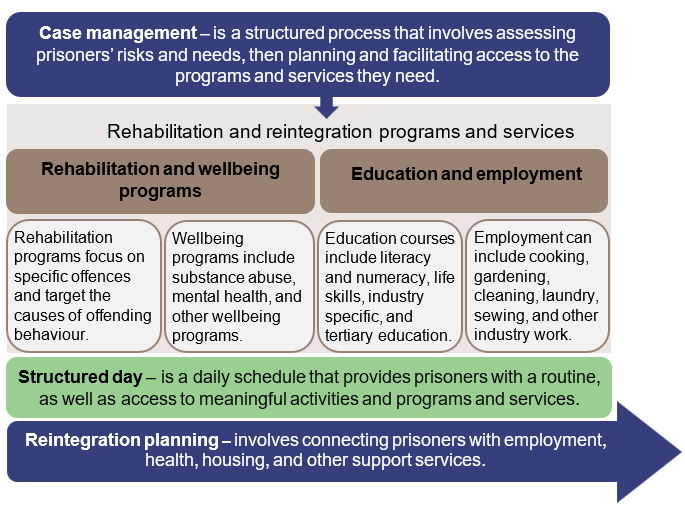
Queensland Corrective Services (QCS) is responsible for rehabilitating and reintegrating the prisoners in Queensland. Figure 3A shows QCS’s approach to doing this.
Queensland Audit Office based on Queensland Corrective Services’ information.
Case management provides the foundation for this approach. This is because it is a structured, person-centred approach used to assess, plan, coordinate, and monitor services that support each offender’s successful reintegration into society. It focuses on reducing reoffending (recidivism) by addressing the underlying factors that contribute to criminal behaviour.
Similarly, providing prisoners with a structured day – a predictable schedule of work, education, programs, and regulated leisure – plays a critical dual role: it enhances safety and security within the correctional centre and improves rehabilitation outcomes, increasing the likelihood of successful reintegration into society.
How many prisoners are in Queensland?
As at 30 June 2025, there were 11,278 prisoners in custody across the state’s 20 correctional centres, all run by QCS.
The number of prisoners in Queensland continues to increase
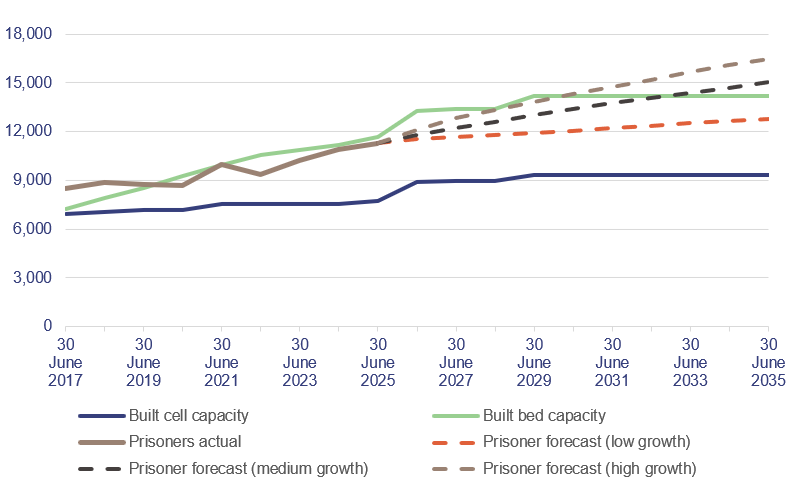
The number of prisoners in Queensland’s correctional centres has increased by 54 per cent from 7,318 in June 2015 to 11,278 in June 2025. Of the 13 high-security correctional centres, 12 house more prisoners than originally intended, as at 30 June 2025. To address the growing prisoner numbers, QCS has built a new correctional centre in Lockyer Valley and added a second bed to cells across existing centres. QCS forecasts that its prisoner numbers will grow between 14 per cent (approximately 1,500 prisoners) and 46 per cent (approximately 5,200 prisoners) by June 2035.
Figure 3B shows the actual and forecast number of prisoners, beds, and cells between 2017 and 2035.
Queensland Audit Office based on Queensland Corrective Services’ information.
An increasing prisoner population places pressure on staffing and infrastructure, heightens safety and security risks, and disrupts routine operations. More prisoners mean greater demand for existing programs and services. If not managed effectively it can impact delivery to programs, training and education, and employment opportunities that are fundamental to effective rehabilitation and successful transition into the community.
Why is prisoner rehabilitation important?
Forty-four per cent of the prisoners released return within 2 years
Without effective rehabilitation, the likelihood of a prisoner reoffending is higher. Prisoner rehabilitation is essential to addressing the root causes behind a prisoner’s offending behaviour and reducing the number of prisoners who reoffend and return to custody after their release. Those prisoners sentenced for property crimes, such as burglary and motor vehicle theft, have a higher risk of returning to custody, compared to other offence types.
In Queensland, 44 per cent of sentenced prisoners released from correctional centres in 2022–23 reoffended and returned to custody within 2 years. The national percentage has typically been higher than Queensland, due to other states and territories that have had higher rates of prisoners returning to custody. For example, 60 per cent of prisoners in the Northern Territory and 50 per cent in New South Wales returned to custody in the same period.
Figure 3C shows the percentage and trend of adults who return to custody within 2 years of their release in Queensland compared to the national percentage.
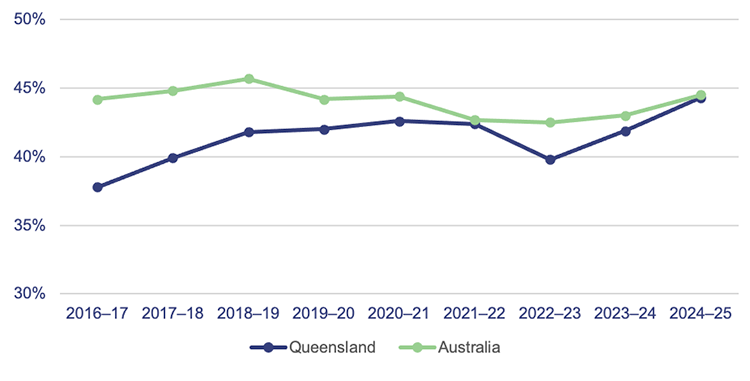
Note: Queensland data reflects prisoners who returned to a correctional centre with a new sentence within 2 years. This is consistent with all states and territories except for Western Australia and the Australian Capital Territory which also include unsentenced prisoners. The dates reflected in this graph represent the year the data was released. For example, the 2024–25 data shows the percentage of prisoners released from a correctional centre in 2022–23 who returned to custody within 2 years.
Queensland Audit Office using data from the Productivity Commission’s Report on Government Services: Justice (Part C).
First Nations prisoners return to custody at a higher rate than non-First Nations people. In 2024−25, 55 per cent of First Nations people returned to custody in Queensland within 2 years compared to 36 per cent of non-First Nations people. Only Northern Territory and New South Wales reported higher rates in the same period. Since 2022−23, the percentage of First Nations people returning to custody in Queensland has increased from 50.5 to 55.4 per cent.
Under the National Agreement on Closing the Gap, Queensland is required to reduce the rate of First Nations adults held in custody by 15 per cent by 2031. The rate of First Nations adults in custody in Queensland per 100,000 people has increased by 40 per cent since the national target was set in 2019.
Cost to house prisoners
The cost to house prisoners underscores the importance of ensuring effective rehabilitation and reducing reoffending. The Productivity Commission's Report on Government Services reports that the real net operating expenditure costs to house a prisoner in Queensland was $296 per day in 2024−25. The total cost–net operating expenditure and capital cost was $396 per prisoner per day.
Who contributes to rehabilitating and reintegrating prisoners?
While QCS is responsible for rehabilitating and reintegrating prisoners, multiple other entities contribute, including state and local governments and non-government organisations. These entities include:
- Queensland Health: supports the physical and mental health of prisoners
- Department of Housing and Public Works: can provide safe housing for people leaving correctional centres
- Department of Trade, Employment and Training: supports people who have left correctional centres to get the right training to access meaningful employment
- non-government organisations: deliver some programs and services to rehabilitate and reintegrate prisoners.
QCS plays a role in coordinating these services to address the needs of prisoners within correctional centres and as they leave custody.
What did we audit?
This audit assessed how effectively Queensland Corrective Services plans for and facilitates the rehabilitation and reintegration of prisoners. We visited 7 correctional centres including men’s, women’s, high security, and low security centres to understand operations and the challenges they face.
We did not audit other entities or how effectively entities support prisoners after their release from prison.
4. Planning to rehabilitate and reintegrate prisoners
Effective planning is important to rehabilitate and reintegrate prisoners given the complex and high-risk environment of Queensland’s correctional system (the system).
In this chapter, we examine how effectively Queensland Corrective Services (QCS) is planning the rehabilitation and reintegration of prisoners across the state. We also examine whether QCS effectively oversees its approach and evaluates the outcomes of its strategy.
Does QCS plan effectively to rehabilitate and reintegrate its prisoners?
QCS’s Strategic Plan 2025-29 (strategic plan) outline its strategies for rehabilitating and reintegrating prisoners. Its strategic plan communicates how QCS plans to meet its legislative responsibilities under the Corrective Services Act 2006 (the Act). The Act requires QCS to facilitate programs and services to help rehabilitate and reintegrate prisoners.
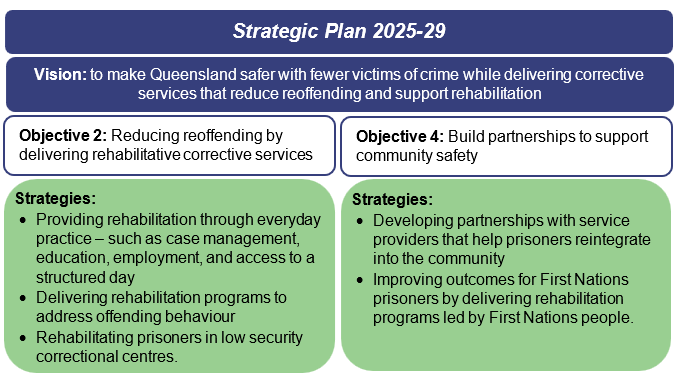
QCS’s strategic plan includes prisoner rehabilitation and reintegration in its vision, purpose, and strategic objectives. Figure 4A summarises QCS’s strategies to rehabilitate and reintegrate prisoners in its strategic plan.
Queensland Audit Office based on information provided by Queensland Corrective Services.
These strategies cover the key elements of an effective approach to rehabilitating and reintegrating prisoners. This includes providing prisoners with opportunity for rehabilitation through effective case management, a structured day, education and employment, and evidence-based rehabilitation programs. Its strategies are underpinned by its approach outlined in Figure 3A.
QCS’s operational plans are not effectively designed to deliver its strategies
QCS has business and divisional plans to support the delivery of its strategies to rehabilitate and reintegrate prisoners. While there are actions in the plans that align to its strategies, key elements are either not included or lack sufficient detail to ensure that they are operationally effective. For example, there is no information or actions relating to prisoner education despite it being a key element of prisoner rehabilitation. Other actions lack sufficient detail. For example, one of the actions is to review the structured day to enable rehabilitation and foster safe work environments. However, there is no supporting information to explain the purpose of a structured day and what it should involve, including minimum standards. None of the actions listed in QCS’s plans have a time frame for implementation, although these plans are reviewed annually. This information should be captured in the plans or supporting documents.
QCS cannot effectively prioritise programs and services because it does not understand the risks and needs of its prisoner population
While QCS requires its staff to assess the safety and security risks of prisoners, it does not consistently assess their rehabilitation and reintegration risks and needs. This impacts QCS’s ability to understand its prisoner cohorts and their risks and needs across correctional centres. It also impacts its ability to effectively manage prisoners and prioritise programs and services across the system. Figure 4B demonstrates the importance of assessing the differing risks and needs of prisoners and the intervention and support they require.
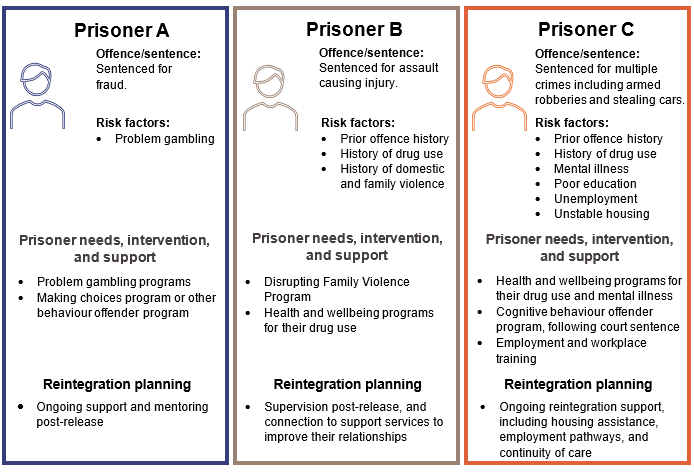
Note: The examples above are hypothetical and not based on real prisoner information.
Queensland Audit Office.
We discuss QCS’s approach to assessing the risks and needs of individual prisoners in Chapter 5. QCS has a range of different prisoner cohorts, such as unsentenced prisoners – also referred to as remand prisoners, males, females, prisoners with a disability, and culturally diverse groups, including First Nations peoples.
QCS is not planning effectively to deliver rehabilitation programs to First Nations prisoners
First Nations people make up 40 per cent of Queensland’s prisoner population despite representing less than 5 per cent of the state’s total population in the 2021 census data. First Nations prisoners are also more likely to return to custody compared to non-First Nations people. In 2024−25, QCS reported 55 per cent of First Nations people returned to custody within 2 years compared to 36 per cent of non-First Nations people. For these reasons, QCS has identified First Nations prisoners as a key cohort in its strategic plan.
QCS has a strategy to improve outcomes by delivering rehabilitation programs led by First Nations people.
However, QCS has not effectively planned how it will deliver this strategy. It has not determined the type and number of programs that it requires for its First Nations prisoners based on their risks and needs and where it should prioritise these across the state. It has developed one rehabilitation program tailored for First Nations people, which aims to reduce sexual offences. This program was co-designed by First Nations staff but is only being used in the Lotus Glen Correctional Centre. First Nations prisoners in other correctional centres do not have access to this program. First Nations prisoners can access rehabilitation programs offered to all prisoners, however these are not designed or led by First Nations people.
While not included in its strategy, QCS has wellbeing programs that are tailored to First Nations prisoners, as well as Cultural Liaison officers, cultural spaces within correctional centres, and a visiting Elders service who provide support to First Nations people in prison.
Recommendation 1 We recommend that Queensland Corrective Services strengthens its planning approach to prisoner rehabilitation and reintegration. This should include:
|
Does QCS monitor and evaluate how effectively it rehabilitates and reintegrates prisoners?
QCS can strengthen its whole-of-system governance for prisoner rehabilitation and reintegration
QCS has a range of committees, panels, and boards that are responsible for elements of prisoner rehabilitation and reintegration. This includes the:
- Offender Program and Services Accreditation Panel – responsible for the governance and quality assurance of rehabilitation programs
- Community Correction Specialist Operations Delivery Board – responsible for delivering and monitoring reform activities, including projects related to prisoner rehabilitation and reintegration.
While these governance structures focus on elements of prisoner rehabilitation and reintegration, none have collective oversight and there is no integrated view of performance across the system.
None of the committees report regularly to the Board of Management (the board) about the effectiveness of prisoner rehabilitation and reintegration programs and services. The board is responsible for providing strategic direction to deliver QCS’s vision – to make Queensland safer with fewer victims of crime and deliver corrective services that reduce reoffending and support rehabilitation.
The board receives performance information about its rehabilitation and reintegration programs and services, but it is more focused on outputs, such as the number of programs completed. The board would benefit from more information to assess whether its strategies are achieving their intended outcomes and effectively rehabilitating and reintegrating prisoners.
QCS monitors and reports its performance, but can improve how it assesses the outcomes of its activities
QCS monitors and reports on its prisoner rehabilitation and reintegration activities. It has a series of performance measures that it monitors and reports performance against, including the:
- number of rehabilitation and wellbeing programs that prisoners complete
- percentage of prisoners engaged in education and employment
- rate of prisoner and staff assaults
- time prisoners spend outside their cell.
QCS reports against one outcome measure about the rate of return of prisoners, which is the percentage of prisoners returning to custody with a new sentence within 2 years. The absence of more outcome measures limits QCS’s ability to determine which activities are working effectively and those that are not.
QCS has a strategy to improve outcomes for First Nations peoples in the correctional system through First Nations-led interventions. It measures the percentage of First Nations prisoners that return to custody within 2 years, but lacks other outcome-focused measures. For example, it could measure the rate of First Nations prisoners returning to custody who complete its First Nations-led program compared to those that do not.
Recommendation 2 We recommend that Queensland Corrective Services strengthens how it oversees prisoner rehabilitation and reintegration across the state. This should include:
|
5. Delivering programs and services to prisoners
Delivering programs and services that rehabilitate and reintegrate prisoners supports reducing reoffending rates.
The Guiding Principles for Corrections in Australia includes the principle that correctional centres should support prisoners to make positive behaviour change by participating in targeted, evidence-based interventions. These interventions should address their offending and wellbeing needs, providing them with the tools and strategies to lead a life free from offending. The principles align with contemporary approaches recognising that punishment alone is insufficient in deterring prisoners from reoffending.
Effective rehabilitation and reintegration involves the following elements:
- identifying and assessing prisoners’ risks and needs for rehabilitation and reintegration
- delivering rehabilitation and wellbeing programs tailored to each prisoner’s risks and needs
- providing training, education, and employment opportunities
- providing prisoners with a structured day and time out of their cell to engage in meaningful activities
- supporting prisoners as they reintegrate back into the community.
In this chapter, we examine how effectively Queensland Corrective Services (QCS) is facilitating the rehabilitation and reintegration of prisoners across the state. This includes how effectively it identifies and assesses the risks and needs of prisoners and delivers rehabilitation programs and services, including education, employment, and a structured day.
Does QCS identify and plan for the risks and needs of individual prisoners?
QCS has an appropriate framework to identify and respond to prisoners’ risks and needs but is using it in less than half of its centres
QCS developed the End-to-End Offender Management Framework (the framework) in 2019. It provides a person-centred and evidence-based approach for case managing a prisoner, from the time they enter custody, through to when they leave and reintegrate back into the community. Key to this is assessing the risks and needs of each sentenced and unsentenced prisoner.
While QCS has a framework to assess the risks and needs of prisoners and provide case management support, it is only using it in 9 of its 20 correctional centres. QCS used a facility-led approach and staggered the roll out of the framework between 2020 and 2023. It prioritised 6 women’s correctional centres, as one of its priority cohorts, and 2 men’s correctional centres. In September 2025, it adopted a version of this framework in Lockyer Valley Correctional Centre. These 9 centres include reception, low security, and high security centres, and they include remand, protected, and general prison populations. The 9 centres account for just over a quarter of QCS’s prisoners.
QCS was granted fixed funding to trial the framework in select correctional centres. There were some challenges in its ability to effectively deliver all elements of the rollout. Challenges include limitations to physical infrastructure, such as a lack of interview rooms, and insufficient staffing levels to meet the workload requirements for ongoing case management.
QCS’s evaluation of the framework in 2024 indicated that it was leading to positive behaviour change in some prisoners, but it was too early to assess outcomes on prisoner reoffending rates. QCS has continued using the framework in the 9 centres; however, there have been ongoing challenges ensuring it is working effectively across these centres. For example, Townsville Correctional Centre has not been able to undertake risk and needs assessments for all prisoners due to a lack of sufficient staff for the growing prisoner population. QCS lacks reliable data to determine how effectively the framework is working in the 9 centres.
QCS has not expanded the framework for the remaining correctional centres due to factors such as prisoner numbers, resourcing, and funding constraints. This means those prisoners who do receive case management do so more based on location and circumstance rather than risk or potential for successful outcomes.
Despite its experience in finding that intensive one‑to‑one case management to every prisoner is often not feasible, QCS has not identified a preferred alternative model. It has no plan to target delivery across centres and optimise the benefits of case management. Alternatives could include differentiated and/or risk-based service delivery models. These delivery models can consist of stratification (who gets what); tiered service intensity (how much); blended delivery modes (how it is delivered); or combinations of these.
Is QCS delivering the right programs and services to prisoners?
A lack of case management means QCS cannot ensure prisoners are accessing the programs and services they need
QCS is delivering a range of programs and services, including rehabilitation and wellbeing programs, education, and employment. For these programs and services to be effective, they need to work together to address a prisoner’s criminogenic needs. Criminogenic needs are personal and social factors that contribute to a person’s likelihood of engaging in criminal behaviour, such as antisocial behaviour, substance abuse, and unemployment. For example, a prisoner with drug addiction may also have unstable housing and employment and need multiple programs and services to address their risks and needs. Addressing only one issue may result in the prisoner reoffending.
Without risk assessment and case management across all centres, QCS cannot ensure prisoners are getting access to the right number and types of programs and services at the right times.
Some prisoners are accessing rehabilitation programs to address their offending behaviour
QCS has a suite of evidence-based rehabilitation programs that it delivers to prisoners to address the causes of their offending behaviour. These programs target a range of different offences, including sexual offending, domestic and family violence, and general offending. QCS identifies prisoners for these programs based on their offence type and interviews them to assess their readiness to engage.
Between 2020–21 and 2024–25, 1,600 prisoners completed rehabilitation programs to address their offending behaviour. There are a variety of reasons why prisoners are unable to access and complete programs. For example some programs are not suitable for unsentenced prisoners, and some prisoners do not have sufficient time to complete rehabilitation programs that typically run for 6 to 12 months. Sixty-three per cent of prisoners who left custody in 2024–25 were in a correctional centre for less than 6 months.
Some prisoners are unwilling to engage in rehabilitation programs. QCS does not separately record whether prisoners are rejecting the programs or whether they are rejected due to eligibility, such as lack of time remaining or appeal processes.
In addition to the factors listed above, some prisoners are waiting to access programs due to lack of specialised staff and available rooms to deliver rehabilitation programs. There were 1,016 prisoners on the waitlists for rehabilitation programs as at 31 March 2026. On average, these prisoners have been waiting one year and 4 months to access these programs.
Currently QCS monitors and reports publicly on the total number of rehabilitation and wellbeing programs completed each year against its target of 3,752 programs. QCS has exceeded this target since 2022–23. Given the rising number of prisoners and the number waiting to access rehabilitation programs, there is value in QCS determining whether this target is appropriate.
QCS is not meeting its targets for prisoner employment
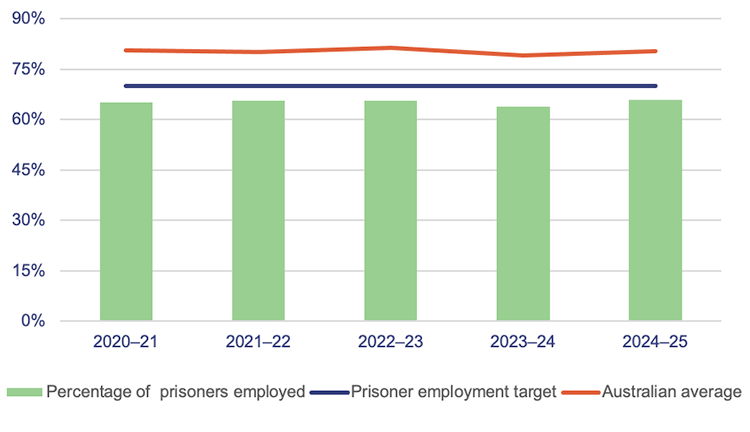
QCS reported employing approximately 65 per cent of prisoners between 2020–21 and 2024–25, against its annual target of 70 per cent. QCS has consistently had the lowest percentage of prisoners employed compared to the national average over several years. For example, in 2024–25, Queensland employed 66 per cent of prisoners, compared to 86 per cent in New South Wales and 92 per cent in Victoria.
Figure 5A shows the percentage of eligible prisoners engaged in these activities compared to QCS’s target and Australia's national average. Not all prisoners are eligible for employment, because they are completing full-time education (such as a bachelor’s degree) or have a medical condition, and others are not required to work, including prisoners not yet sentenced by the courts.
Queensland Audit Office using information provided by Queensland Corrective Services.
Assessment of suitability of prisoners for employment should be informed by their risk and needs assessment and case management plan.
Employment provides opportunities for prisoners to engage in meaningful work, earn an income, and develop employable skills. This can help provide prisoners with a structured day routine and support their reintegration back into the community. Prisoner employment can also help support the operation of the correctional centre and local industries. Typical prisoner employment within correctional centres includes cooking, gardening, cleaning, laundry, and sewing prisoner uniforms. QCS also obtains contracts with local industries to build and manufacture parts, such as farming equipment and wooden pallets.
QCS is improving its approach to educating prisoners
In July 2024, QCS standardised the list of education courses it offers in its centres to help ensure prisoners can continue their education even if they need to move to a different centre. This is a relatively common occurrence for prisoners. Between 1 July 2020 and 30 June 2025, 54 per cent of prisoners moved at least once between correctional centres.
QCS offers 66 individual units for its vocational education training. Service providers deliver these in some centres, and QCS has employed trainers in others. More than half of these courses relate to language, literacy, and numeracy. Almost a third focus on future workforce growth industries, such as construction and retail trade. It also offers access to other courses, including distance education and university degrees.
QCS reported the percentage of prisoners that accessed some type of education, such as vocational education, varied between 27 to 33 per cent between 2020–21 and 2024–25. QCS aims to have more than 32 per cent of its prisoners engage in education but has only achieved its target once in the last 5 years. This target is based on what QCS has historically been able to achieve rather than what prisoners need for their rehabilitation. There are a range of factors that have impacted QCS’s ability to provide education to its prisoners, including a lack of available rooms and space.
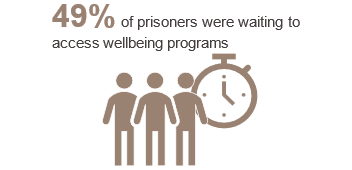
Almost half of QCS’s prisoner population are waiting to access wellbeing programs
Wellbeing programs help prisoners enhance their life skills, improve mental health, and develop healthy relationships. They are available to all prisoners, regardless of their offending behaviour or whether they are sentenced.
QCS offered 21 different types of wellbeing programs in 2025. Seven of these focus on substance abuse and the remaining focus on life skills and healthy relationships.
QCS has increased the number of wellbeing programs completed by prisoners from approximately 3,900 programs in 2020–21 to 4,600 programs in 2024–25. However, there are a high number of prisoners waiting to access wellbeing programs.
As at 31 March 2026, 5,778 prisoners were waiting to access 13,270 wellbeing programs. There are some prisoners waiting to access multiple programs.
Queensland Audit Office using information provided by Queensland Corrective Services.
Recommendation 3 We recommend that Queensland Corrective Services identifies and implements a case management delivery model to enhance delivery across the correctional system and optimise rehabilitation and reintegration outcomes. This should include ensuring all prisoners get a risk and needs assessment on entry to custody to inform their rehabilitation and reintegration support. |
The need for QCS to modify correctional centre routines impacts its ability to provide prisoners time out of cells and structured days
Providing prisoners with a structured day with meaningful activity can reduce the risk of violence, improve mental health, and better prepare prisoners for release. A structured day gives prisoners a schedule for their meals and medication, and access to programs, education, and employment. It also gives prisoners time outside of their cells to engage in activities that can help improve their mental and physical health.
All correctional centres have daily routines that intend to provide prisoners with a structured day and access to programs and services, but some have not been able to implement a structured day effectively. High prisoner numbers and limited space and infrastructure have impacted their ability to give prisoners a structured day. This has meant less time for prisoners to access the programs and services they require, including education and employment, and engage in meaningful activities. For example, some correctional centres are operating above capacity and cannot allow all prisoners access to common areas like exercise yards at the same time. To manage, they use a modified routine, releasing half of the prisoners from their cells in the morning, and the other half in the afternoon. There are a range of factors that correctional centres consider when planning the time prisoners spend outside their cell, including the capacity of common areas and the risk profile of prisoners.
Data recording issues
Some correctional centres do not accurately capture the time prisoners spend outside their cells or have a consistent approach for recording this. QCS reported publicly that the time prisoners spent outside their cell decreased from an average of 9 hours outside their cell each day in 2020–21 to 8.2 hours in 2024–25. It does not have a target for the amount of time prisoners should spend outside their cell.
We heard from staff at 2 of the correctional centres we visited that not all prisoners were getting this amount of time. In some high security correctional centres, prisoners have a maximum of approximately 4 hours out of cell to restrict the number of prisoners in common areas at any one time. QCS advised these centres locked down prisoners due to incidents and staff shortages, which restricted prisoners accessing programs. QCS did not accurately capture these reduced hours or lockdowns in its public reporting for these centres.
QCS advised that it was not validating the data that centres were collecting before reporting it to the Australian Government for its Report on Government Services. QCS is developing a new process to ensure correctional centres accurately record and report the time prisoners spend outside their cells. This is not the first time that we have identified discrepancies in the information that QCS reports publicly. For example, in our report Criminal justice system—reliability and integration of data (Report 14: 2016–17) we highlighted discrepancies in the data it was reporting to the Australian Government.
Recommendation 4 We recommend that Queensland Corrective Services strengthens its data governance. This should include its processes for data capture and its quality assurance mechanisms to ensure the information that it reports, including the time prisoners spend outside their cell, is accurate and complete. |
Is QCS effectively preparing prisoners to reintegrate back into the community?
Preparing a prisoner to reintegrate back into the community needs to start from the time a prisoner enters custody, through to when they leave and reintegrate back into the community. However, this planning and case management is not occurring across many correctional centres, impacting QCS’s ability to successfully help prisoners reintegrate back into the community.
QCS uses service providers that provide pre-release planning and support to prisoners to assist them as they leave custody. This transitional support involves connecting prisoners with services in the community, including services offered by:
- Department of Housing and Public Works, for access to social housing
- non-government organisations that offer substance use support, employment services, and other health and wellbeing services.
QCS is not effectively optimising its use of low security correctional centres, despite being one of its strategies for rehabilitation and reintegration of prisoners
Transitioning suitable prisoners to low security centres is one of the strategies QCS lists in its strategic plan for rehabilitation and reintegration. These can be an important bridge between custody and the community. They can improve correctional centre system efficiency and safety while building the skills, habits, and behaviours that significantly increase the likelihood of successful reintegration and reduced reoffending.
Figure 5C shows that low security correctional centres continue to be underutilised. This not only presents a missed opportunity for rehabilitation and reintegration but also places additional pressure on over-capacity areas of the correctional system.
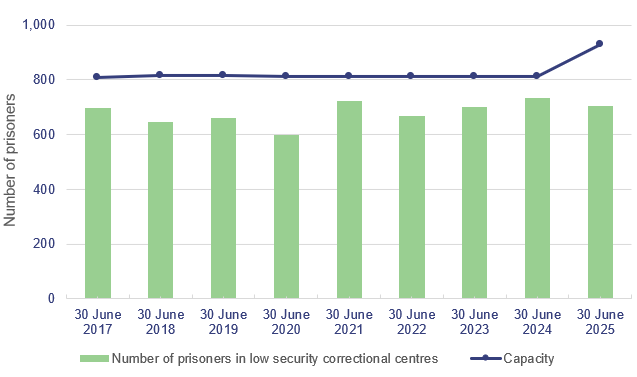
Queensland Audit Office using information provided by Queensland Corrective Services.
Effective use of low security facilities requires adequate risk assessment, and case management to ensure the safety of the community and maximise successful reintegration. QCS is currently working through how it can manage the risks in these less secure centres. The inconsistency, and in some cases absence, of case management is an inhibitor.
There is a lack of support to help prisoners reintegrate back into the community
Pre-release support includes providing prisoners with individualised plans and general advice on how to access services, set up bank accounts, and access legal advice and unemployment benefits.
Less than half of all prisoners that leave custody receive pre-release support. QCS provided this support to 7,899 prisoners of the 16,365 who left custody in 2024–25. While pre-release support is offered to all prisoners, not all accept it.
QCS does plan to prioritise support to those most at risk of reoffending or those with more complex needs to ensure they are connected to the right support services. However, it does not know whether the right prisoners are getting this support.
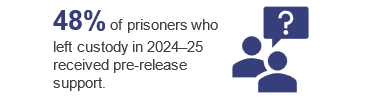
Queensland Audit Office using information provided by Queensland Corrective Services.
QCS can improve its contracts for delivering reintegration services
QCS contracts 2 non-government organisations, one supporting male prisoners and the other female prisoners, to help prepare and support them as they reintegrate back into the community. These organisations provide support to prisoners both within the correctional centres and outside in the community. However, there are gaps in QCS’s reintegration contracts, which mean it cannot effectively monitor the success of these services. Its contract for women’s reintegration services is more comprehensive than its contract for men’s reintegration services.
QCS established a contract for the provision of reintegration services to women prisoners in June 2024. It includes performance measures and requires the non-government organisation to report quarterly on its performance. QCS could strengthen its contract by including a mix of output and outcome-focused metrics. QCS meets regularly with this organisation.
In December 2024, QCS established a contract for the provision of reintegration services to male prisoners and it commenced in July 2025. QCS has some performance measures but is still establishing others. For example, it is developing a metric to measure prisoner attendance for reintegration services. Since the contract commenced, QCS has not been proactively monitoring whether reintegration services are leading to better outcomes for male prisoners.
Recommendation 5 We recommend that Queensland Corrective Services improves its approach to prisoner reintegration by:
|