Overview
Demand for social housing in Queensland continues to grow. Factors such as population growth, housing affordability, and complex social and economic challenges have increased pressure on the social housing system.
In our previous audit, Delivering social housing services (Report 1: 2022–23), we found opportunities for the department to improve its systems and processes to better manage increasing demand for social housing in Queensland.
Tabled 19 June 2026.


Report summary
This report examines whether the Department of Housing and Public Works (the department) has effectively addressed recommendations from Delivering social housing services (Report 1: 2022–23).

| What is the status of recommendations? |
The department has fully implemented 4 of the 8 recommendations and partially implemented 4. The table below summarises the department’s progress against each recommendation, including actions taken, further actions needed, and our assessment.
| Original recommendation | Actions taken by the department | Issues identified and actions needed |
|---|---|---|
| Applying for social housing | ||
1. Communicate needs assessment clearly Fully implemented | Updated website, materials, and policies; removed references to outdated needs categories. | No further action needed. |
2. Confirm applicants on register remain eligible for housing Partially implemented | Updated policies and procedures; established a central review team; updated systems to exclude inactive applicants from allocation. | Issue: Some applicant eligibility reviews are overdue, and the housing register may not accurately reflect applicants’ current circumstances. Action: Regularly review applicants’ eligibility and update the register. New recommendation made to strengthen management of applicants living in transitional and community housing. |
3. Consistently complete and review new housing applications Partially implemented | Implemented system-based assessment and review process; updated training materials. | Issue: New housing applications are not always reviewed in a timely manner. Action: Strengthen oversight of application reviews and approvals. New recommendation made to strengthen internal testing across recommendations 3, 5, and 6. |
| Allocating social housing | ||
5. Consistently perform pre-allocation checks Partially implemented | Implemented system changes; updated processes and training. | Issue: Pre-allocation checks are not always completed, reviewed, or timely. Action: Strengthen system controls and oversight of checks, including reviews. |
6. Apply a consistent priority allocation process Partially implemented | Introduced standard criteria; statewide system for approvals and monitoring. | Issue: Lack of system controls to enforce approvals; untimely reviews. Action: Strengthen system controls and oversight of priority allocations. |
| Managing the changing needs of tenants | ||
4. Model future demand for social housing Fully implemented | Developed statewide demand model; targets allocated to regional areas and South East Queensland local government areas. | No further action needed. New recommendation made for ongoing monitoring of inputs to the model. |
7. Improve tenancy management approach Fully implemented | Introduced annual rent and tenancy reviews for public housing under its new tenancy management approach. | No further action needed. New recommendations made to review the effectiveness of the department’s tenancy management approach and strengthen oversight of tenants in community housing. |
8. Support tenants to transition out of housing Fully implemented | Commenced rent and tenancy reviews under its new tenancy management approach; updated staff training. | |
We made 5 new recommendations to address gaps identified through this audit.
1. Audit conclusions
The Department of Housing and Public Works (the department) has not effectively implemented all recommendations from Delivering social housing services (Report 1: 2022–23). While the department assessed that it had fully implemented all our recommendations, we found that gaps remain for 4 of the 8 recommendations. We also found opportunities to further improve its effectiveness related to ongoing management and performance of the social housing register and tenancies.
Addressing the remaining recommendations and the 5 new recommendations we make in this report is necessary to support accurate information and planning, investment, and housing allocation decisions.
The department has taken steps to increase housing supply and improve its management of social housing. However, in an environment of increasing demand, the social housing register will continue to grow, and the department will increasingly find it challenging to effectively service those in need.
2. Recommendations
We have directed the following recommendations to the Department of Housing and Public Works (the department).
| Monitoring and improving performance | Entity responses |
| Agree |
| Managing applicants living in transitional and community housing | Entity responses |
| Agree |
| Overseeing community housing providers | Entity responses |
| Agree |
| Managing changing tenant needs | Entity responses |
| Agree |
| Updating demand modelling | Entity responses |
| Agree |
Reference to comments
In accordance with s. 64 of the Auditor-General Act 2009, we provided a copy of this report to the Department of Housing and Public Works. In reaching our conclusions, we considered its views and represented them to the extent we deemed relevant and warranted. The formal response from the Department of Housing and Public Works is at Appendix A.
3. Social housing in Queensland
The Department of Housing and Public Works (the department) is responsible for social housing in Queensland. This includes managing applications for social housing, allocating properties, and managing public housing tenancies. It provides a range of products and services to help Queenslanders who need housing assistance. Social housing is intended for those with the greatest housing need.
The department works with stakeholders, including community housing providers and specialist homelessness service providers, to deliver social housing services in Queensland.
Social housing is rental housing that is funded or partly funded by the government. It is available to Queenslanders who meet eligibility requirements and cannot access or sustain a tenancy in the private rental market.
Social housing includes public housing, First Nations housing, and housing owned or managed by community housing providers in partnership with the Queensland Government (community housing).
The housing register (the register) is a list of all approved social housing applicants in Queensland. It contains information about an applicant’s housing needs, including their bedroom requirements and preferred housing locations.
What did we find in Delivering social housing services (Report 1: 2022–23)?
Delivering social housing services (Report 1: 2022–23) assessed whether social housing was effectively managed to meet the housing needs of vulnerable Queenslanders.
We concluded that the department’s processes to manage the housing register were not effective. It needed to improve its systems and processes to better manage increasing demand for social housing in Queensland. Figure 3A outlines the key findings from this report.
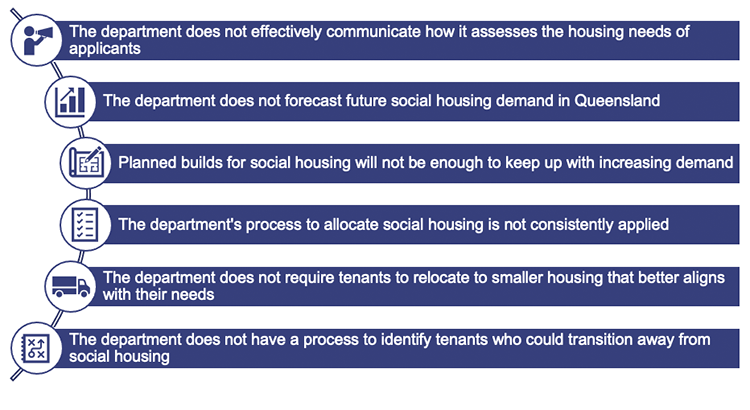
Queensland Audit Office, using information from Delivering social housing services (Report 1: 2022–23).
Our report made 8 recommendations to the then Department of Communities, Housing and Digital Economy (now the Department of Housing and Public Works). These focused on improving how the department manages the housing register and application process, its allocation practices, and tenants whose housing needs may change over time.
Appendix C sets out the original recommendations and our assessment of their implementation.
What has changed since our 2022–23 report?
Since our 2022–23 report, demand for social housing in Queensland has continued to grow. Population growth, housing affordability pressures, and complex social and economic challenges have increased pressure on the social housing system.
While the number of applicants on the housing register has fluctuated, overall demand has increased since 2017. Figure 3B shows changes in the housing register between June 2017 and December 2025.
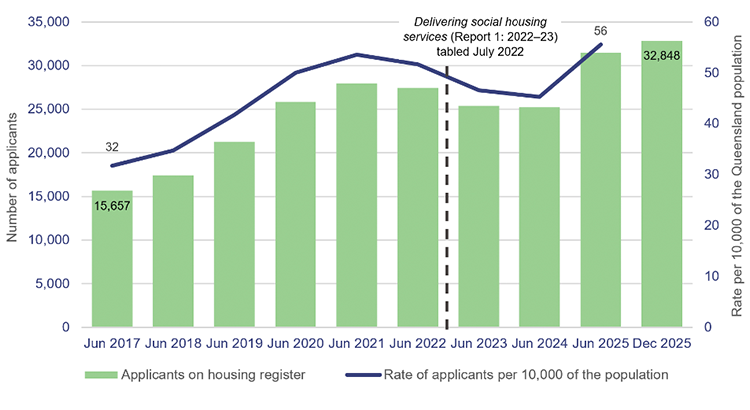
Note: The December 2025 data point reflects a different reporting period to the earlier June-based data. Australian Bureau of Statistics data for December 2025 was not available at the time of this report, so we could not calculate the application rate per population for that period.
Queensland Audit Office, using data from the Department of Housing and Public Works and the Australian Bureau of Statistics.
Applicants on the housing register declined between June 2022 and June 2024, aligning with the department’s increased management of the register including removing ineligible or uncontactable applicants. Applicant numbers then increased by 30 per cent between June 2024 and December 2025. The department advised that reduced staffing and review activity for managing the housing register in 2025 have contributed to the increase in applications on the register.
Figure 3C shows a snapshot of the housing register as at 31 December 2025, compared to the register examined in Delivering social housing services (Report 1: 2022–23) as at 31 March 2022.
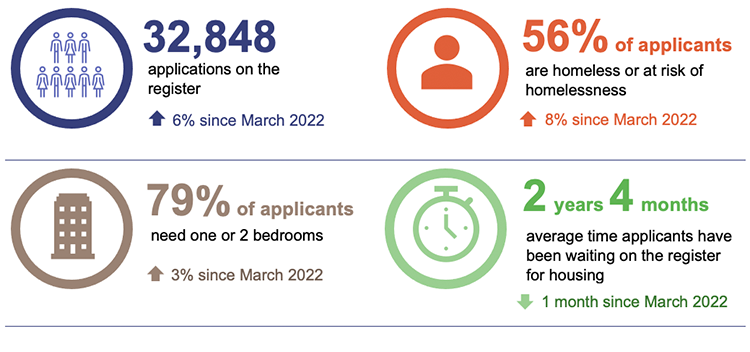
Queensland Audit Office, using data from the Department of Housing and Public Works.
To respond to expected growth in demand, the Queensland Government committed to delivering 53,500 social and community homes by 2044. This includes a range of housing types, including domestic violence shelters and housing in remote and discrete First Nations communities.
Overview of how the department manages social housing
The department’s social housing process covers application, assessment, allocation, and ongoing tenancy management. The department has updated aspects of this process over time, including in response to our original audit. We discuss these changes further in this report.
Figure 3D shows the key stages in the social housing process, from application through to tenancy and tenants leaving social housing.
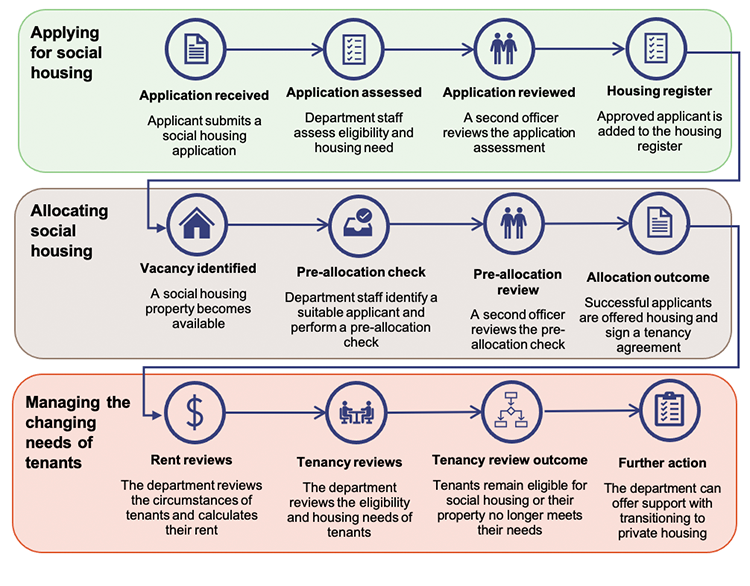
Note: Department staff can request priority allocation for approved applicants. We discuss priority allocations further in Chapter 5.
Queensland Audit Office, using information from the Department of Housing and Public Works.
What did we audit?
In this follow-up audit, we examined whether the department effectively addressed our 8 recommendations from Delivering social housing services (Report 1: 2022–23). Appendix C outlines the original recommendations, the department’s responses to them, and our assessment of its effectiveness in addressing them.
Figure 3E shows how this follow-up audit relates to both the department’s social housing process and the recommendations from our original report.
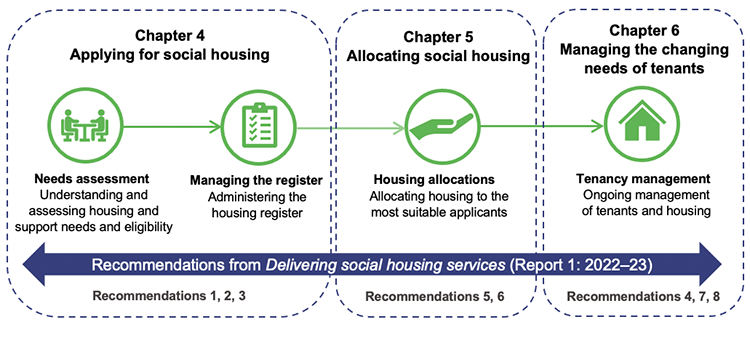
Compiled by Queensland Audit Office.
Our conclusions in this report provide reasonable assurance about how effectively the department addressed our recommendations from Delivering social housing services (Report 1: 2022–23). They do not provide assurance on the overall effectiveness of the department’s delivery of social housing services.
4. Applying for social housing
This chapter examines the progress of the Department of Housing and Public Works (the department) in addressing recommendations from 1 to 3 from Delivering social housing services (Report 1: 2022–23), which relate to:
- consistently assessing and reviewing new housing applications
- communicating the housing needs assessment process
- confirming the ongoing eligibility of applicants on the register.
The department uses a pathway planning process to identify an applicant’s circumstances and match them with suitable housing options. Based on this, the applicant may proceed with a social housing application.
Figure 4A shows the department’s process for assessing social housing applications, from receiving an application to adding an applicant to the housing register.
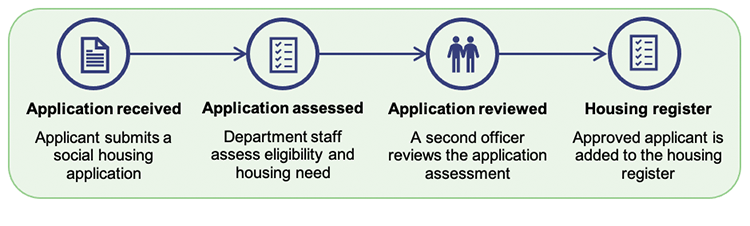
Queensland Audit Office, using information from the Department of Housing and Public Works.
Does the department consistently assess and review new housing applications?
In Delivering social housing services (Report 1: 2022–23), we examined a sample of new housing applications and found that 22 per cent did not have their needs accurately recorded in the system. We also found that approximately 50 per cent of applications were missing evidence of review by a second officer.
We recommended that the department consistently completes and reviews all new housing applications. This is to ensure only eligible applicants are included on the housing register and that the department has an accurate understanding of applicants’ needs.
In response to this recommendation, the department:
- implemented a system-based process for assessing and reviewing new housing applications
- updated training materials to support officers in consistently applying the revised process.
In this follow-up audit, we assessed this recommendation as partially implemented.
The department’s actions have not fully addressed weaknesses in how it assesses and reviews new housing applications
The department’s analysis shows inconsistent assessment practices for new housing applications. Errors remain in key aspects of application assessment, including income verification, eligibility checks, and confirming applicants’ living circumstances.
Figure 4B shows selected results from its analysis of new housing applications in 2024 and 2025. Of the 3 areas tested in both years, results improved in one and declined in 2 areas.
2024 | 2025 | ||
|---|---|---|---|

| Household incomes correctly documented | 95% | 98% |

| Applicant and co-applicant eligibility verified | 92% | 88% |

| Correct financial and non-financial indicators selected | 96% | 88% |

| Living circumstances verified at approval | N/A | 97% |
Note: Based on a sample size of 390 for 2024 and 192 for 2025.
Queensland Audit Office, using data from the Department of Housing and Public Works.
Similar issues in how the department applies key processes also occur across other stages of the housing process, including pre-allocation checks and reviews of tenants’ circumstances. We discuss these areas further in this report.
These findings highlight the importance of staff consistently applying key requirements across the housing process. The department has updated training materials across these areas. However, it does not track whether relevant staff have completed the training or whether this training has addressed issues identified through its internal checks.
About half of frontline service staff had less than 3 years of experience with the department as at 31 December 2025. This increases the importance of effective oversight, training, and quality assurance processes to support consistent application of key systems, processes, and controls across the housing process.
The department does not ensure all new housing applications are reviewed
While the department has updated its processes, it does not ensure all new housing applications are reviewed before being added to the register. Its system does not enforce application reviews, allowing officers to add applicants to the register without review or approve applications outside their authorised level.
The department identified these issues through its own checks. Figure 4C shows the results declined from 2024 to 2025.
2024 | 2025 | ||
|---|---|---|---|

| Second officer reviews completed | 77% | 71% |

| Documentation to support second officer decision-making included | 68% | 52% |

| Reviews performed within the policy time frame (10 days) | 69% | 46% |
Note: Based on a sample size of 390 for 2024 and 192 for 2025.
Queensland Audit Office, using data from the Department of Housing and Public Works.
Inconsistent review of new housing applications increases the risk that ineligible or inaccurate applications are added to the housing register. The department relies on the housing register to inform planning and investment decisions. We discuss the importance of the register for planning and investment further in Chapter 6.
Although the department has processes to review applicant eligibility and perform pre-allocation checks before offering housing, these occur later in the process. Relying on them to identify and resolve issues creates extra work and reduces efficiency.

| Recommendation status: Partially implemented The department still needs to:
Note: *These actions apply across multiple stages of the housing process. |
The department’s internal checks do not effectively drive improvement
While the department’s sampling provides useful insight, its approach could be strengthened to provide greater assurance over application quality and to better drive improvements in practice. Sampling continues to identify errors, but there is limited evidence the department adjusts its testing approach or response based on these results.
While sampling results are shared with relevant teams, the department does not consistently track what actions are taken, who is responsible, or whether those actions address the issues identified. This limits its ability to drive improvement.
The department also reduced its sampling in 2025 despite mixed results in 2024, including in areas where performance was poor. This shows its approach is not sufficiently scaled or responsive to identified risks.
Recommendation 1 We recommend that the department strengthens how it uses internal testing to monitor performance and drive improvement. This includes ensuring testing is scaled to risk and responds to identified issues. |
Does the department accurately communicate how it assesses applicant needs?
In Delivering social housing services (Report 1: 2022–23), we found the department assigned applicants on the register to low, moderate, and high needs categories. These categories no longer reflected how it assessed applicant’s needs. Although the department stopped using these categories in 2019, references remained on its website and could mislead users about how needs are assessed and prioritised. We also found stakeholders did not understand the department’s needs assessment process.
We recommended that the department clearly communicate the needs assessment process it applies. This included delivering a proactive communication campaign to key stakeholders and providing consistent, complete information on its website to support applicants understanding of their eligibility for social housing.
In response to this recommendation, the department:
- delivered a communication campaign to raise awareness of eligibility requirements and the needs assessment process
- updated its website and public-facing materials to clarify eligibility requirements and key terms
- removed references to outdated needs categories from its website, materials, systems, and policies.
In this follow-up audit, we assessed this recommendation as fully implemented.
The department accurately and consistently communicates the current needs assessment process
Published information on the department’s website and public-facing materials now reflect the current needs assessment process and eligibility requirements for social housing. This reduces the risk of applicants and stakeholders relying on outdated or inconsistent information. Staff from peak bodies and specialist housing and homelessness service providers told us they understand the needs assessment process for social housing.
The department continues to improve how it communicates the needs assessment process
While the department’s actions have improved how it communicates the needs assessment process, its research shows that some applicants still find the information difficult to understand.
Applicants primarily rely on in-person interactions at housing service centres, as well as printed materials and the department’s website, to understand the needs assessment process.
To support ongoing improvement, the department reviews its website and materials annually to identify where applicants may need more support or information. This includes checking that information is accurate and consistent, and reviewing changes before publication.

| Recommendation status: Fully implemented The department accurately and consistently communicates the current needs assessment process through its website, materials, and stakeholder engagement. |
Does the department effectively monitor the eligibility and needs of applicants?
In Delivering social housing services (Report 1: 2022–23), we found that many applicants on the register were unlikely to be allocated social housing. This included 31 per cent of applicants who were uncontactable or had inactive applications.
An application is inactive when the applicant is eligible for social housing but is unable to accept an offer of housing. For example, an applicant may have a current lease or be in a correctional facility, and not ready or able to respond to offers.
The inactive period is set for a maximum of 12 months, with limited exceptions. In practice, some applications remain inactive beyond this period and are subject to ongoing review. Inactive applications are not considered for housing allocations during their inactive period.
We recommended the department periodically confirm the ongoing eligibility of all applicants and update the register as needed. Removing inactive and uncontactable applicants supports an accurate housing register to inform planning, investment, and service delivery, and could potentially reduce waiting times for eligible applicants.
In response to this recommendation, the department:
- updated its policies and procedures to support management of the housing register, including limiting the number of housing offers an applicant can refuse and defining active and inactive applications
- established a central team to review active applications at least annually
- updated its systems to exclude inactive applicants when allocating social housing.
To maintain an accurate register, the department’s policy requires an annual review of applicant’s circumstances. Reviews can be initiated by applicants or by the department through its annual review process. The purpose of these reviews is to confirm applicants’ housing needs and ongoing eligibility.
In this follow-up audit, we assessed this recommendation as partially implemented.
The department does not review applications within required time frames
The department had not reviewed 34 per cent of active applications in the previous 12 months. Figure 4D shows the status of active application reviews.
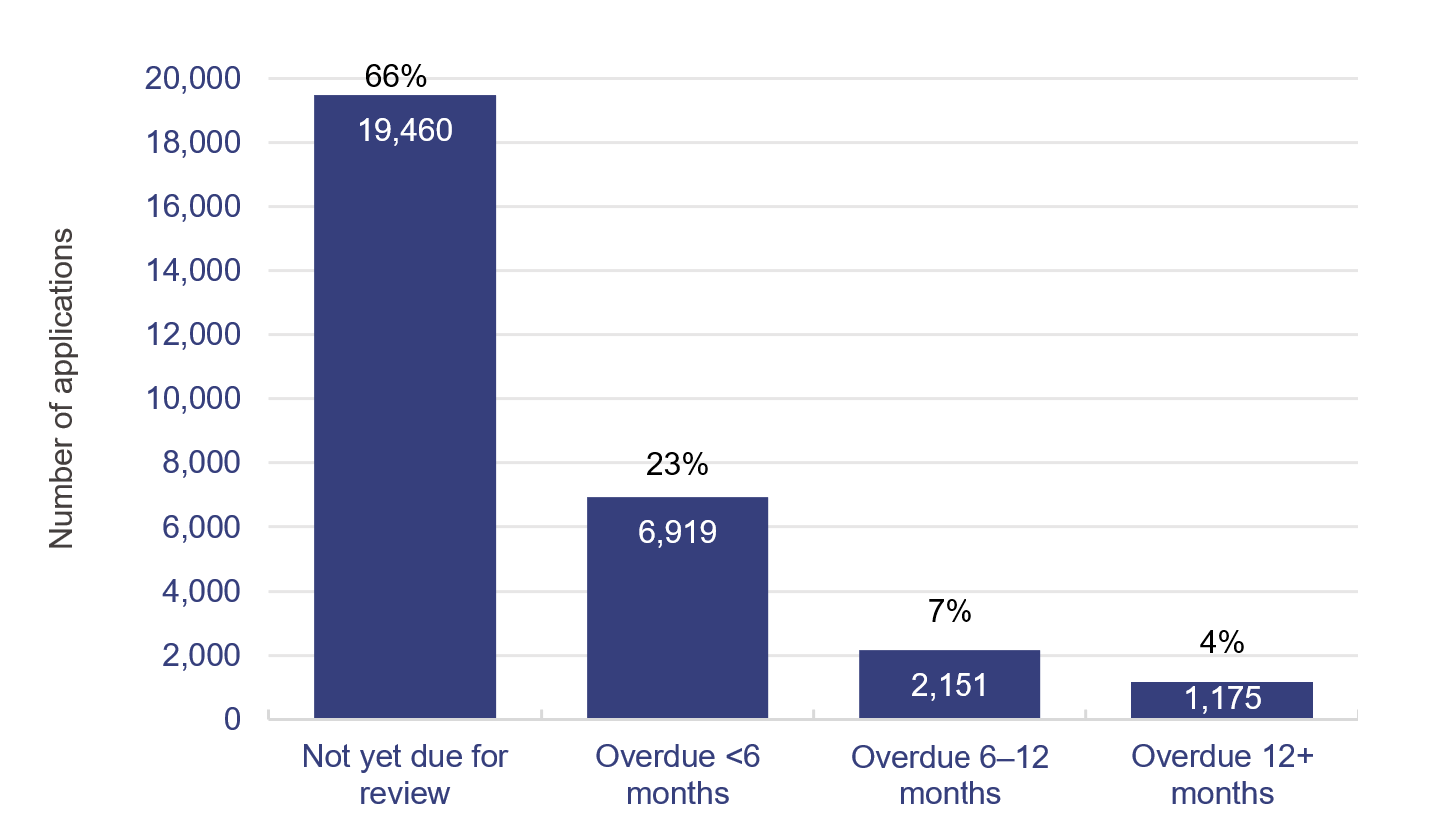
Queensland Audit Office, using data from the Department of Housing and Public Works.
In June 2023, the department established a central team to conduct annual reviews of active applications on the housing register. The department advised that the number of reviews completed declined in 2025 due to reduced staffing within the team. The department has also advised that staffing levels in the team have since increased enough to support the timeliness of reviews.
Most inactive applications are overdue for review
Some inactive applications remain on the register beyond their inactive period. Our analysis identified 2,369 inactive applications, most relating to applicants in transitional housing or correctional facilities.
Transitional housing is a form of social housing offered by community housing providers. It supports eligible people to stabilise their circumstances before moving to longer-term housing.
We found 63 per cent of inactive applications were past their inactive period end date at 31 December 2025. On average, these applications were last reviewed 7 months before the end of their inactive period.
Applicants can be classified as inactive for up to 12 months, with extensions allowed in some circumstances. The department's policy requires reviews during and at the end of the inactive period.
Local housing service centres manage these reviews, but performance varies. In some centres, 31 per cent of inactive applications have exceeded their inactive period and require updating. In others, this number is as high as 75 per cent.
The department needs to improve how it manages applicants living in transitional and community housing
In response to the COVID-19 pandemic, the department suspended time limits on how long a household can stay in transitional and community housing to support household stability until the end of the declared public health emergency.
The housing register includes 4,847 active applicants in transitional housing and 603 in community housing. This represents 17 per cent of the total housing register at 31 December 2025.
The department has a central team responsible for reviewing active applications on the housing register. However, this team has not performed reviews for applicants living in transitional and community housing as part of the annual review process. These reviews are intended to confirm that applicants living in these arrangements remain eligible for housing and are appropriately classified on the housing register.
The department advised that it plans to work with funded community housing providers to update the housing register. It also advised that its central team will commence annual reviews for these applicants.
Recommendation 2 We recommend that the department strengthens how it manages applicants on the housing register who are living in transitional and community housing, including:
|
The department removes applicants from the register when they are no longer eligible
The department cancelled and removed 26,844 applications from the register between 2022 and 2025. Applicants who have been removed from the register can reapply if their circumstances change in the future. Figure 4E shows the most common reasons for cancellation.
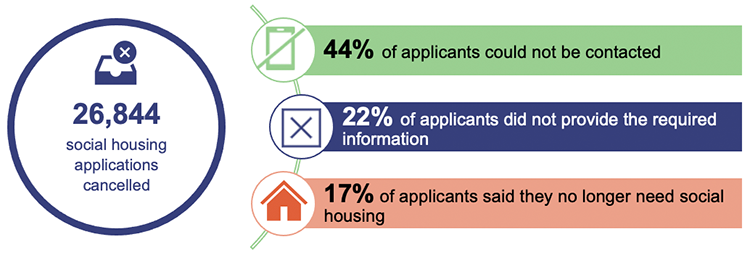
Queensland Audit Office, using data from the Department of Housing and Public Works.
Department staff have a range of methods available to contact applicants before cancellation, including phone, SMS, email, and mail. The department also engages with Queensland Corrective Services and other support services to reach applicants who do not use digital or postal services. The department requires officers to make reasonable attempts to contact applicants before cancelling their applications.
However, the department does not maintain aggregated data on how many times or by what means applicants are contacted before their applications are cancelled. This limits its ability to monitor whether staff consistently apply these requirements.
|
| Recommendation status: Partially implemented The department still needs to:
|
5. Allocating social housing
Once applicants are assessed as eligible and added to the housing register, the Department of Housing and Public Works (the department) needs to confirm they remain eligible before being allocated housing. Applicants facing serious, urgent, or extraordinary circumstances may be prioritised for an offer of housing.
This chapter examines the department’s progress in addressing recommendations 5 and 6 from Delivering social housing services (Report 1: 2022–23), which relate to:
- checking applicants’ needs and ongoing eligibility before making an offer of housing
- implementing a consistent process to identify, approve, record, and monitor priority applicants on the housing register.
Figure 5A shows the department’s process for allocating social housing, from a property becoming available to allocating it to an applicant on the register.
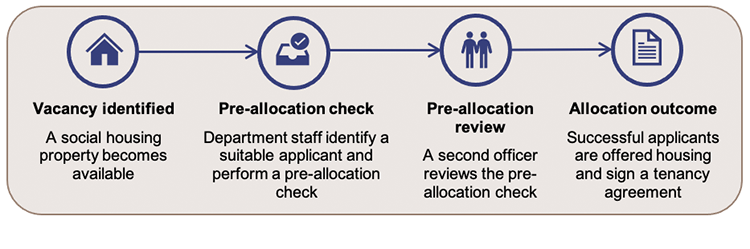
Queensland Audit Office, using information from the Department of Housing and Public Works.
Does the department prioritise housing to applicants in urgent need?
In Delivering social housing services (Report 1: 2022–23), we found the department prioritised social housing for applicants facing serious, urgent, or extraordinary circumstances. Each housing service centre maintained its own list of priority applicants, and there were no standard criteria to assess priority allocation. Assessments relied on housing officers’ judgement and varied across locations.
We recommended the department implement a consistent process to identify, approve, record, and monitor priority applicants across the state.
In response to this recommendation, the department:
- developed standard criteria to support housing officers to consistently identify and assess priority applicants
- implemented a statewide system in September 2022 to record, approve, and monitor priority allocations
- updated training materials to support consistent application of the revised process.
In this follow-up audit, we assessed this recommendation as partially implemented.
The department does not effectively monitor priority allocation approval and reviews
Each local housing service centre area manager is required to approve requests for priority allocation. However, the department cannot provide evidence that only area managers approved all priority applicants. Officers can bypass area manager approval or may seek approval from area managers outside of the system. This could include through free-text notes or email correspondence. While these practices increase the risk that applicants are inappropriately prioritised, the department also performs pre-allocation checks before making housing offers. We discuss these checks further below.
Figure 5B shows the department’s analysis of priority allocations for 2024. The department chose not to test priority allocations in 2025 but has advised this will resume in 2026.
2024 | ||
|---|---|---|

| Decision-making for priority allocation requests sufficiently detailed | 75% |
|
| Priority allocation decisions approved within the 10-day policy time frame | 91% |
Note: Based on a sample size of 100 for 2024. The department did not sample priority allocations for 2025.
Queensland Audit Office, using data from the Department of Housing and Public Works.
The department approved most priority allocation decisions within policy time frames. However, for one in 4 cases tested in 2024, there was not enough detail to support the decision-making process. This creates a risk that some applicants were approved for priority allocation without sufficient information to support the decision.
The department does not complete timely reviews of priority allocations
The department’s policy requires reviews at least every 6 weeks to confirm ongoing need and identify changes in circumstances.
Between June and December 2025, the number of priority allocations decreased from 2,160 to 150, a reduction of 93 per cent. During this period, the department increased its review of existing priority allocations and identified that many applications were no longer eligible for priority status.
The department’s analysis for 2024 found 41 per cent of priority allocations were overdue for review. Our analysis found that, at 31 December 2025, 66 per cent of priority allocations were overdue for review. Of these, 11 per cent were overdue by more than one year. This indicates that performance in conducting reviews has declined since 2024.
Delays in reviewing priority allocations increase the risk that applicants remain inappropriately prioritised ahead of other applicants on the housing register. While pre-allocation checks can help identify some issues before housing is offered, they do not remove the need for timely reviews.
Figure 5C shows the review status of priority applicants on the housing register, based on the last recorded review date.
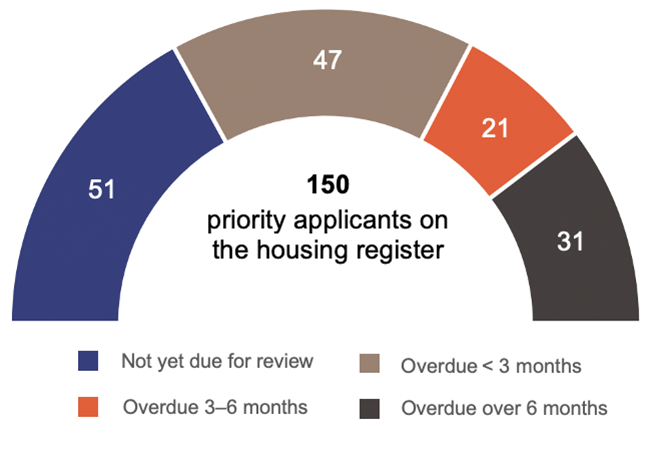
Queensland Audit Office, using data from the Department of Housing and Public Works.
Staff manually enter review dates in the system, which means recorded dates may not accurately reflect when reviews occurred. The department’s analysis for 2024 found review dates were current in 57 per cent of cases.
|
| Recommendation status: Partially implemented The department still needs to:
|
Does the department confirm the needs and eligibility of applicants before allocating housing?
Before making an offer of housing, the department performs a pre-allocation check to confirm applicants remain eligible and that the property aligns with their needs.
In Delivering social housing services (Report 1: 2022–23), we examined a sample of allocations and found 18 per cent did not have a pre-allocation check on file. We also found no evidence of a second officer review for 20 per cent of checks tested. Without both a pre-allocation check and review, applicants were not appropriately screened before allocation.
We recommended the department consistently perform pre-allocation checks through a system-based process.
In response to the recommendation, the department:
- implemented system changes to support consistent completion and review of pre-allocation checks
- updated training materials to support consistent application of the revised process.
In this follow-up audit, we assessed this recommendation as partially implemented.
Pre-allocation checks are not always performed or reviewed before housing is allocated
Given the high demand relative to supply of social housing, it is essential that final pre-allocation checks are conducted for all applicants prior to them being allocated a house. Our analysis of system data shows pre-allocation checks were performed for 96 per cent of housing offers made between 1 January and 31 December 2025.
The department’s internal checking processes have identified that errors remain in key aspects of pre‑allocation checks. For example, current income and assets were documented in around 70 per cent of sampled cases, compared with higher rates of verification for other fields such as household details.
Pre-allocation checks are a key control to confirm applicants remain eligible and that housing offers are appropriate before housing is allocated. These checks are required for all housing offers because applicants’ circumstances can change while they are on the housing register. Not completing checks for all offers increases the risk that housing is allocated using outdated or incomplete applicant information. Once housing is allocated, it can also be difficult for the department to reverse unsuitable allocation decisions or transition tenants to alternative housing arrangements.
Figure 5D shows the department’s analysis of pre-allocation checks for 2024 and 2025.
2024 | 2025 | ||
|---|---|---|---|

| Property needs and household members confirmed | 90% | 95% |

| Applicant income and assets are current in the system | 69% | 71% |
Note: Based on a sample size of 390 for 2024 and 170 for 2025.
Queensland Audit Office, using data from the Department of Housing and Public Works.
The department’s data indicates second officer reviews are not always completed before it offers housing
The department does not monitor whether second officer reviews are completed for all pre-allocation checks. As with other system approvals, housing officers can bypass the approval process and obtain approvals outside of authority levels.
In some cases, the department’s policy does not require a second officer review, for example, decisions made by senior housing officers or community housing providers. However, these exceptions cannot be readily identified in system data, limiting the department’s ability to monitor whether reviews occur.
The department requires pre-allocation checks to be reviewed within one business day of an allocation decision. The department’s analysis shows these checks were not always reviewed or completed within this period. As detailed above, this is an important step to ensure housing allocation decisions are appropriate and this should be undertaken for all decisions.
Figure 5E shows that while completion of second officer reviews improved in 2025, timeliness declined, with 67 per cent completed within one business day.
2024 | 2025 | ||
|---|---|---|---|

| Second officer reviews of pre-allocation checks completed | 75% | 88% |
|
| Reviews completed within the one business day policy time frame | 91% | 67% |
Note: Based on a sample size of 390 for 2024 and 170 for 2025.
Queensland Audit Office, using data from the Department of Housing and Public Works.
Limited monitoring of reviews and approvals increases the risk of allocating housing to ineligible applicants or to applicants whose needs have changed.
|
| Recommendation status: Partially implemented The department still needs to:
|
6. Managing the changing needs of tenants
This chapter examines the progress of the Department of Housing and Public Works (the department) in addressing recommendations 4, 7 and 8 from Delivering social housing services (Report 1: 2022–23), which relate to:
- modelling future demand for social housing to inform planning and investment
- responding to the changing needs of tenants
- identifying and supporting tenants who can transition from social housing.
Improving these tenancy management practices will help deliver a fair and equitable social housing system.
Figure 6A shows the department’s process for reviewing and responding to tenant’s changing needs.
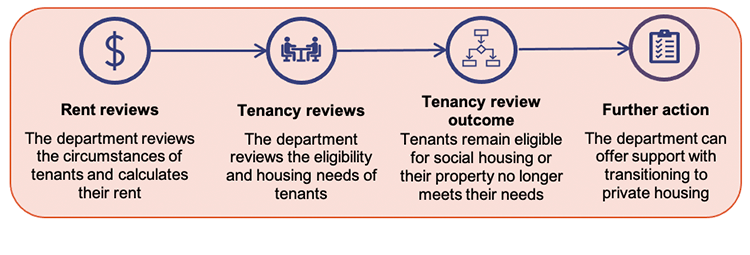
Queensland Audit Office, using information from the Department of Housing and Public Works.
The department and community housing providers manage a large and diverse social and community housing portfolio to meet tenants’ needs. Figure 6B shows the scale and composition of this portfolio.
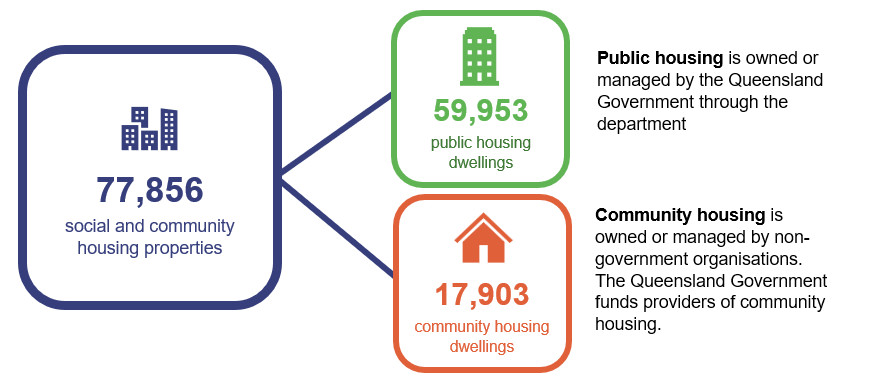
Queensland Audit Office, using data from the Department of Housing and Public Works.
Does the department respond to tenants’ changing circumstances?
In Delivering social housing services (Report 1: 2022–23), we found the department did not proactively review tenants to identify changes in their circumstances, including finances, family composition, and accessibility needs. We also found it did not require tenants to relocate to housing that better matched their needs.
We recommended the department review its approach to tenancy management to better respond to tenants’ changing needs. We also recommended it use structured conversations with tenants to identify and support those who can transition from social housing.
In response to these recommendations, the department:
- reviewed its approach to tenancy management and implemented its Strengthening Tenancy Management (STM) approach in July 2025
- began annual tenancy reviews under the STM approach, including rent reviews and tenancy conversations to confirm eligibility and assess tenant’s changing needs
- recruited and trained staff to undertake rent reviews and tenancy conversations
- updated its website and developed materials to inform tenants about annual reviews under the STM approach.
In this follow-up audit, we assessed these recommendations as fully implemented but identified a further improvement opportunity.
The department has started engaging with tenants to address their changing needs
Tenancy reviews support the department in identifying tenants who are no longer eligible for public housing or whose housing no longer aligns with their needs.
The department has commenced rent and tenancy reviews
The department began rent reviews under the STM approach in July 2025. It completed 16,770 rent reviews between 1 July 2025 and 1 March 2026 to identify changes in household circumstances and assess whether rent should be adjusted. These reviews resulted in rent adjustments where required, including charging market rent to tenants who do not provide information to verify their income.
In September 2025, the department also began tenancy reviews to confirm tenants’ circumstances and ongoing eligibility. It engaged with 4,970 households between September 2025 and 1 March 2026. Of these, 98 per cent were confirmed as remaining eligible for social housing. Figure 6C shows the outcomes of these reviews to date.
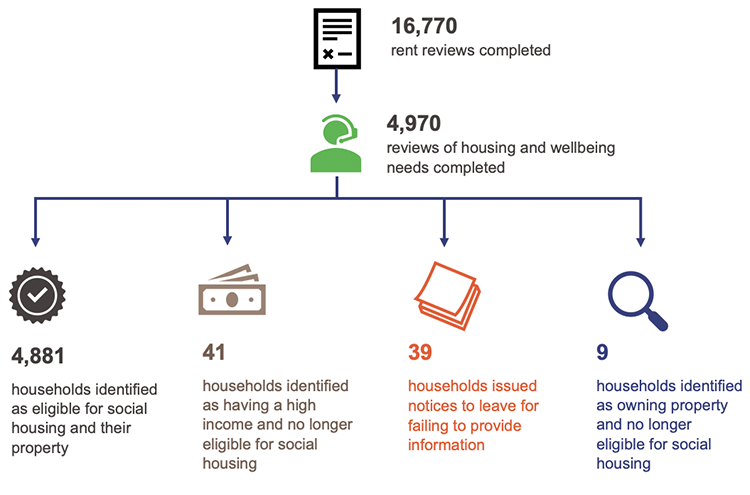
Note: Tenants who fail to provide information can provide the required information at any time before their tenancy is terminated and can request a review of mitigating circumstances at any time during the review period.
Queensland Audit Office, using data from the Department of Housing and Public Works.
At 31 March 2026, no tenants had exited public housing due to ineligibility. Tenants identified as ineligible have 4 months to vacate their properties from the time they are notified by the department.
The department has gaps in overseeing funded community housing providers
The department does not have a direct relationship with tenants in community housing. It relies on funded community housing providers to review tenants’ ongoing eligibility and report outcomes to the department through contractual reporting requirements. These contracts also require funded community housing providers to report on a range of other performance measures, including average time to tenant a vacant property, and the percentage of tenants supported with accessing housing in the private rental market.
Despite these reporting requirements, the department is not receiving all required reporting from funded community housing providers or consistently acting on the information it does receive. This limits the department’s visibility over whether issues are identified and addressed, and whether tenants remain appropriately housed.
Recommendation 3 We recommend that the department strengthens its oversight of funded community housing providers. This should include collecting, analysing, and acting on provider performance, including tenant outcomes. |
The department introduced a policy to manage behaviour of social housing tenants
Alongside the STM approach, the department implemented an Antisocial Behaviour Policy (ASB) from 1 July 2025.
The policy defines consequences for poor tenant behaviour, including:
- issuing verbal or written warnings and breach notices
- requiring tenants to sign acceptable behaviour agreements
- ending tenancy agreements.
If a tenant engages in substantiated dangerous or antisocial behaviour, the department can end the tenancy after the first incident. For ongoing disturbances, the department can end the tenancy after a third incident within 12 months.
Exclusion periods prevent tenants from reapplying for social housing if they are evicted under this policy. The exclusion period is 12 months for disruptive or aggressive behaviour and 24 months for dangerous or illegal activity.

| While still early in its implementation, frontline housing officers we spoke to provided positive feedback about the ASB policy as a way to discuss behaviour expectations and drive change. |
Figure 6D shows the number and outcomes of ASB complaints as at 1 March 2026.
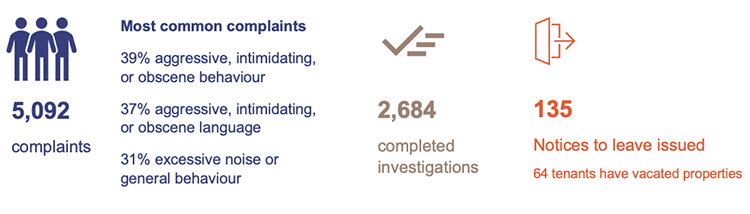
Note: A single complaint can be included in multiple categories.
Queensland Audit Office, using data from the Department of Housing and Public Works.
At 1 March 2026, not all tenants who were issued a notice to leave had vacated their properties. This is because tenants have time to vacate their properties after they are notified by the department.
Dwellings are under or over occupied
Under (or over) occupancy occurs when a dwelling has too few (or too many) people living in it. The department considers a dwelling under occupied if it has 2 or more spare bedrooms, and over occupied if at least one more bedroom is required to meet tenant needs. The department uses criteria such as the number, age, and gender of occupants to assess occupancy.
The current level of under occupancy is below the department’s 15 per cent service delivery target. Figure 6E shows the level of occupancy in public housing across Queensland as at 31 December 2025.
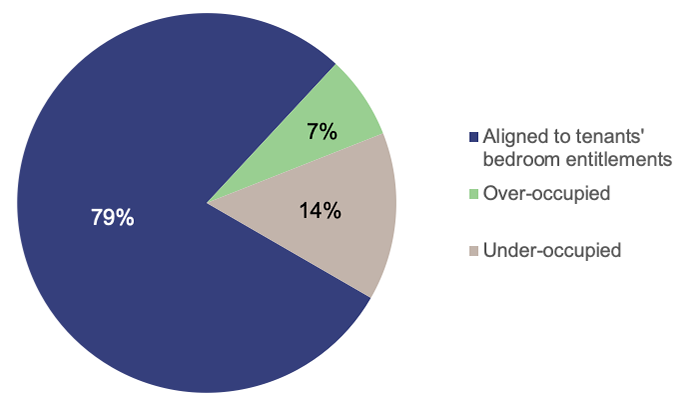
Queensland Audit Office, using data from the Department of Housing and Public Works.
The department relies on voluntary transfers to manage under occupancy
Tenants are required to notify the department if their circumstances change. They may also contact the department to request a property transfer. Through these interactions, the department may identify tenants suitable for downsizing. Between 1 July 2022 and 1 March 2026, 826 households voluntarily transferred properties. Most downsized to one or 2-bedroom properties, making 1,227 bedrooms available for families in need.
In addition to these tenant-initiated transfers, the department uses tenancy reviews to identify under‑occupancy. This process identified 487 tenants under occupying their properties. Of these, 89 per cent indicated they were not willing to relocate. At 1 March 2026, no tenants had relocated directly as a result of tenancy reviews.
The department relies on voluntary transfers, supported by relocation assistance and incentives, to encourage tenants to move to more suitable properties. This includes covering removalist costs and offering rent-free periods for tenants who move to smaller homes.
The department also provides a range of incentives to help tenants transition from social housing to the private rental market. However, it does not monitor whether these supports help tenants establish and sustain private tenancies.
In some circumstances, tenants can be required to vacate 5-plus bedroom or wheelchair-accessible properties if they no longer demonstrate an ongoing need. The department has limited reporting on tenants required to vacate these properties, reducing visibility over whether this approach supports better use of housing stock.
Current housing stock does not align with tenant needs
Queensland’s social housing stock does not align with the bedroom entitlements of current tenants. This limits the department’s ability to reduce under and over occupancy.
Figure 6F compares existing housing stock with tenant bedroom requirements as at 31 December 2025.
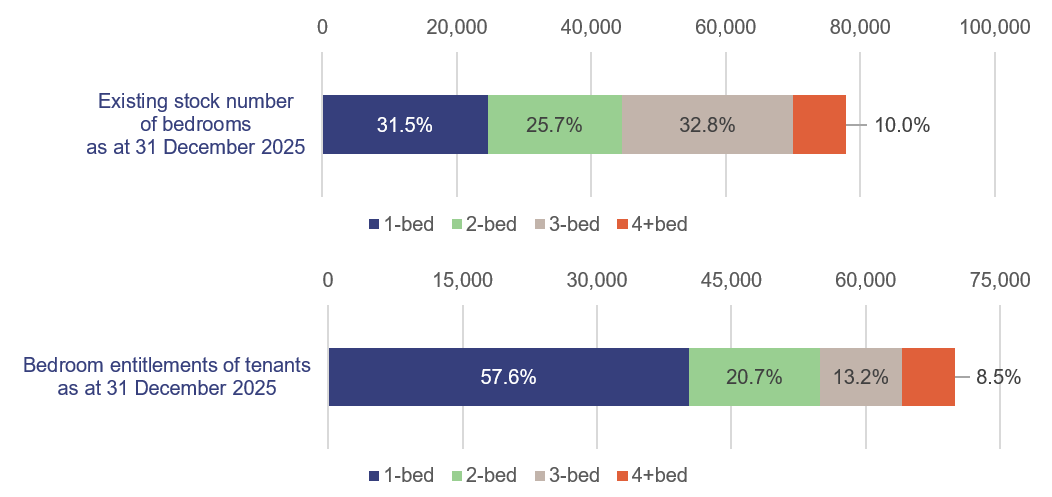
Queensland Audit Office, using data from the Department of Housing and Public Works.
Most tenants need one-bedroom properties, but existing stock does not meet this demand. The department’s use of demand modelling to inform planning and investment is discussed further below.
|
| Recommendation status: Fully implemented (recommendations 7 and 8) The department has reviewed its approach to tenancy management and implemented its Strengthening Tenancy Management approach. This includes annual tenancy reviews and rent reviews to confirm tenants’ ongoing eligibility for social housing and address their changing needs. It has also implemented processes and incentives to support tenants to transition from social housing. |
Recommendation 4 We recommend that the department monitors and reviews the effectiveness of its tenancy management approach, including whether its incentives support tenants’ changing housing needs and transition from social housing where appropriate. |
Does the department forecast demand to inform planning and investment decisions?
In Delivering social housing services (Report 1: 2022–23), we found the department did not have a model to forecast growth of the housing register to inform planning, investment, and service delivery.
We recommended the department models future demand for social housing at the state and regional levels, incorporating historical and predictive analysis, including social, economic, and environmental factors. This would improve its understanding of whether its investment and service delivery initiatives would meet future demand.
In response to this recommendation, the department:
- engaged Queensland Treasury and Queensland Treasury Corporation to model the future demand for social housing at a state level
- allocated the state target to regional areas and South East Queensland local government areas to inform planning, investment, and service delivery decisions.
In this follow-up audit, we assessed this recommendation as fully implemented. We have also made a new recommendation for the department to regularly update its demand modelling.
The government developed a statewide housing demand model
In 2023, the Queensland Government, through Queensland Treasury and the Queensland Treasury Corporation, engaged specialists to model the gap between housing demand and supply at a state level. This modelling informed the government’s target to deliver 53,500 social and community homes by 2044.
The model used population projections, census data, social housing vacancy rates, and homelessness estimates to produce a point-in-time estimate of social housing need.
The modelling produced a single statewide target for Queensland and did not allocate demand at a regional level.
The department developed a distribution model to inform planning
The department developed a distribution model to allocate the statewide target to regional areas and South East Queensland local government areas. This model uses housing register needs data, homelessness data, and population forecasts.
The distribution model informs planning and delivery of new social and community homes, including allocation of tenancies in both government-managed and community housing. The department also monitors housing delivery against these targets.
Figure 6G compares social and community homes delivered between 1 July 2023 and 31 December 2025 with applicants’ bedroom requirements on the housing register.
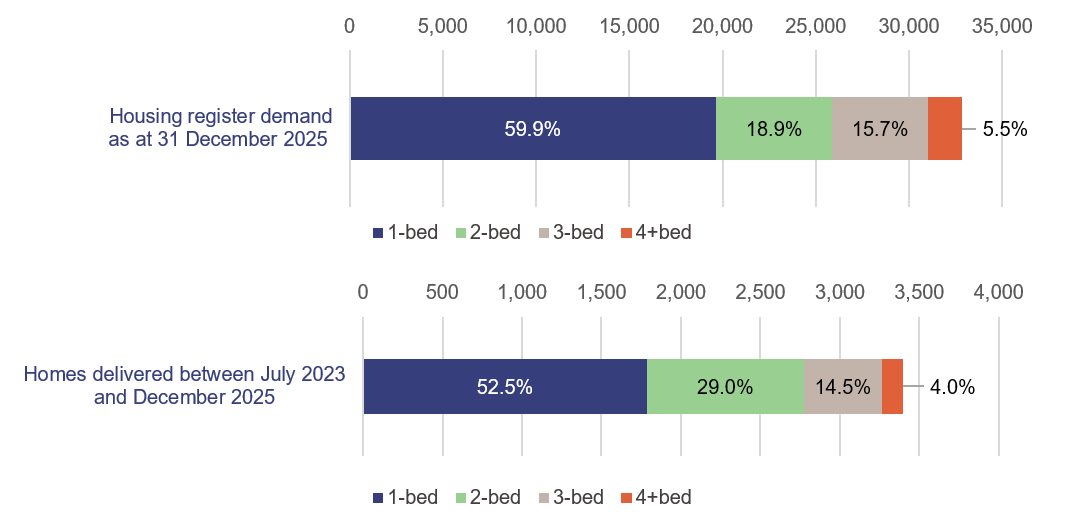
Queensland Audit Office, using data from the Department of Housing and Public Works.
The distribution model uses census data and population projections from 2021 and 2023, respectively. While the department is reviewing the distribution model for 2026, it has not yet finalised this update. As a result, the model remains based on point-in-time data.
Updating these inputs could change how the statewide demand target is distributed across Queensland, in line with changes in population, rental affordability, and homelessness data.
|
| Recommendation status: Fully implemented A demand model has been developed as recommended and is used to inform the department’s planning, investment, and service delivery. |
The department does not have the demand model or a process to update it
The department does not have access to the statewide demand model, including its assumptions and outputs. As a result, it cannot update the inputs underpinning the model or reflect changes in demand over time.
Without access to the model, the department cannot test assumptions or compare forecasts with actual demand to refine it over time. The model is therefore likely to become outdated over time and may not reflect current demand for social housing. Over the medium to long-term, this increases the risk that planning and delivery of new housing supply does not align with demand.
The target for additional housing will also affect the department’s workload across housing applications, allocations, and tenancy management. The department is reviewing its operating model to align with current and future demand.
Recommendation 5 We recommend that the department establishes an approach to periodically review and update key inputs to the demand model so that the model reflects current demand and informs planning decisions. |