
Overview
The Queensland Government uses debt and investments to manage the state's finances. This ensures government can provide a wide range of services for Queenslanders, deliver new initiatives, and meet its liabilities. It also supports ongoing access to long-term investments to strengthen the state’s future.
Tabled 5 March 2026.


Report on a page
This report examines how the Queensland Government is managing its finances, including the overall financial performance of the state. It reports on key changes to debt and investments and the management of some major initiatives.
Financial position and performance of the state
The Report on State Finances includes the revenue, expenses, assets, and liabilities for general government (departments and statutory bodies) and the total state sector (adding in financial and corporate entities). The report was completed in October 2025 and covers the year to 30 June 2025.
For the year to 30 June 2025, the net operating deficit increased by $7.1 billion to $8.5 billion. This was mainly due to an increase in employee expenses and a decrease in several sources of revenue. There was also an increase in net assets by $20.7 billion, mainly due to an increase in the value of state-owned land and buildings.
Interest costs have increased with higher borrowings
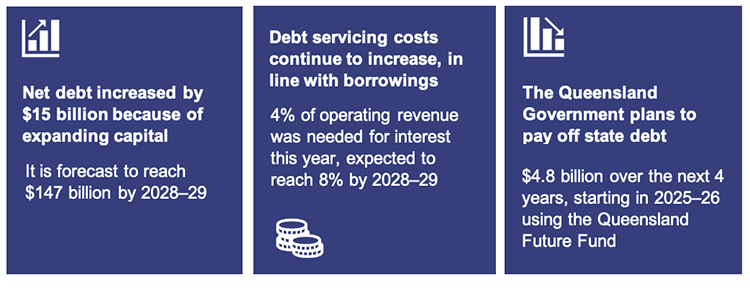
To fund its infrastructure and investments, the Queensland Government's non-financial public sector increased its net debt by $15 billion this year. Net debt is the borrowings of the sector less its investments. Interest costs associated with debt were $4.3 billion for this area, representing 4 per cent of expenses. Interest costs are expected to rise to $9.7 billion in 2028–29, when net debt is projected to reach $147 billion. The government currently uses its investment, called the Queensland Future Fund, to offset debt – helping to manage interest costs and the state’s credit rating. In future years, it plans to directly pay off $4.8 billion of its debt using this investment.
Long-term investments increased to $49 billion
The state holds long-term investments to fund obligations like superannuation and insurance payments. This year, investment performance helped offset the impact of higher borrowings. The Queensland Future Fund increased by $2.2 billion due to strong performance in several investments. One of these investments is the Titles Queensland Group. The fair value of this has increased by 83 per cent over the last 5 years to $10.7 billion.
The state also provided support and investment in Virgin Australia during the COVID-19 pandemic. This has now been finalised with a debt of $125 million repaid and a debt of $50 million forgiven, after certain requirements were met. The original equity investment of $25 million is now valued at $27.9 million after the company was relisted on the ASX.
QIC is now managing more Queensland Government initiatives
QIC Limited (QIC) is the investment manager for several Queensland Government initiatives. Recently it was also appointed as investment and development manager for Queensland Hydro, which was previously a company controlled by Queensland Treasury. The Queensland Government also announced that QIC will be involved in overseeing several projects under its Energy Roadmap 2025. This includes assessing delivery and funding options for additional pumped hydro projects, CopperString East (which is a major Queensland transmission line in north Queensland), and other clean energy and gas projects held in Queensland state-owned generators.
1. Entities involved in managing Queensland’s finances
We have outlined the roles and responsibilities of the entities directly involved in managing the state’s finances in Figure 1A.
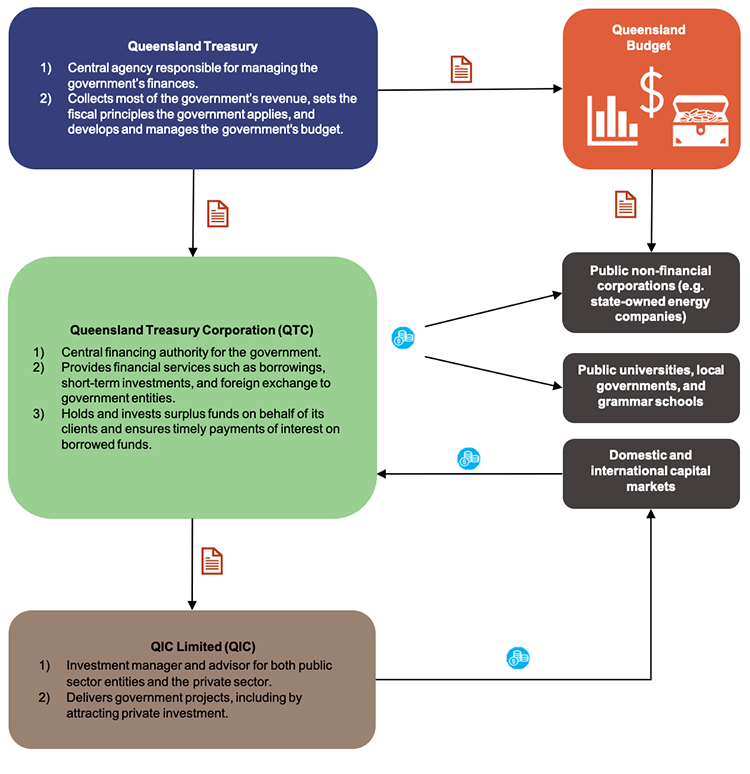
Note: ‘Fiscal’ refers to government spending, revenues, and/or debt. ‘Capital markets’ refers to the market where companies, governments, and individuals buy and sell long-term investments like stocks and bonds to raise or invest capital for growth, operations, or public projects.
Queensland Audit Office.
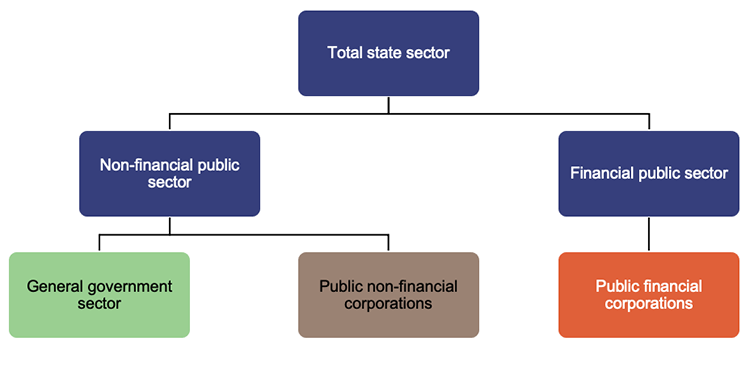
The Queensland budget sets out how public money will be raised and spent each financial year to deliver a wide range of services to Queenslanders. Queensland Government entities may use debt to fund investment in infrastructure projects or pay for operating expenditure. These entities fit within the Queensland Government sectors shown in Figure 1B and explained below.
The Queensland Audit Office.
The general government sector provides services to the community. It is mainly financed by taxes, royalties, fees, and Australian Government grants. It also uses debt, mainly to finance capital investments, which are long-term assets or projects that should generate benefits for years to come. Examples of capital investments include:
- Department of Education – schools
- Department of Health – hospitals
- Department of Transport and Main Roads – road infrastructure.
Public non-financial corporations are entities that provide goods or services to consumers on a commercial basis. They are financed through revenue for goods and services, which sustains their operations. Significant purchases are financed through money invested into the business or through debt. Examples include:
- Stanwell Corporation Limited
- Energy Queensland Limited
- Queensland Rail
- Powerlink Queensland.
Public financial corporations provide financial services, including central bank functions, savings deposits, investment fund management, and insurance services. They typically hold significant investments and may assist with managing treasury operations for government entities. Examples include:
- National Injury Insurance Agency, Queensland
- QIC Limited
- Queensland Treasury Corporation
- WorkCover Queensland.
2. Financial performance and position of the Queensland Government’s total state sector
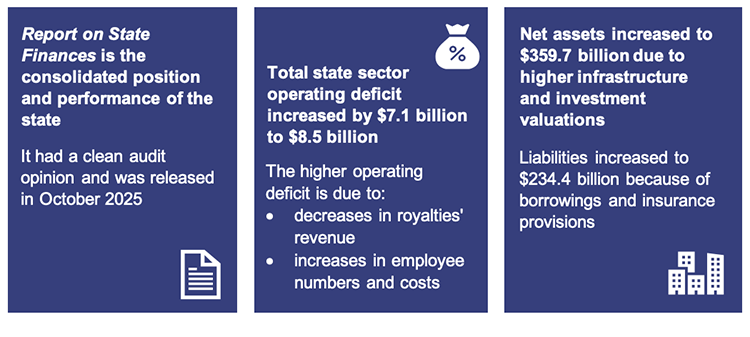
This chapter highlights the results and financial position of the total state sector, movement compared to last year, and the main reasons for this movement. Total state sector is the consolidated position of all departments, statutory bodies, and government owned corporations.
Chapter snapshot
Audit opinion results
The Financial Accountability Act 2009 requires the Treasurer to prepare annual consolidated financial statements for the Queensland Government. These financial statements are included in the 2024–25 Report on State Finances of the Queensland Government.
On 15 October 2025, the Auditor-General issued an unmodified audit opinion on the Queensland Government’s 2024–25 consolidated financial statements. This means the financial statements can be relied upon.
Financial results of the total state sector
In 2024–25, the Queensland total state sector recorded a net operating deficit of $8.5 billion, $7.1 billion more than last year ($1.4 billion). As shown in Figure 2A, this was driven by a growth in employee expenses and interest expenses. There was a decline in royalties revenue, partly offset by higher taxation and grants revenue.
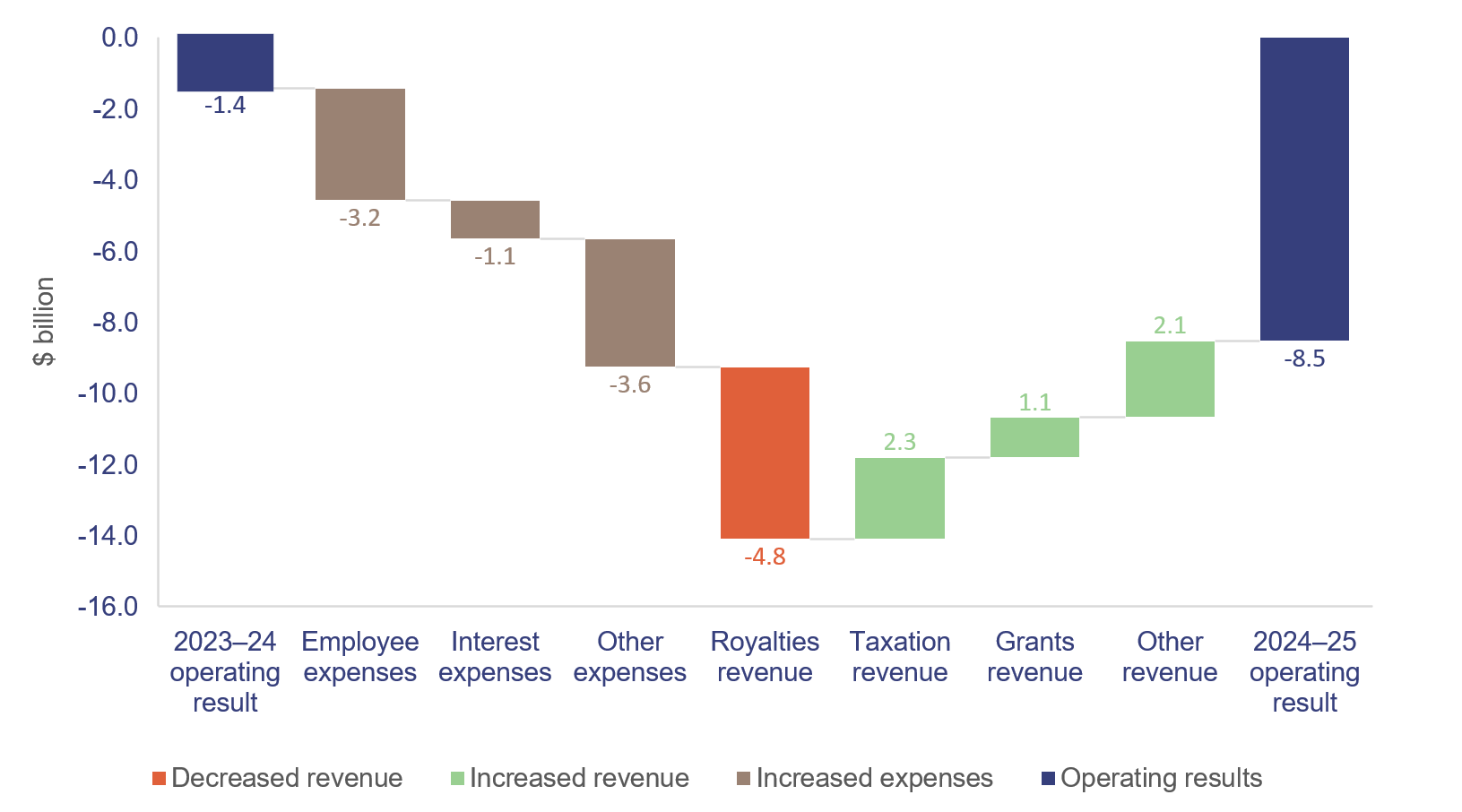
Compiled by Queensland Audit Office from the 2024–25 Report on State Finances of the Queensland Government.
Expenses in 2024–25
In 2024–25, total state sector expenses increased, largely due to higher employee expenses. The employee expenses for the total state sector were $39.2 billion, $3.2 billion higher than the prior year. The number of total state full time equivalent (FTE) employees as of 30 June 2025 was 305,823 – an increase of 5 per cent (or 14,205 employees) compared to last year. The average cost per employee is $128,000 (from $123,000).
The hospital and health sector was the largest contributor to the increase in employee expenses, with a $1.4 billion increase due to employing more staff and higher salaries and wages for employees. The number of FTE employees in the hospital and health sector increased to 95,006 employees as of 30 June 2025 – an increase of 6 per cent (or 5,313 employees) compared to last year. This was to meet the pressures of population growth, an aging population, and a shift in demand from private to public healthcare.
Interest expenses increased by $1.1 billion, reflecting $19.8 billion in additional long-term borrowings by Queensland Treasury Corporation to support the Queensland Government’s expenditure on infrastructure and other assets.
The end of temporary rebates, such as for residential electricity, delivered some savings. However, this was offset by increased funding for child safety and housing and homelessness programs, and by higher costs in the electricity and insurance sectors. Grants expenses were also higher in 2024–25, but this was offset by increased revenue received from the federal government for these grants.
Revenue in 2024–25
Revenue growth has slowed due to a decline in royalties, but taxation and grants revenue increased. Taxation revenue grew by $2.3 billion, driven by increased transfer duties charged on real estate purchases. Transfer duties are impacted by rising property prices and a higher volume of transactions.
Payroll taxes also increased due to strong employment and wage growth, and land taxes increased due to higher land valuations. Grants revenue grew by $1.1 billion, mostly from increased national partnership payments. These are funds the federal government provides to the Queensland Government to support specific projects – such as the federal Infrastructure Investment Program.
Other revenue increased by $2.1 billion mainly due to sale of goods and services, which includes electricity supply and distribution, increasing by $1.5 billion and interest received increasing by $567 million.
However, the $5 billion reduction in coal royalties resulted in the decrease in all royalties by $4.8 billion. We discuss this below as a key driver of the operating result.
Looking ahead to 2025–26, operating deficits are forecast to continue as revenue growth remains flat and the government prioritises cost-of-living support and investments in health, housing, and community safety.
Coal royalties as a key driver of the operating result
The Queensland Government receives royalties revenue from mining companies who extract coal, metals, petroleum and gas, and other minerals. In recent years, the Queensland Government’s total overall financial performance has been closely linked to coal royalties, as shown in Figure 2B.
Coal royalties increased strongly from 2020–21 and peaked in 2022–23, in line with higher global coal prices and Queensland’s introduction of a 3-tiered progressive royalty system in 2022.
In 2023–24 and 2024–25, coal royalties declined due to lower global prices and weather-related production disruptions. This is lower than what was previously expected in the budget.
Financial position of the total state sector
The net assets of the total state sector increased to $359.7 billion as of 30 June 2025, an increase of $20.7 billion from the previous year. This was mainly due to an increase in the value of state-owned land and buildings. The revaluation reflects:
- rising inflation
- higher prices for raw materials
- increased labour costs
- high demand for resources and expertise across the Queensland construction industry due to a large number of projects.
The Queensland Government also spent $20.3 billion on new infrastructure assets, including $7.1 billion on Queensland’s transport network and $5.1 billion on energy projects.
Total liabilities increased by $23.6 billion, driven mainly by higher borrowings to fund the Queensland Government’s capital projects. The insurance liabilities held with WorkCover Queensland and other insurance agencies also went up due to higher healthcare costs and increased claims for certain workplace injuries, particularly mental health-related claims.
3. The Queensland Government’s debt position
The Queensland Government typically borrows money to fund infrastructure, such as for schools, hospitals, and roads. This borrowing is used in the non-financial public sector (NFPS), which consists of the general government sector (GGS) and public non-financial corporations (PNFC). Entities within the public financial corporations (PFC) sector help to oversee and raise the debt (particularly Queensland Treasury Corporation).
It needs to effectively manage its debt to:
- attract domestic and international investments
- manage interest costs
- manage the costs of providing significant projects or services across several years.
This chapter analyses the Queensland Government’s net debt, and how the government plans to manage it.
Chapter snapshot
Note: Queensland Future Fund (QFF): the QFF is a framework which allows investment funds to be created. The returns on these investment funds should be used to support Queensland’s credit rating and reduce debt. The Debt Retirement Fund is the only fund which has been established under the QFF.
One of the fiscal principles of the Queensland Government is to manage the non-financial public sector gross debt to revenue ratio, and the general government sector net debt to revenue ratio. The fiscal principle was changed in the 2025–26 Queensland Budget to include managing non-financial public sector gross debt, which was previously not included. The previous principle only included management of general government sector net debt. This puts a greater focus therefore on all debt as well as gross debt and not just general government’s net debt. The government’s target is to stabilise the sectors’ ratios in the medium term and reduce these ratios in the long term.
Gross debt is:
- the total amount of debt before considering financial assets.
Net debt is calculated as:
- financial liabilities – which include deposits held, advances received, borrowings with QTC, leases and other loans, and securities
minus
- financial assets – which include cash and deposits, advances paid, loans paid, and investments.
What has caused movements in the net debt in recent years?
Figure 3A shows the net debt for the general government sector and the non-financial public sector since the 2015–16 financial year. It also shows the projected net debt.
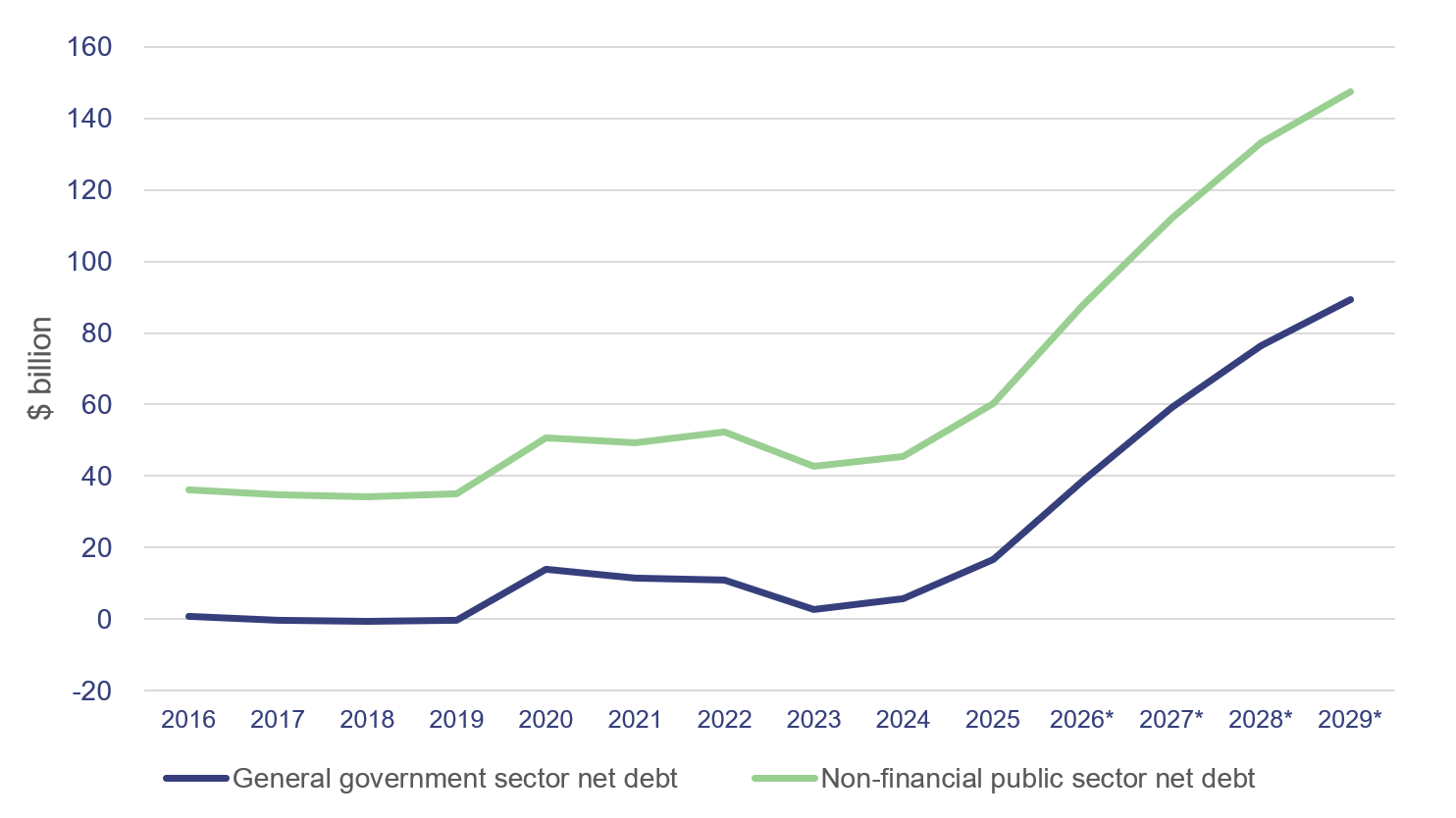
Notes: Years marked with an asterisk are projected figures, from the 2025–26 Mid-year fiscal and economic review.
Non-financial public sector includes the general government sector and the public non-financial corporations sector (these are the only figures available).
Compiled by Queensland Audit Office from the Report on State Finances and the 2025–26 Budget Strategy and Outlook.
From 2015–16 to 2023–24, Queensland had mostly stable net debt. From 2024–25, net debt has increased, and this is expected to continue across the forward estimates, which covers the 4 years from 2025–26 to 2028–29. Net debt for the non-financial public sector is projected to reach $147 billion in 2028–29.
The 2025–26 Mid-year fiscal and economic review outlines the planned areas of capital spending, including infrastructure and leases. Recent disaster events, additional capital grants to support the future of Mount Isa and north west Queensland, and some timing changes to projects are incorporated in the budget.
In response to the government’s expanded capital program (and subsequent increase in forecast debt), Queensland Treasury Corporation (QTC) has announced its largest borrowing program to date at $32.5 billion during 2025–26. This increased borrowing as per the QTC’s public borrowing program will continue into future years, with new borrowings and refinancing expected to peak at $35.4 billion in 2026–27.
As debt continues to increase, the costs to service the debt also rise, which may leave less funding for future services if other costs and revenues stay the same. If that occurs, the government may need to borrow more to maintain services; or increase revenues, for example, through new/increased taxes or royalties; or cut costs.
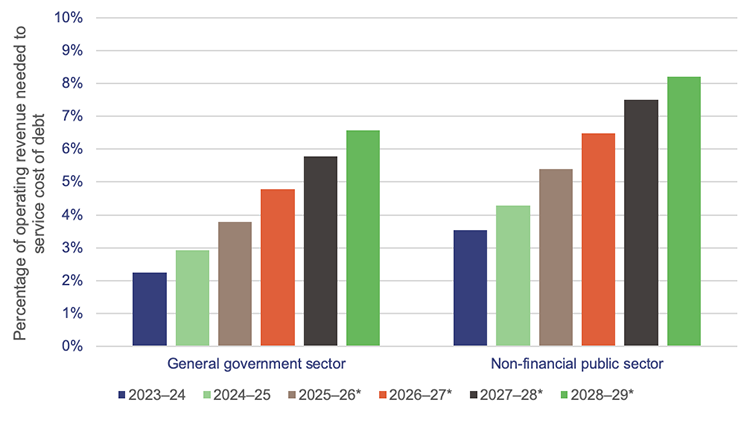
By comparing interest expenses to operating revenue, we can see what percentage of revenue must be used to service debts. Figure 3B shows that this percentage is projected to increase over the forward estimates.
Note: Years marked with an asterisk are projected figures, from the 2025–26 Mid-year fiscal and economic review.
Compiled by Queensland Audit Office from the Report on State Finances and the 2025–26 Mid-year fiscal and economic review.
The general government sector used 2.92 per cent of its operating revenue to service the cost of debt in 2024–25. This is expected to increase to 6.57 per cent by 2028–29. The non-financial public sector, which includes the general government sector and non-financial corporations sector, used 4.28 per cent of its operating revenue to service the cost of debt in 2024–25. This is forecast to grow to 8.22 per cent in 2028–29.
In October 2025, S&P Global affirmed QTC’s credit rating of AA+ with a negative outlook, meaning there was no change to the previous rating it issued. To support the current credit rating, the government has stated that it will use the Debt Retirement Fund (see below) to pay down debt. It plans on repaying $4.8 billion over the coming 4 years.
Use of Queensland Future Fund in managing Queensland’s debt
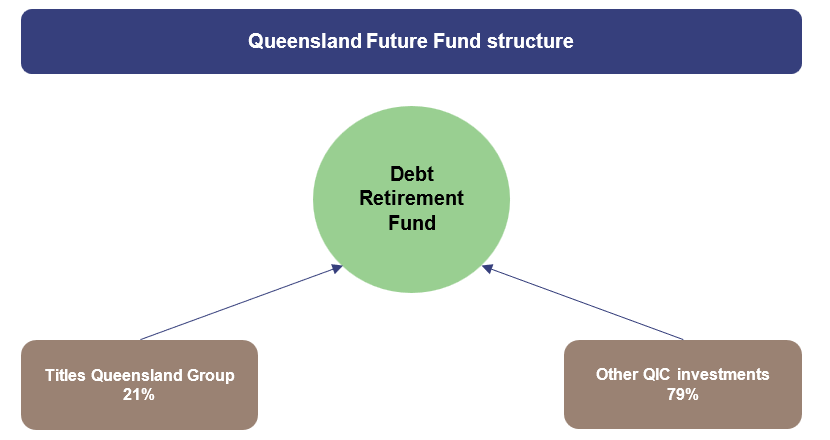
The Queensland Future Fund (QFF) is a framework established to support Queensland’s credit rating and reduce debt. In 2021, the Debt Retirement Fund was created under this framework. It was funded by 3 initial investments of $7.7 billion:
- a portion of the defined benefit superannuation surplus
- the Titles Queensland Group, which maintains the land and water titles registries for the government. The group includes Registry Hold Trust, Queensland Titles Registry Pty Ltd, and Registry Finance Pty Ltd.
- shares in Aurizon Limited (a listed company), which the government held following the privatisation of QR National in 2010.
Some of these investments (including the Aurizon shares) were sold, and new investments purchased, soon after the assets were contributed. The structure of the investments in the QFF has continued to evolve since then. Figure 3C outlines the QFF structure as at 30 June 2025.
Queensland Audit Office.
Figure 3D summarises the asset classes the Debt Retirement Fund invests in. The investment mix is similar to what it was in 2023–24.
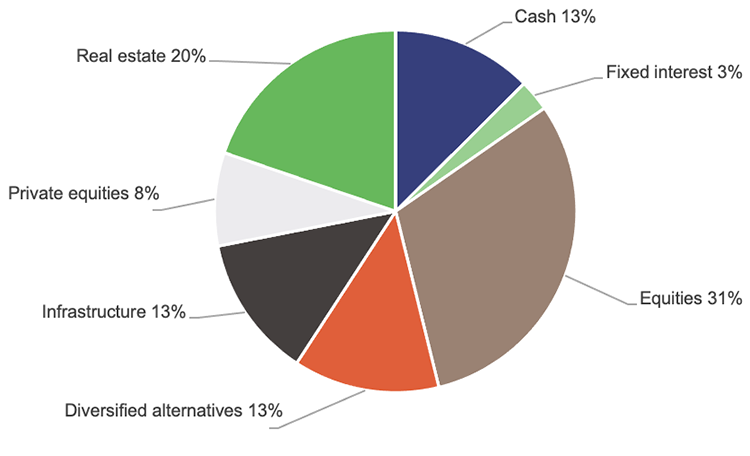
Compiled by Queensland Audit Office from the 2024–25 Queensland Treasury Corporation financial statements.
The Debt Retirement Fund was established with the intention of being used to repay and offset Queensland’s debt. Distributions from the Debt Retirement Fund can only be used to pay down the Queensland Government’s debt.
Figure 3E explains the differences between the 2 purposes.
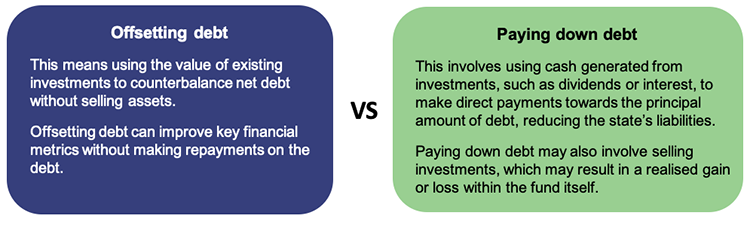
The Queensland Audit Office.
As of June 2025, returns from the Debt Retirement Fund have only been reinvested into the fund (and as such continuing to offset debt), and not used to pay down debt.
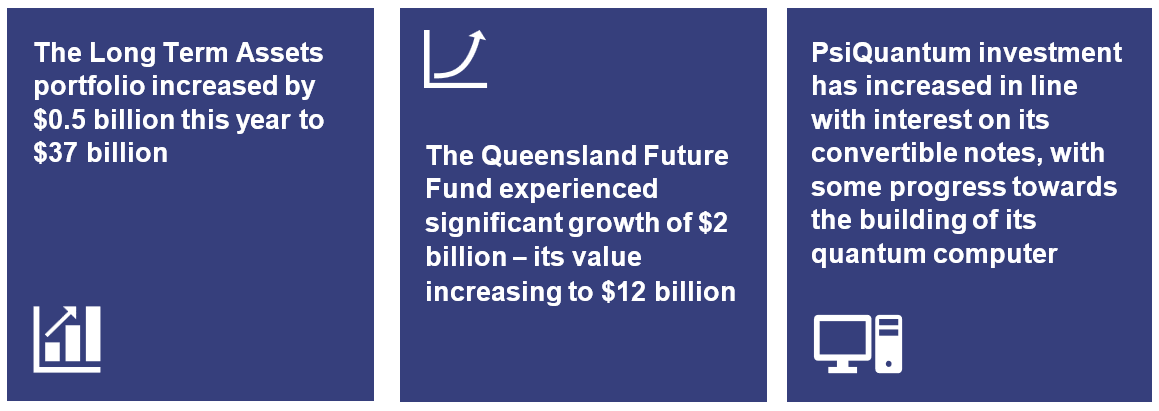
The fund’s value increased by $2.2 billion in 2024–25 – $1.6 billion related to valuation increases and $550 million related to additional investments. The total value of the fund was $12 billion, which helped offset some of Queensland Government’s debt position. The Queensland Government has announced in its 2025–26 Queensland Budget that it will begin using the investments in the Debt Retirement Fund to pay down state debt. This is in accordance with the objectives of the Queensland Future Fund, as outlined in Figure 3F.
| Budget objective | Assessment of progress |
|---|---|
| Provide for debt reduction | As of 30 June 2025, no payments have been made from the Queensland Future Fund to reduce the state’s borrowings, but the Queensland Government has announced it plans to make repayments from 2025–26. |
| Hold state investments for future growth | The assets in the fund are diversified across a range of asset classes including QIC funds that invest in private markets, in accordance with the investment strategy set by the State Investment Advisory Board. It continues to hold a portion of Queensland Titles Registry. The investments experienced positive growth in 2024–25, as outlined in Figure 4B. |
| Offset state debt to support Queensland’s credit rating | S&P Global and Moody’s (external rating agencies) have not changed their credit rating or outlook for Queensland since February 2025. |
Note: We have excluded one objective from Figure 3F as it has been fully achieved. The objective was to provide a contribution of $7.7 billion to the fund as at 30 June 2021.
Compiled by Queensland Audit Office.
Using the defined benefits superannuation scheme surplus
Queensland holds a defined benefits scheme, which currently has surplus assets. The defined benefit superannuation obligation is held for the State Public Sector Superannuation Scheme and the Judges’ Scheme. These schemes provide for post-retirement benefits to certain public service employees and have been closed to new members since November 2008.
An independent actuary – who estimates the value of future superannuation payments – is engaged to review the defined benefits scheme every 3 years. In its most recent review, the actuary concluded that there was a $10 billion surplus in the defined benefits scheme as at 30 June 2024.
The Queensland Government plans to draw down $3 billion of this surplus to transfer into the Debt Retirement Fund in 2025–26 to support the debt repayment. This is in addition to the draw down of $1.5 billion from the scheme in 2021 when the Debt Retirement Fund was established. After this draw down, a surplus is expected to be retained in the defined benefits scheme in line with the state’s fiscal principle of fully funding the scheme.
Repayment of debt
From 2025–26, the Queensland Government plans to make regular debt repayments totalling $4.8 billion over 4 years to 2028–29. Despite the planned debt repayments, net debt is still projected to reach $147 billion in 2028–29, an increase of $87 billion from 2024–25.
Reducing debt levels may help strengthen the state’s fiscal position through helping manage interest costs, particularly as net debt continues to rise.
This approach to debt management could have a favourable impact on Queensland’s credit rating, as more stable debt levels and strong investment performance are often viewed as indicators of long-term economic stability.
4. The Queensland Government’s investments
The Queensland Government maintains investments to support long-term obligations and future financial expenditure. This chapter provides an overview of the government’s investment portfolio, including:
- how it manages its investments
- how its investments have performed this year
- benefits from its previous key investments.
The state has 2 key groups of investments, the Long Term Assets (LTA) portfolio and the Queensland Future Fund (QFF). Both are managed by QIC Limited (QIC) on behalf of the state.
The LTA portfolio holds investments to fund the long-term obligations of the state and to provide returns and growth over time. The LTA portfolio is the largest single asset pool held within the state and is a mix of different types of investments.
The QFF was established to use investment growth to support the state’s credit rating and to ultimately reduce the state’s debt.
The Queensland and Australian governments hold an investment in developing technology through the American technology company PsiQuantum Corp and its Australian subsidiary.
Chapter snapshot
How does the government manage its investments?
The Queensland Government holds investments to fund long-term obligations and manage the state’s finances. Holding investments also helps the government manage risks linked to future payments – such as insurance claims and court-ordered settlements – which can be unpredictable in both timing and value.
Many of these investments are held through managed funds established by the government. These are managed by an investment manager and used to pool investments for investors to achieve a specific purpose.
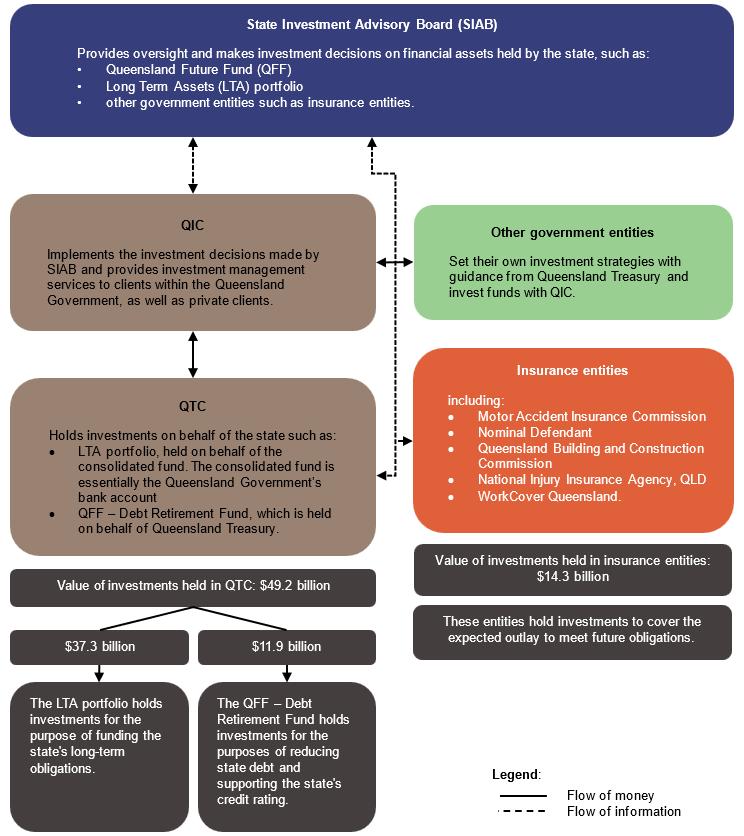
The state’s portfolio of investments is overseen by a range of government entities. The key parties include:
- State Investment Advisory Board (SIAB) – oversees the government’s managed fund strategies, and is an advisory board of Queensland Treasury Corporation (QTC). It is responsible for setting investment objectives, strategies, and policies for Queensland Government investment funds as advised by Queensland Treasury.
- QIC – the Queensland Government’s investment manager, overseeing long-term investments, and handling their day‑to‑day management.
- QTC – this entity holds investments on behalf of the Queensland Government.
Figure 4A illustrates the relationship between the key parties involved in managing the state’s investments, and their roles and responsibilities.
Queensland Audit Office.
How have the investments performed?
The LTA portfolio and the QFF have both performed well and contributed positively to the Queensland Government’s overall fiscal position. Figure 4B shows their performance from 2020–21 to 2024–25.
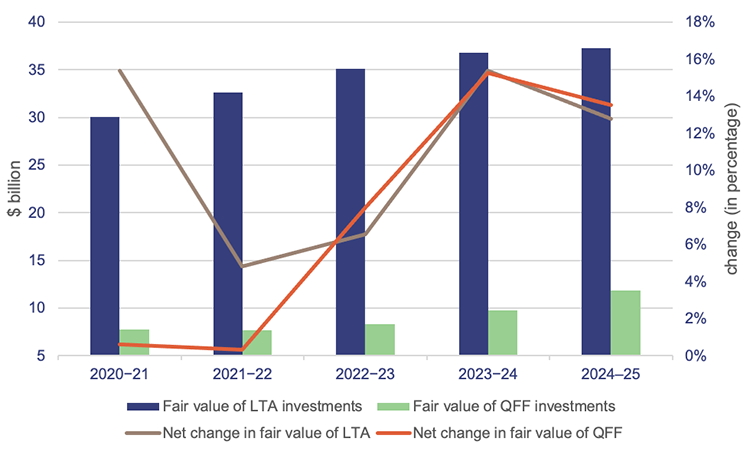
Notes: Net change in fair value represents only the movement in the fair value of investments each year. It does not include deposits or withdrawals made during the year.
The fair value of investments represents the total value of the investment at each year end, which includes the movement in fair value, deposits, and/or withdrawals made during the year.
Queensland Audit Office.
Long Term Asset portfolio performance
The LTA portfolio is the Queensland Government’s largest financial asset pool, made up of a diversified mix of investments. It is primarily maintained to support the funding of the Queensland Government’s long-term obligations.
As seen in Figure 4B, the fair value of the LTA portfolio has been increasing over the past 5 years. In 2021–22 and 2022–23, it had lower returns compared to 2020–21. The impact of the COVID-19 pandemic and other geopolitical pressures has eased in recent years, and the portfolio’s returns have returned to a similar position to what they were in 2020–21.
In 2024–25, the net change for the LTA portfolio for the year was an increase of $529 million, which mainly consisted of:
- a change in fair value of $4.8 billion due to the contribution of positive investment performance to the portfolio. The portfolio has a wide mix of investments, which means that the overall performance of the portfolio will differ to that of individual investment classes (such as equities, which performed stronger than the portfolio this year). Although the portfolio provided a positive return this year, this is lower than the 2023–24 change in fair value of $5.7 billion. This is because contribution to returns from the international equities asset class, which is investments in shares of companies outside Australia, were lower in 2025 (2025: 4.54 per cent versus 2024: 7.58 per cent).
- investment returns, which were offset by net withdrawals of $4.7 billion made by various funds that the LTA portfolio holds investments for. One of these funds is the Royalties Fund, which made withdrawals of $1.7 billion. This fund was closed in 2025 and withdrew all monies held by the fund. The remaining $3 billion relates to business-as-usual withdrawals made mostly to fund defined benefit superannuation payments.
Queensland Future Fund performance
As seen in Figure 4B, QFF’s fair value has increased since its establishment in 2021. In the 12 months leading up to 30 June 2025, it increased by $2.1 billion to $11.9 billion. This is mostly due to higher valuations of the fund’s investment in the Titles Queensland Group, which increased by 17 per cent this year. We explain the reasons for this later in this chapter.
The Queensland Government has announced its intention to start debt repayments in the next financial year. We discuss this further in the ‘Use of Queensland Future Fund in managing Queensland’s debt’ section in the previous chapter.
What are the significant investments of the Queensland Government?
This section explores significant investments made by the Queensland Government in:
- Titles Queensland Group
- Virgin Australia Holdings
- PsiQuantum.
We examine these below.
Investment in Titles Queensland Group
Titles Queensland Group, trading as Titles Queensland, maintains the titles register for land and water in the state and raises revenue through fees for registering land transactions, searching records, and managing property-related registers. The ownership of Titles Queensland Group is ultimately held by several government entities (including the QFF).
During the year, the fair value of the investment in Titles Queensland Group increased by 17 per cent, with a current value of $10.7 billion. Since its inception in 2022, the value of Titles Queensland Group has been steadily increasing, as shown in Figure 4C, reflecting growing demand for housing in Queensland.
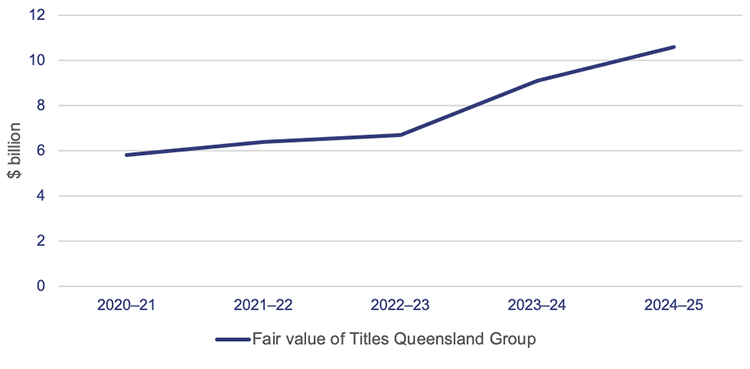
Note: The fair value of investments represents the total value of the investment at each year end and excludes the value of debt financing within the Titles Queensland Group.
Queensland Audit Office.
The increase in value is largely attributed to the Titles Queensland Group’s role as the provider of land title registry services in Queensland, a sector that has benefitted from rising property prices and land values. The increase in Queensland’s house prices and transaction volumes in 2024–25 has contributed to the Titles Queensland Group’s financial performance for the year.
The fair value of the investment in Titles Queensland Group is based on its expected future income from the business over the period it is contracted to run the business for (50 years after its transfer in 2021). This is then converted into today’s dollars through a discounted cash flow model. The model factors in future expectations around borrowing rates and inflation to do this conversion.
Within the Titles Queensland Group structure there are also borrowings from Australian and overseas lenders. The borrowings were raised after the business was transferred into the structure in 2021 and have been refinanced several times since. The money from the borrowings has been used to provide returns to investors and liquidity within the QFF when it was first created.
$200 million support and investment in Virgin Australia
In mid-2020 during the COVID 19 pandemic, Virgin Australia (Virgin), one of Australia’s largest airlines, went into voluntary administration. To keep Virgin’s workforce and headquarters in Brisbane and to help minimise the loss of Queensland jobs, the Queensland Government provided a debt facility of $125 million, an operational facility of $50 million, and purchased a 3 per cent private equity stake in Virgin for $25 million. The debt facility and grant have now been finalised, with the debt facility repaid and the operational facility converted to a grant. The state continues to hold equity in the now publicly listed company, valued at $27.9 million as at 30 June 2025.
This transaction was facilitated through QIC and held in the Government Holdings Trust, which is a QIC managed fund. Figure 4D provides a summary of the debt and equity investments and the current status.
| Debt and equity investments | Investment original value | Current status of investment |
|---|---|---|
| Working capital facility |
| Fully repaid in August 2025 with no loss of the amount loaned. QIC received payments of the interest. |
| Operational investment facility |
| QIC has assessed Virgin Australia to be meeting requirements as outlined in the SID. No repayment was deemed necessary. |
| Equity investment |
| In June 2025, Virgin Australia has been relisted on the ASX. As of 30 June 2025, QIC’s equity shareholding in Virgin Australia was valued at $27.9 million. |
The Queensland Audit Office.
Operational investment facility, including the requirement to maintain operations in Queensland, has now finalised
The operational investment facility was governed by the State Investment Deed (SID), which outlined specific conditions for Virgin. These conditions required it to maintain its core operations in Queensland, including its central management, facilities, a significant portion of air crew and staff, and its headquarters. Virgin met those requirements, and was not required to repay the operational facility investment. The facility and the conditions finalised on 17 November 2025.
QIC was responsible for monitoring the use of the funds, which was primarily done through quarterly reports provided by Virgin. These reports included Virgin’s financial performance for the quarter. In addition, Virgin reported key metrics that form part of the SID’s requirements, such as employee headcount, staff location, and the status of core operations on a quarterly basis. QIC monitored these and reported on compliance internally through their valuation committees. Virgin also provided annual certificates to confirm its compliance with the SID’s conditions.
Investment in PsiQuantum
In April 2024, the government invested approximately $470 million in PsiQuantum – a quantum computing company looking to build the world’s first utility-scale, fault-tolerant quantum computer (FTQC) facility in Brisbane. In our report Managing Queensland’s debt and investments (Report 12: 2024–25), we outlined the investment process and structure of the investment. The joint investment with the Australian Government has achieved several project and technology milestones since it was initially made. The government has been overseeing the investment’s progress in line with the requirements of the agreement reached between the parties.
Overseeing the investment
In May 2024, agreements were signed that provide consistent defined terms, oversight requirements, and clauses that apply to all agreements. The parties to the agreements consist of Queensland and Australian governments and PsiQuantum related entities.
QIC is responsible for managing the PsiQuantum investment on behalf of the Queensland Government and reports to the Under Treasurer. Any major changes to the terms of agreements with PsiQuantum require formal consultation with the Queensland Government. QIC must also report semi-annually to Queensland Treasury, providing a summary of any minor changes made to agreements with PsiQuantum that have not already been reported during the period.
A project committee is responsible for monitoring performance, status, and PsiQuantum’s progress against the agreed commitments. The project committee currently consists of 2 PsiQuantum representatives and 4 government representatives. The government representatives include one representative from QIC for the Queensland Government, and one representative from the Australian Government. Additionally, one representative from Queensland Treasury and one from the Australian Department of Industry, Science and Resources (DISR) attend as observers. Figure 4E illustrates the structure of the project committee.
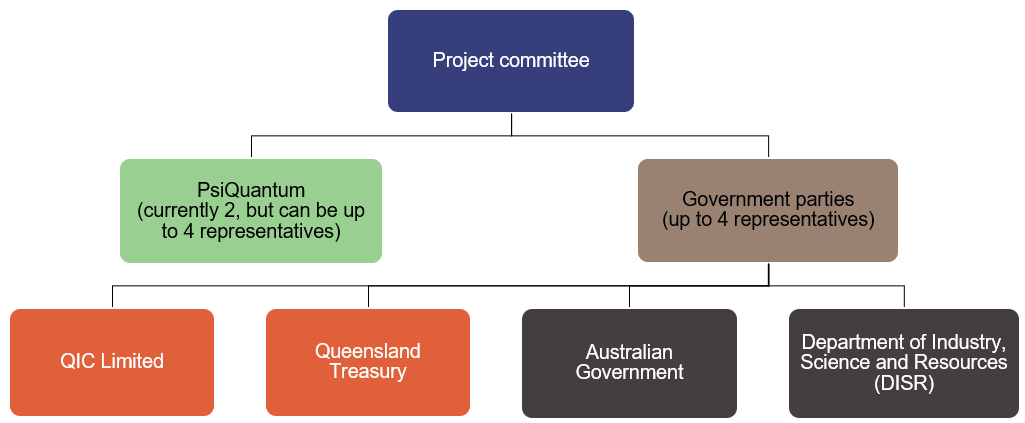
Compiled by Queensland Audit Office, based on the provided agreements.
The project committee also monitors progress against the project and technology milestones. The project milestones cover site preparation and construction of the operations building. The technology milestones describe the technical success criteria needed to build and operate the FTQC.
The Queensland Government, Australian Government, and PsiQuantum jointly appointed independent advisors to advise the committee on PsiQuantum’s progress in achieving the key milestones in the project. This includes an independent infrastructure advisor (IIA) and an independent technical advisor (ITA). After a milestone is completed, the relevant advisor will review information to confirm terms under the agreement have been satisfied and verify that the milestone was achieved in accordance with the agreements.
The project committee meets at least quarterly to review the project’s progress against the milestones. To support the government parties’ oversight, the independent advisors, together with subject-matter experts in quantum computing, provide regular updates and advice during these meetings.
Update on progress
Since the FTQC will be built around the Brisbane Airport area, PsiQuantum needs to obtain approvals from the federal government before commencing construction on site. PsiQuantum, Brisbane Airport Corporation (as owners of the land being used), and the Australian Government are working through the approvals process, including providing reports needed to assess any impacts to the site from construction and operation of the FTQC.
Once approvals are obtained, PsiQuantum will be able to withdraw funds for construction expenses from the PsiQuantum Australia Construction Account. PsiQuantum US has been funding project costs in the interim, including the deposits on the cryoplant building contract. The building will act as the cooling facility for the FTQC.
Expected value and form of the investment
The Queensland Government’s investment is structured into 3 components. Figure 4F provides details on these, together with the current value.

| A convertible note in PsiQuantum
|

| A conditional loan facility of $200 million
|

| A conditional grant funding facility of $75 million
|
Queensland Audit Office
As at 30 June 2025, there have been no adjustments to the initial valuation of the investment except for the accrued interest on the convertible note. The convertible note is valued at principal cost plus unpaid accrued interest.
In September 2025, PsiQuantum completed its latest funding round (Series E), raising US$1 billion (including the Queensland and Australian government convertible notes) and bringing its total post-money valuation to US$7 billion. A post-money valuation is equal to the company’s valuation before the funding round plus the new funds raised.
The convertible note will not be converted into shares until PsiQuantum satisfies other requirements of the agreements. The conditional loan facility and the conditional grant funding facility may only be drawn down once the convertible note converts to equity.
5. Management of Queensland’s major initiatives
The Queensland Government manages the state’s finances through planned initiatives and strategies. These shape the revenues, expenses, debt profile, and investments of the state. Some of these initiatives involve major projects and substantial investment funding, which the government oversees through relevant government entities to ensure proper use of the state’s finances.
Several projects have been reallocated from general government entities to management by QIC Limited (QIC) under the government’s Energy Roadmap 2025. This is based on the need to consider the delivery of projects as well as how they are funded.
This chapter outlines the role of government entities, in particular QIC, in financing and supporting these projects.
Chapter snapshot
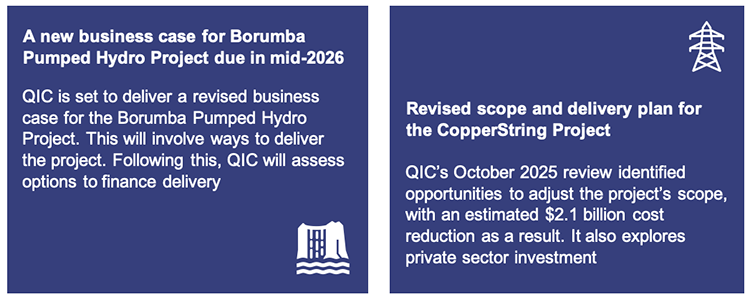
Energy Roadmap 2025
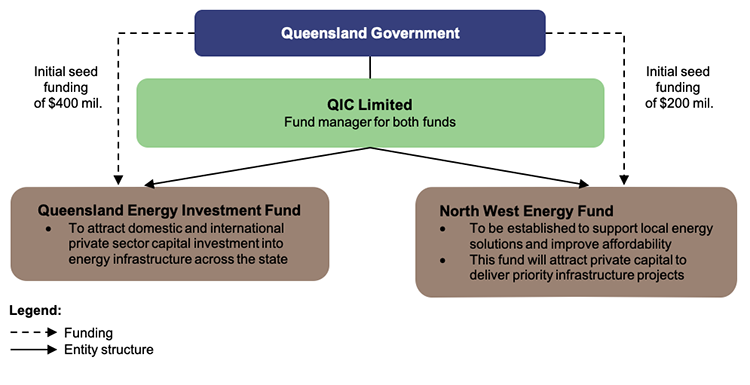
The Energy Roadmap 2025 was released in October 2025. It introduced several initiatives to deliver new energy solutions within Queensland. We provide further information on project developments in our reports Major Projects 2025 (Report 8: 2025–26) and Energy 2025 (Report 7: 2025–26). The roadmap transferred delivery of several projects to QIC. The roadmap also introduced a QIC investor gateway, mandating that QIC attract private sector investors to help fund delivery of the projects.
Under the investor gateway, it has 2 funds:
- A new North West Energy Fund (NWEF) to support the delivery of energy projects within north west Queensland. The Queensland Government will provide $200 million seed funding to the NWEF to explore private sector investments.
- The Queensland Energy Investment Fund (QEIF), which will be used to attract investment into other energy projects in Queensland. The Queensland Government will provide $400 million of funding to the QEIF.
Figure 5A summarises the QIC investor gateway.
Compiled by Queensland Audit Office.
Under the roadmap, QIC has 4 key pillars for delivery and financing:
- pumped hydro projects, which we explain further below in this chapter
- delivery of a revised CopperString East, which we explain further below in this chapter
- investigating solutions for energy delivery and financing in north west Queensland (under the North West Energy Fund outlined above)
- assessing the market and tendering for gas fired power generation.
Pumped Hydro

| Queensland Hydro was set up to deliver 2 significant pumped hydro projects. One, the Pioneer-Burdekin Pumped Hydro Project, was cancelled in November 2024 by the Queensland Government. The other is the Borumba Pumped Hydro Project. The project was initially designed to deliver up to 2,000 megawatts of energy storage capacity. The project is still subject to obtaining some key environmental approvals. |

| In June 2025, QIC and Queensland Treasury entered into an investment development management agreement (IDMA), under which the Queensland Government appointed QIC as the investment and development manager for Queensland Hydro. The IDMA is a formal contract that assigns the overall responsibility for overseeing and executing a development project to an independent investment development manager. Under the IDMA: |

|
|

|
|

|
|
Figure 5B shows how QIC Limited is involved in managing Queensland Hydro for the Queensland Government.
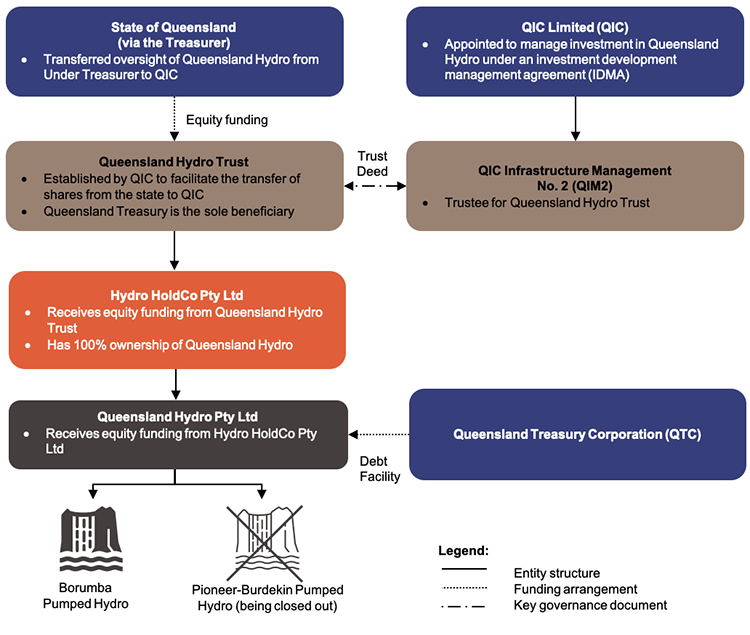
Compiled by Queensland Audit Office, based on information obtained from the IDMA and trust deed.
QIC will continue to manage and oversee the delivery of the Borumba Pumped Hydro Project under the Energy Roadmap 2025. It also will assess other pumped hydro proposals being investigated by other Queensland state government energy entities for technical feasibility and cost of delivery, to deliver a whole of state hydro solution.
CopperString
The CopperString project aims to support economic growth in the North West Minerals Province (NWMP) in the north west of Queensland, and enable large-scale renewable energy investment in the region.
It was initially established as a private company. It was acquired by the state government in 2023 and transferred to Powerlink, one of the Queensland Government’s energy companies. The government commissioned a review of the project by QIC in April 2025. This involved reviewing the project’s cost, scope, and delivery.
The project’s original scope was to connect Queensland’s NWMP to the National Electricity Market by building 836 kilometres of electricity transmission line. This was made up of a 342 kilometre Eastern Link and a 494 kilometre Western Link. It also included additional transmission lines to connect diversified energy generators to CopperString.
In October 2025, QIC’s report on the review highlighted potential changes to the project scope, timeline, and delivery. This included reductions in scope for the Eastern Link, with an estimated $2.1 billion cost reduction. It is also reviewing the Western Link to target short-term options for a more efficient energy market in the region. The Queensland Government subsequently released its Energy Roadmap 2025, which adopted these changes and transferred responsibility for delivering the project to QIC. QIC will establish a new regulated entity to deliver the Eastern Link and establish structures within QIC to manage the project.